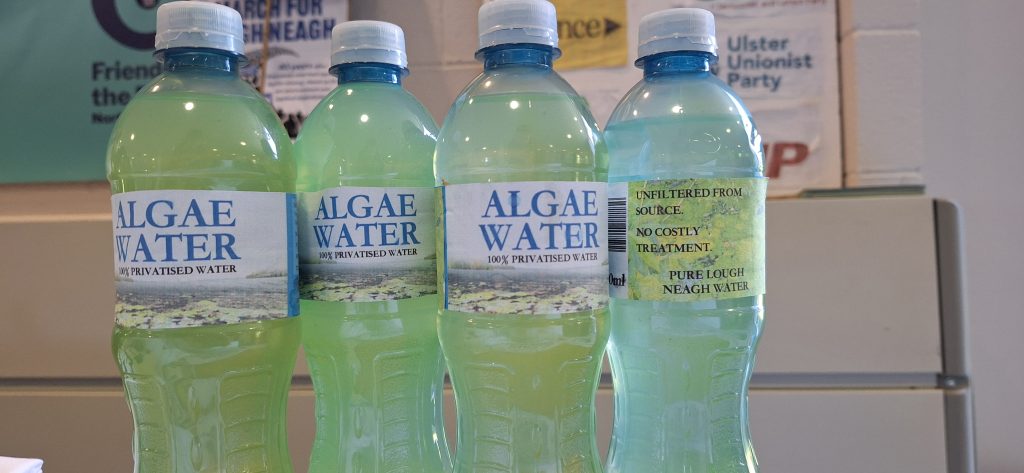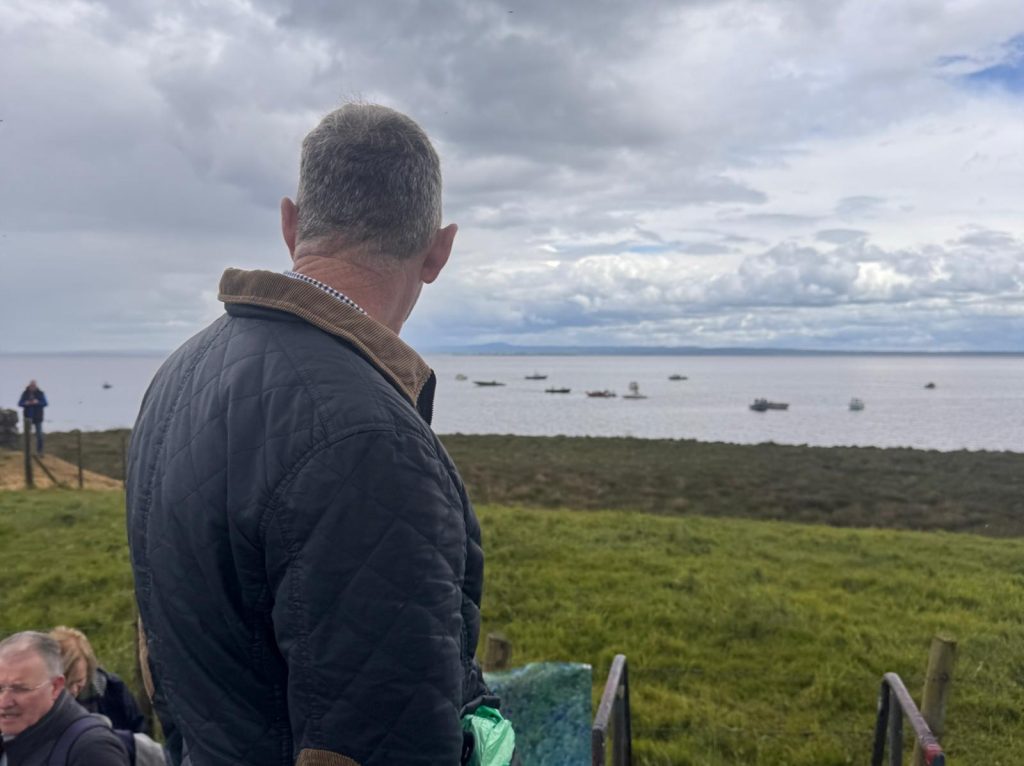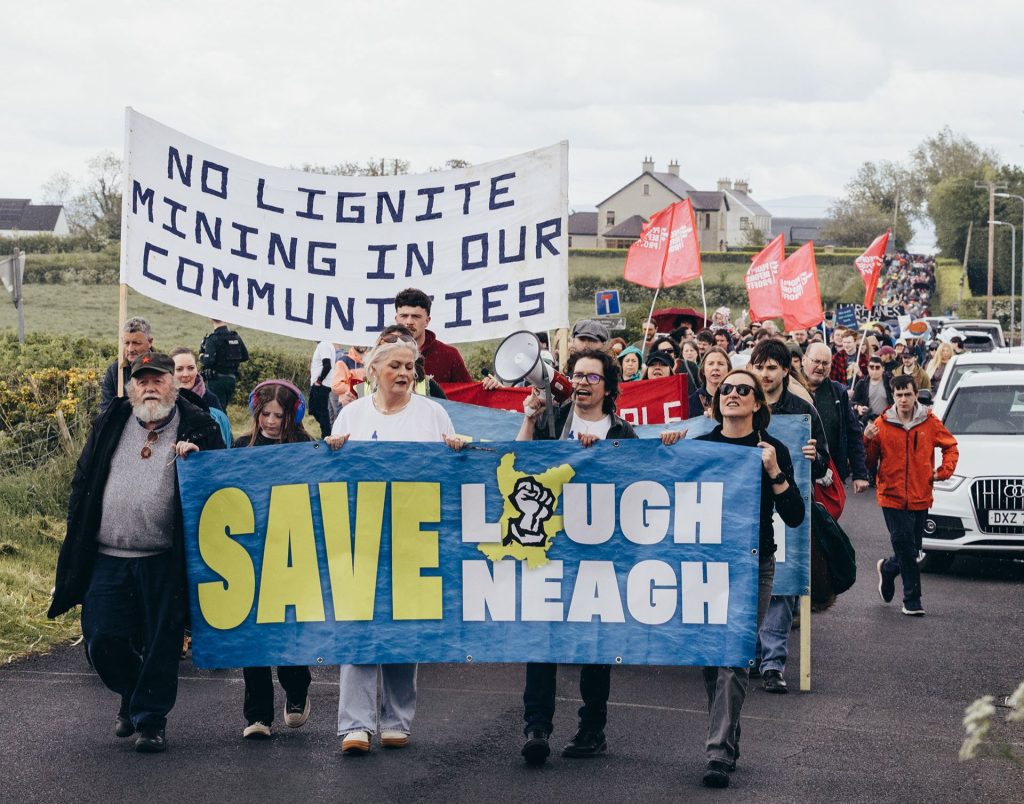
When a fisherman must go to court to save a lough

Download PDF
By Enda McGarrity, Director at P.A. Duffy & Co. Solicitors

Lough Neagh is the largest lake in the United Kingdom and Northern Ireland. It supplies drinking water to much of Northern Ireland and supports a unique ecosystem, a historic fishing community and livelihoods that stretch back generations. Today, this vital natural asset is in crisis.

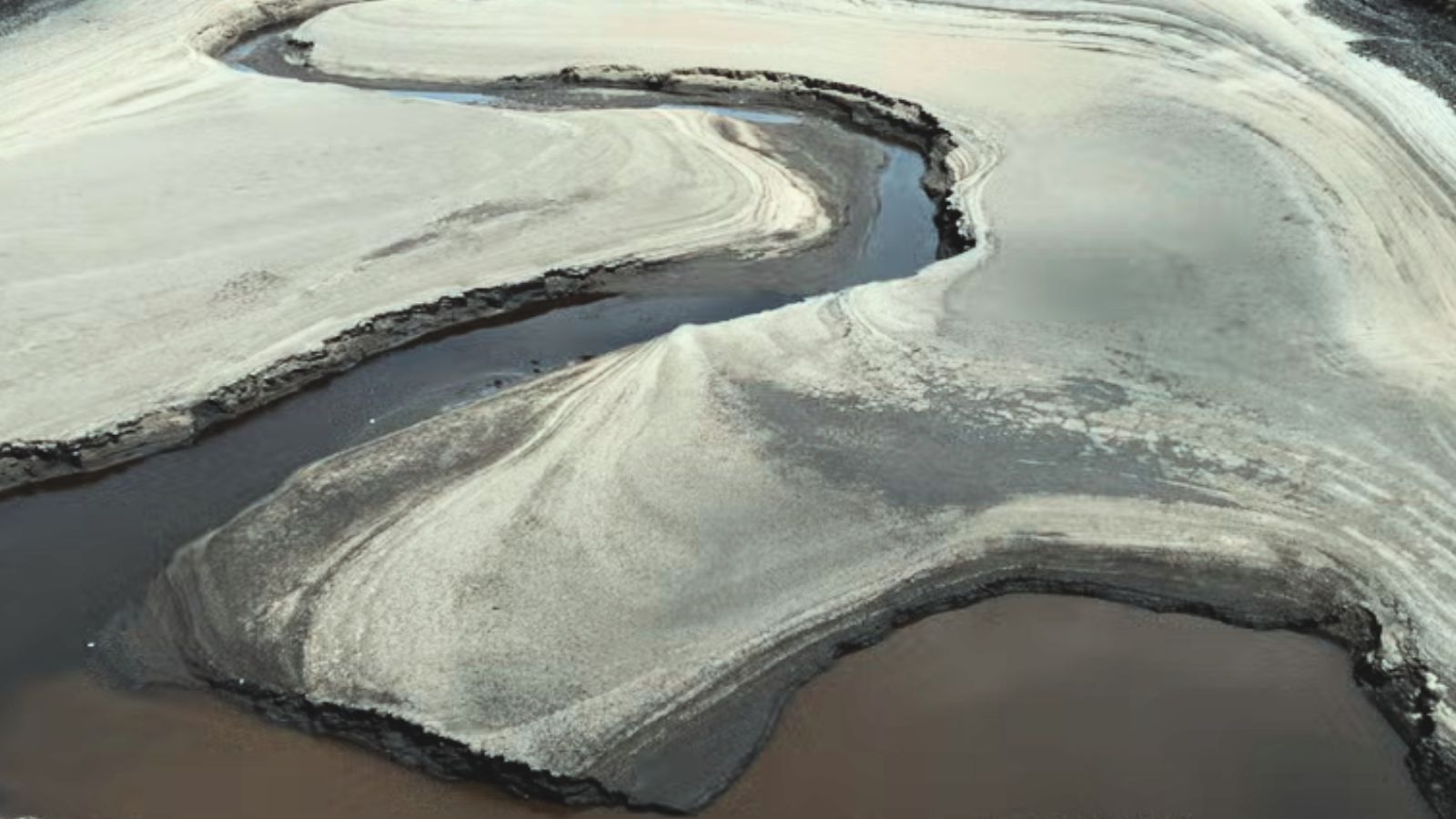
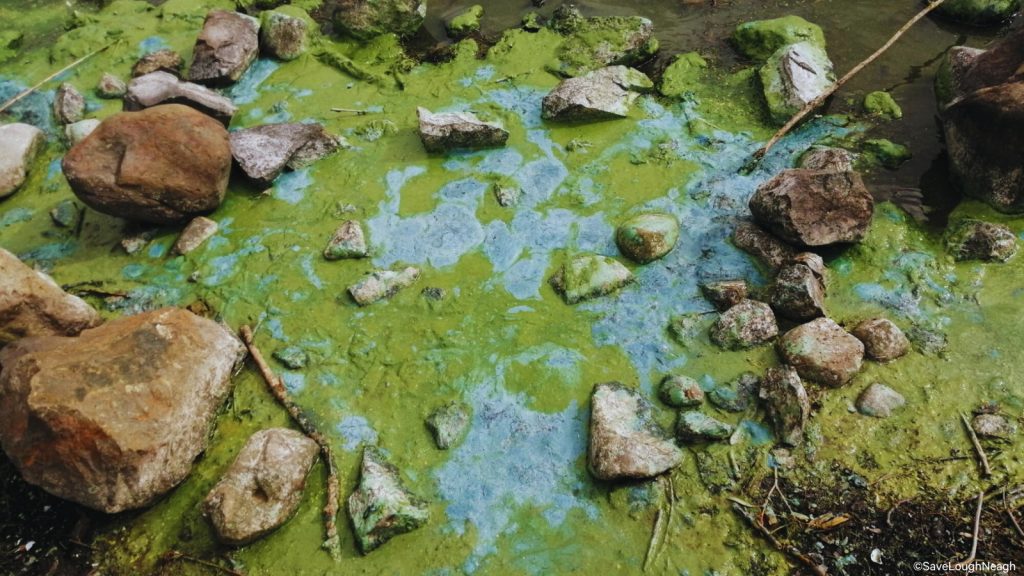
For several summers, Lough Neagh has been smothered by severe blue-green algal blooms driven by excessive nutrient pollution. The green slicks spreading across the water are not merely unpleasant to look at. They signal ecological failure. Wildlife is disappearing, fish stocks are under pressure, and communities around the lough are increasingly concerned about the consequences of prolonged pollution.

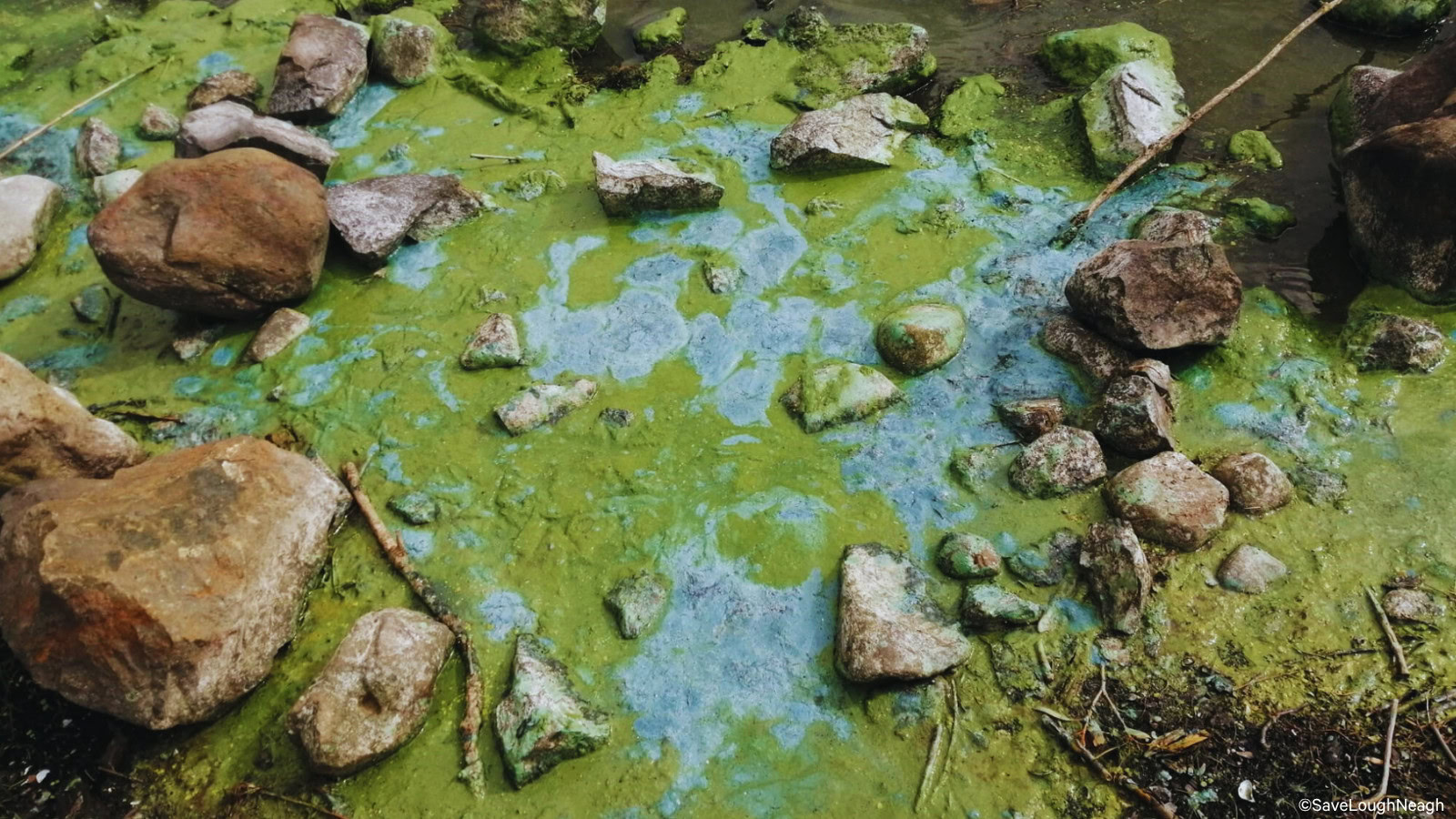
Blue-green algal blooms in Lough Neagh ©SaveLoughNeagh

Against this backdrop, local eel fisherman Declan Conlon has brought a legal challenge against the Department of Agriculture, Environment and Rural Affairs (DAERA). His case asks the courts to examine whether the authorities have fulfilled their legal responsibilities to protect Lough Neagh and those who depend upon it from nutrient pollution.

In his sworn affidavit to the High Court of Justice in Northern Ireland, Declan described the long tradition of eel fishing in his family. He told the court, “Our father James Gerard Conlon was an eel fisherman and his father Hughie Conlon before him was an eel fisherman. Going further back than that, beyond memory, my family would all have been fishermen.”

Eel fisherman, Declan Conlon arrives at the Belfast courts ©Mark Marlow/PA Media Assignments

For families like the Conlon’s, fishing on Lough Neagh is not simply a job but a way of life built on generations of knowledge and experience. The eel fishery is internationally recognised, and Lough Neagh eel holds Protected Geographical Indication status.


But what Declan and many others are witnessing today is a serious decline in the ecosystem that once supported this way of life.

The algal blooms affecting the lough are the visible symptom of excessive nutrients entering the water from agricultural runoff and wastewater discharges. When nutrients accumulate in a lake, they fuel the explosive growth of algae that can damage ecosystems and threaten wildlife.

Declan has seen these changes directly. He has described a lough where the flies that once fed the eels have disappeared, birdlife has diminished, and at times the blue-green algae gives off a very bad smell, an unpleasant gassy odour. The fishing season, once a reliable source of income, has been severely disrupted.

As Declan told the court:

“My way of life has been destroyed by the blue green algae and I want the DAERA to do whatever is necessary to stop the algae and safeguard and protect Lough Neagh, the fish, the flies and the wildlife for the benefit of future generations.”

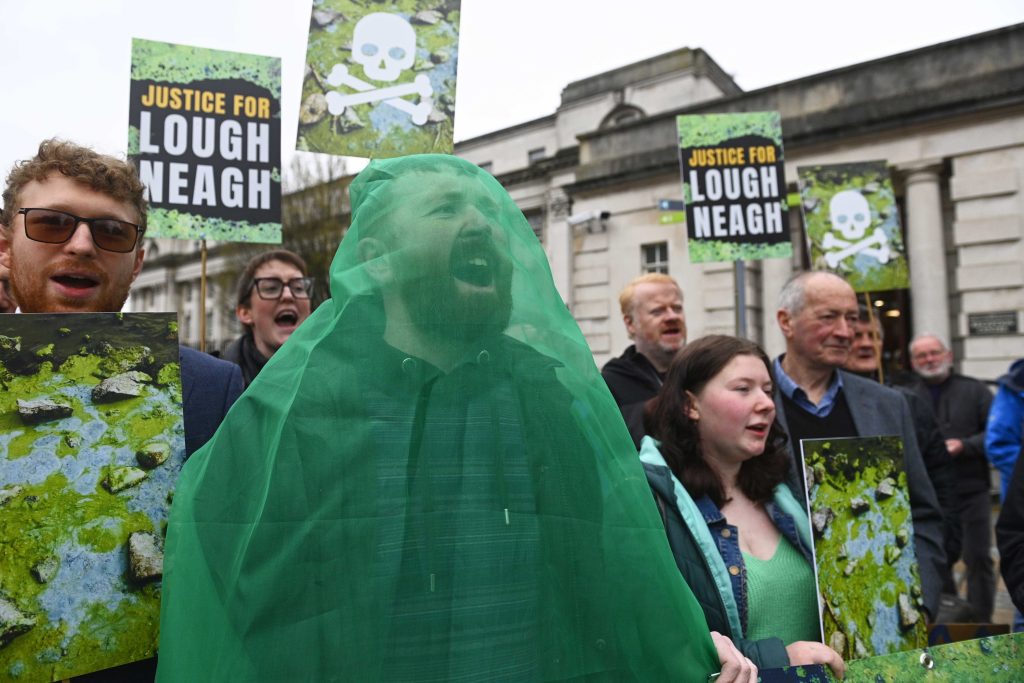
Campaigners gather in support of eel fisherman Declan Conlon. ©Mark Marlow/PA Media Assignments.

It should never fall to a fisherman to bring a case of this magnitude. Yet Declan’s action highlights an important truth: environmental protections only matter when they are implemented effectively. When they are not, the environment and the communities dependent upon them suffer.

Northern Ireland has legal frameworks designed to protect rivers, lakes and coastal waters from pollution. River Basin Management Plans and regulatory controls on nutrient discharges are intended to ensure water bodies achieve good ecological status.

But when pollution persists year after year, and ecological decline becomes visible to those who depend on the water, it is right to ask whether those legal duties are being fulfilled.

Declan’s judicial review asks the court to examine that question.

We welcome the interventions of River Action and Friends of Earth NI in this case.

River Action has a strong track record of holding environmental regulators to account through the courts, including legal actions over pollution in the River Wye challenging the Environment Agency and Natural Resources Wales on nutrient pollution oversight.River Action is applying to intervene to assist the court by clarifying what constitutes a lawful River Basin Management Plan and by addressing the duty of regulators to put in place effective and enforceable measures where pollution is causing clear ecological harm.

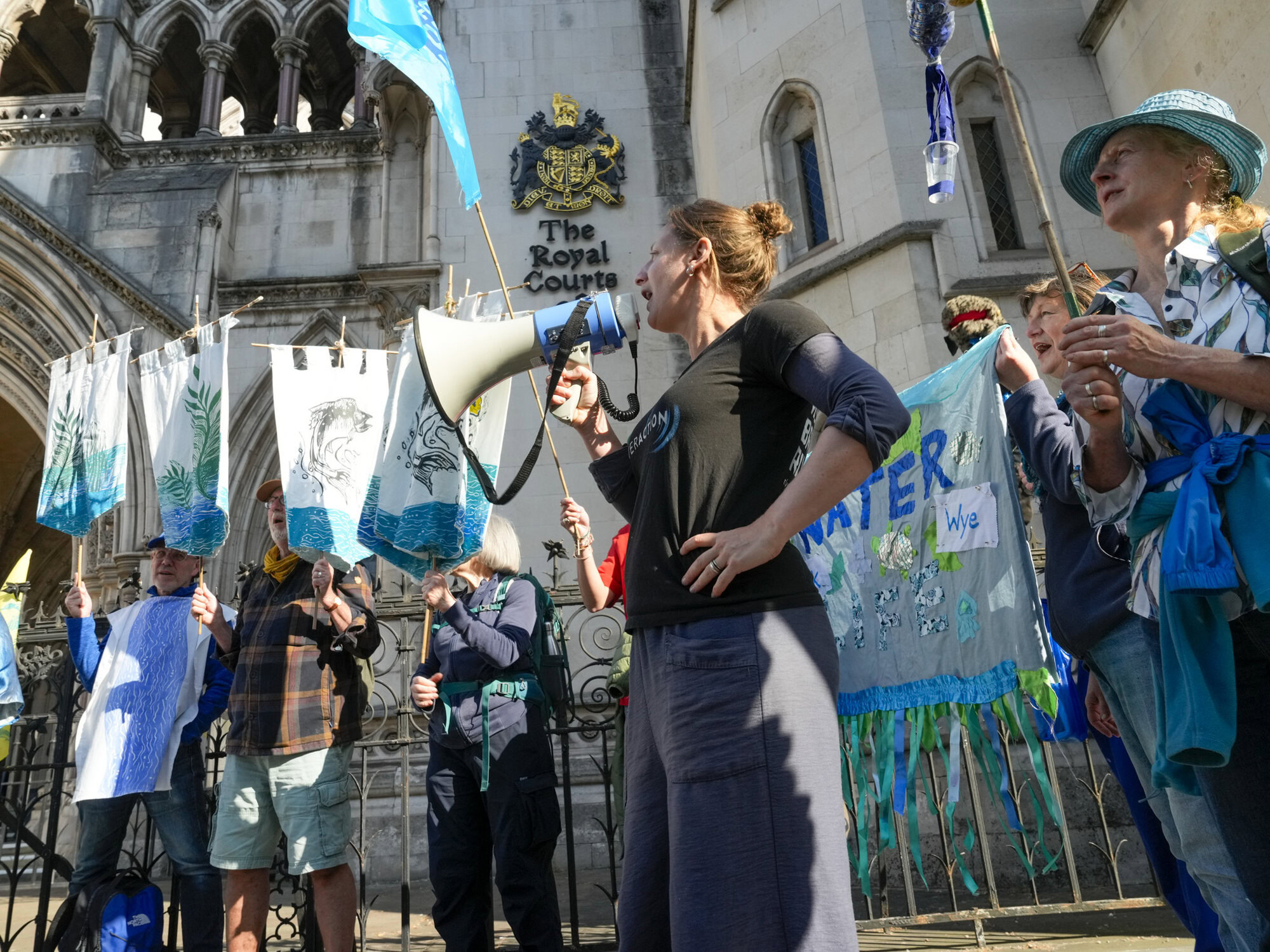
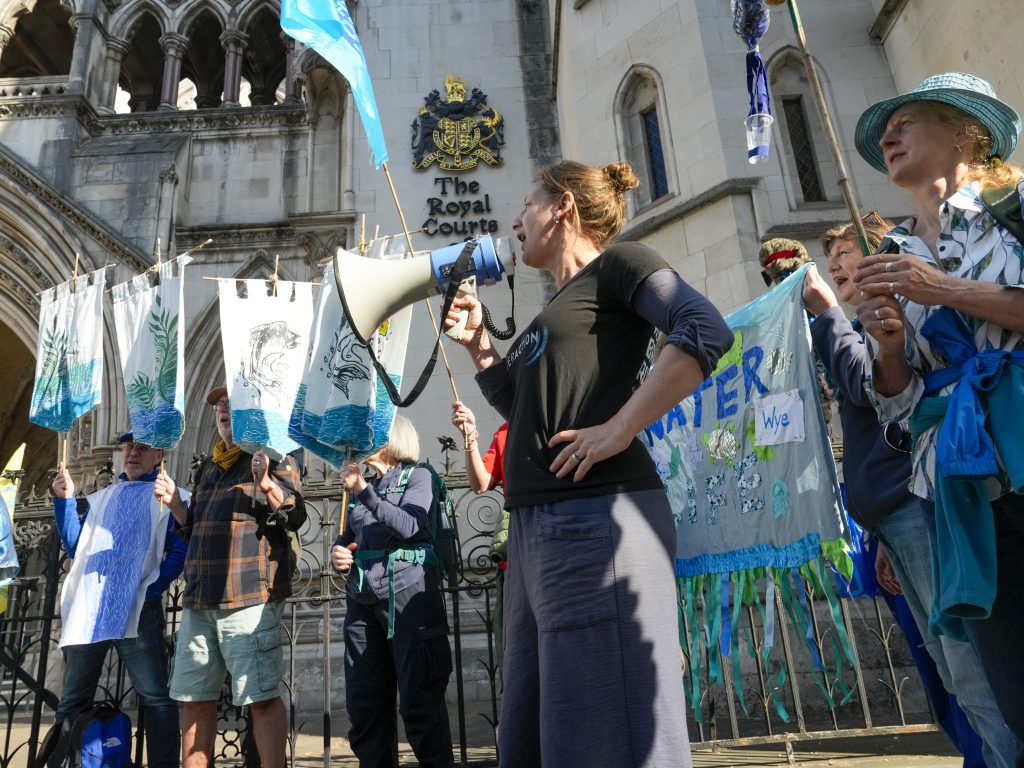
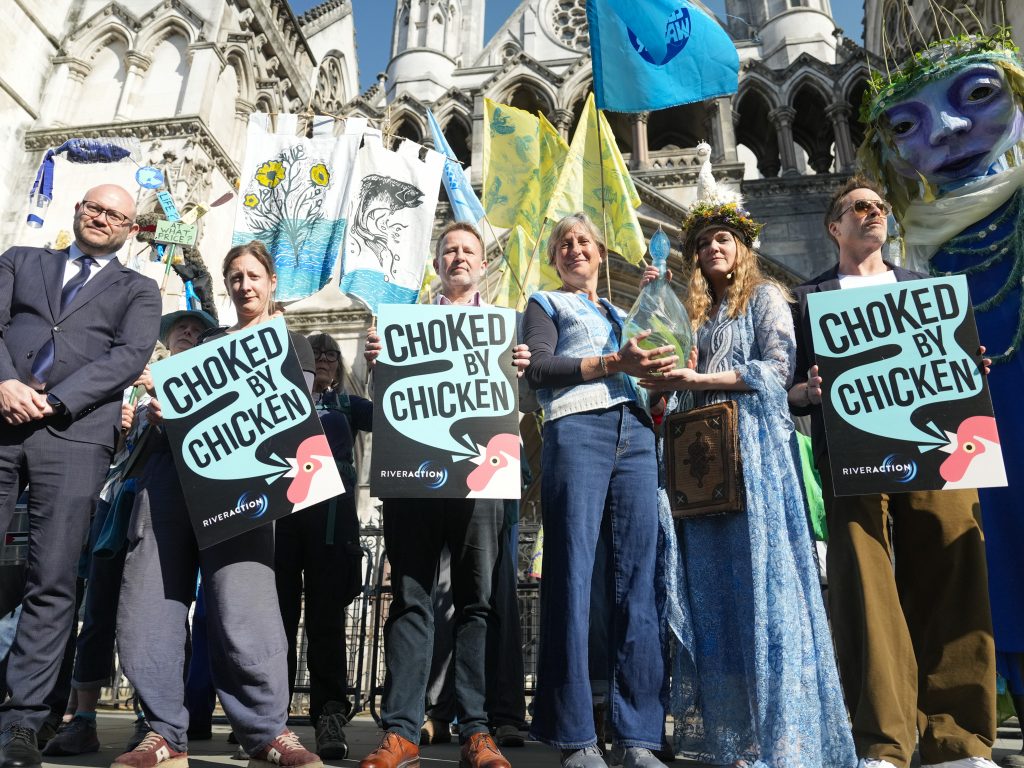
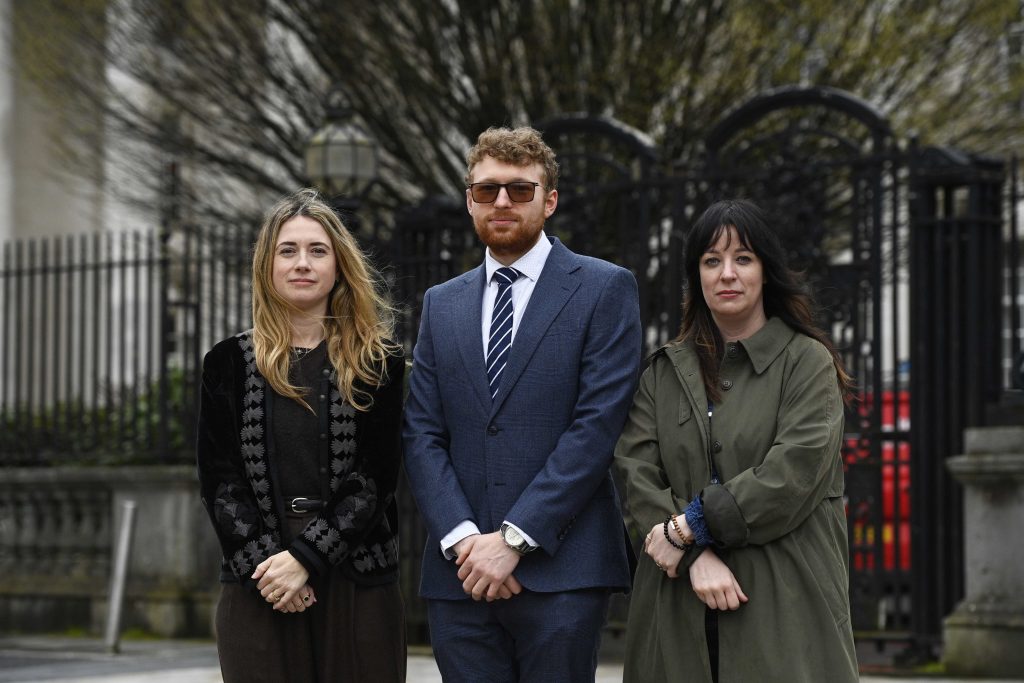
Emma Dearlaney , Christian Fuller of River Action and Laura Neal of Friends of the Earth NI gather outside the Royal Courts of Justice in Belfast in support of eel fisherman Declan Conlon’s judicial review. ©Mark Marlow/PA Media Assignments.

This case is not about assigning blame to any single sector. Farmers, fishermen, businesses and residents all depend on the health of Lough Neagh. Rather, the case seeks clarity about whether current plans to tackle nutrient pollution are strong enough to restore the lough.

The legal question at the heart of the challenge is straightforward: when a protected water body is clearly failing, are authorities taking the steps required by law to reverse that decline?

Judicial review ensures public authorities act within the law and fulfil duties placed upon them.

This case matters not only for the Conlon family or the fishermen of Lough Neagh. It matters for everyone who depends on clean water and responsible environmental governance.

Lough Neagh is central to Northern Ireland’s landscape, culture and water supply. Allowing it to decline year after year is not inevitable, nor acceptable.

Declan Conlon has shown courage in bringing this case. His aim is not only to defend his livelihood and way of life,  but to ensure the law protects the lough for future generations.

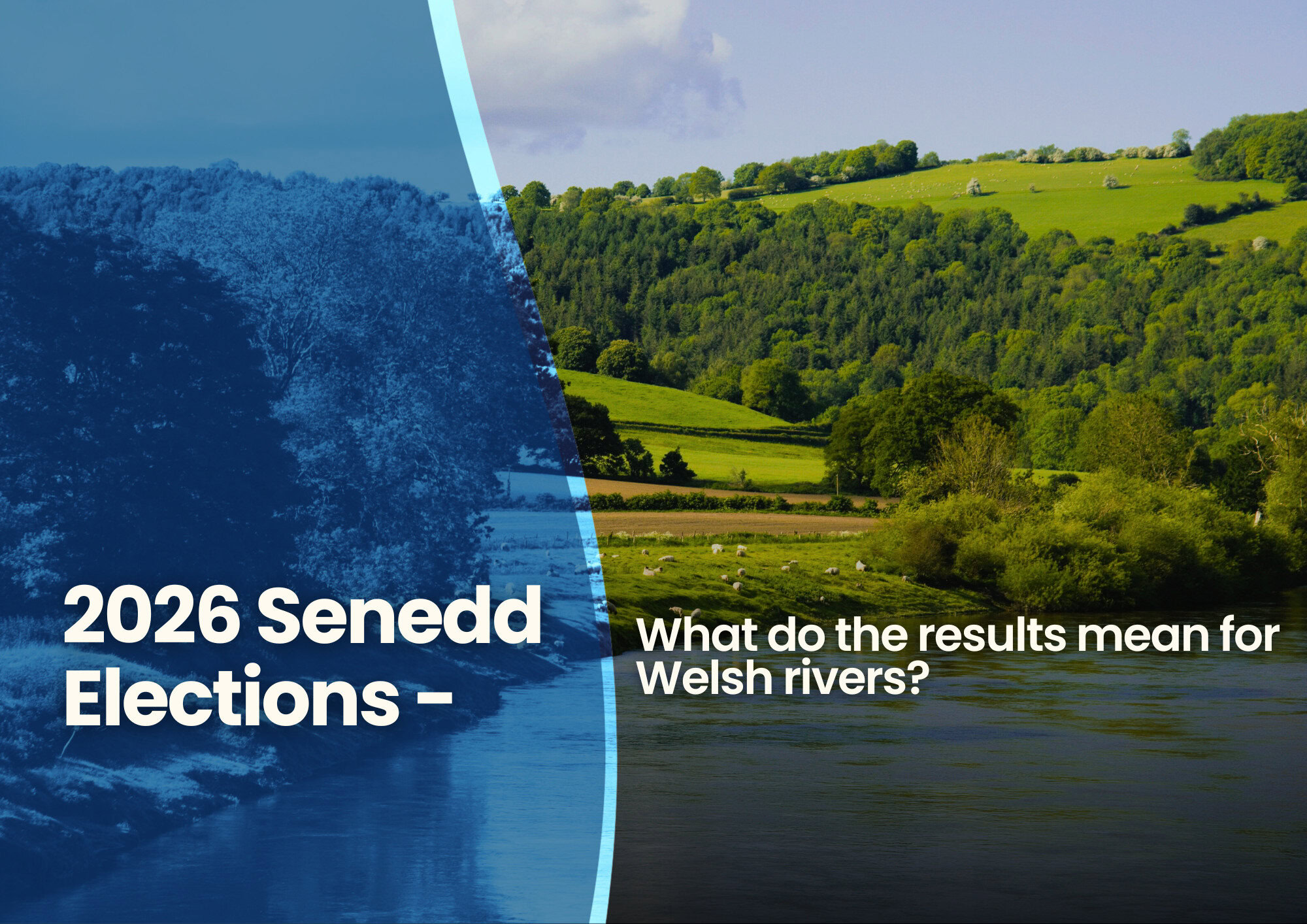
What Are Welsh Parties Doing About River Pollution? Senedd Election 2026 Explained

Download PDF
By Ellie Roxburgh, Policy and Advocacy Manager, and Erica Popplewell, Head of Engagement

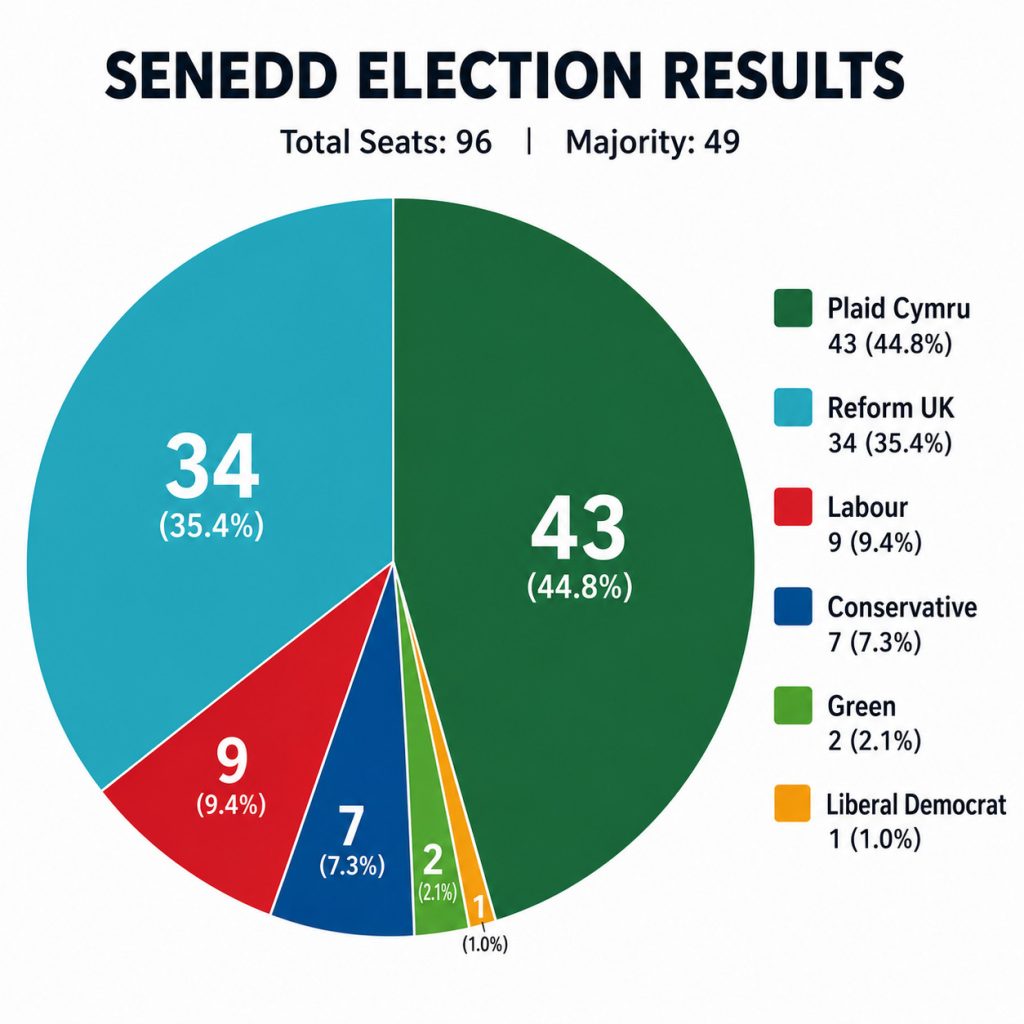
There’s a lot of noise ahead of May’s Senedd election – new voting systems, shifting polls, and speculation about who might form the next government. But beneath that sits a more important question: what kind of country does Wales want to be when it comes to its rivers? Because the decisions taken after this election will shape their future for decades.

This election matters precisely because it is so uncertain. No party is likely to win outright, which means priorities will be negotiated in coalition talks. In that kind of environment, issues only stay at the top if they are politically unavoidable—and river health has too often been treated as something that can be traded off. That’s a risk Wales cannot afford to take.

The reality is that Welsh rivers are already under serious strain. Sewage pollution, agricultural runoff and weak enforcement have pushed many waterways beyond ecological limits. Public awareness is growing, and rightly so, this is about health, nature and the places people live. Crucially, there are decisions to be made in Wales. The Senedd has the power to act.

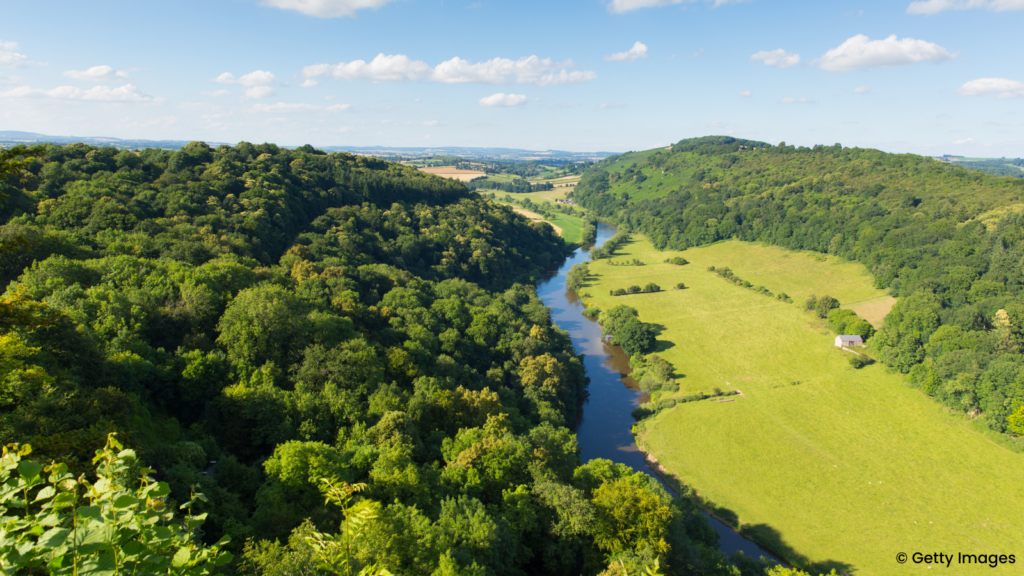
River pollution near the River Wye ©TillyHunter

So what are the parties offering? 

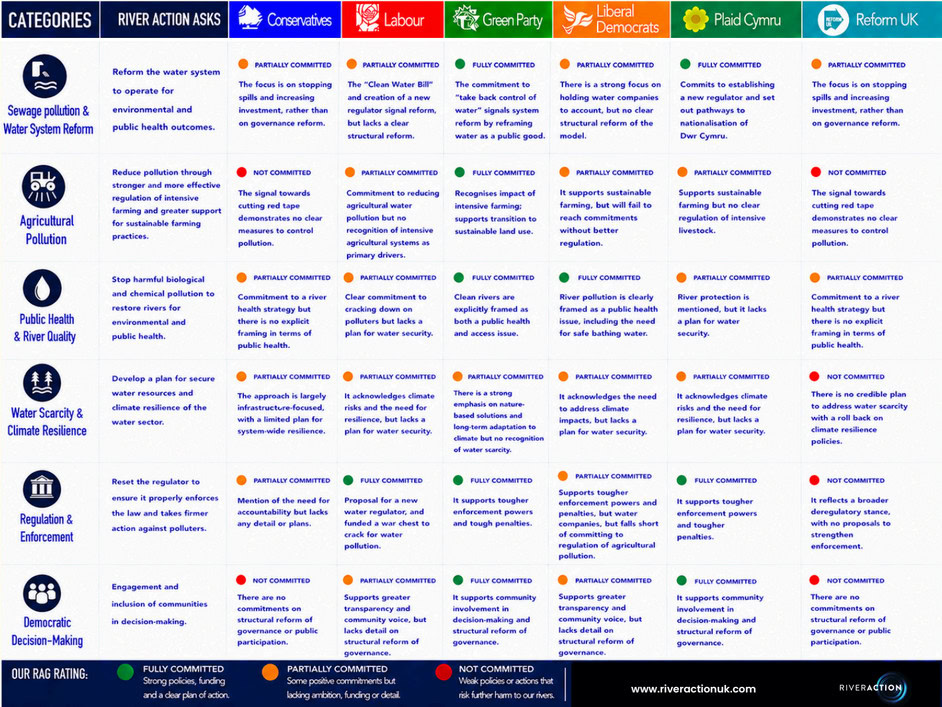
River Action’s Red–Amber–Green analysis against the asks set out in our Cymru Elections Manifesto shows a familiar pattern: some recognition of the problem; however, few parties have set out credible solutions.

On water system reform, most parties acknowledge that water companies should be held accountable but stop short of fundamental change. Labour’s proposed Clean Water Bill and new regulator are steps forward, while others focus on infrastructure and sewage discharges without addressing the system itself. Only Plaid Cymru and the Greens clearly challenge the current model and treat water as a public good.

Senedd Elections 2026 – River Action’s RAG review for river pollution manifestos (Click image for full size)

Agriculture remains the biggest gap

Despite being a major source of river pollution, agricultural pollution is still politically under-addressed. In a bid to make lives easier for farmers by taking the approach of cutting red tape, Reform and the Conservatives will struggle to meet other commitments to clean up rivers.

Labour and the Liberal Democrats favour support and incentives over firm regulation, whereas Plaid Cymru takes the approach of replacing unfit regulations with something that is science-led and risk-appropriate. Only the Greens fully recognise the impact of intensive farming. The result is a clear mismatch between the scale of the problem and the strength of the response.

Agricultural pollution run-off ©RiverAction

Progress, but not enough to fix Wales’ rivers

There are some positive shifts. More parties are now framing river pollution as a public health issue, reflecting growing public concern. But stronger language is not the same as stronger policy. Without clear targets, monitoring and enforcement, many commitments risk falling short in practice.

Overall, the picture is one of partial progress but insufficient ambition. In a fragmented Senedd, that matters even more. Without clear commitments, river health risks being diluted in post-election negotiations.

This is why River Action is calling for a step change:

  • A water system that prioritises public and environmental health
  • Real action on agricultural pollution
  • Enforceable plans to restore rivers
  • A long-term approach to water resilience

These are not radical demands – they are the foundations required to get the system to work.

Why I’m taking a water company to court

Download PDF
By Jo Bateman, Open Water Swimmer and Campaigner

I took a water company to court over sewage pollution. Here’s why I’m still campaigning.

My name is Jo Bateman, and I am taking legal action against South West Water because I am sick of sewage pollution ruining the sea where I swim.

A few years ago, I was living in the Midlands, about as far from the coast as you can get. I loved walking, so I decided to spend a week on the South West Coast Path, from Poole to Lyme Regis. That week changed everything. I fell in love with the sea. Not long after, I handed in my notice, sold my house, and moved to Exmouth to live by the coast.

Then one winter’s day, I was persuaded to get into the sea, reluctantly at first. From that moment, I was hooked. I have been sea swimming year-round ever since. When I am in the water, everything going on in my head gets left behind on the shore. All that exists is me, the sea, and the cold. When I get out, I feel completely transformed. The mental health benefits are huge. It reduces stress, lifts my mood, and gives me a sense of calm I cannot find anywhere else.

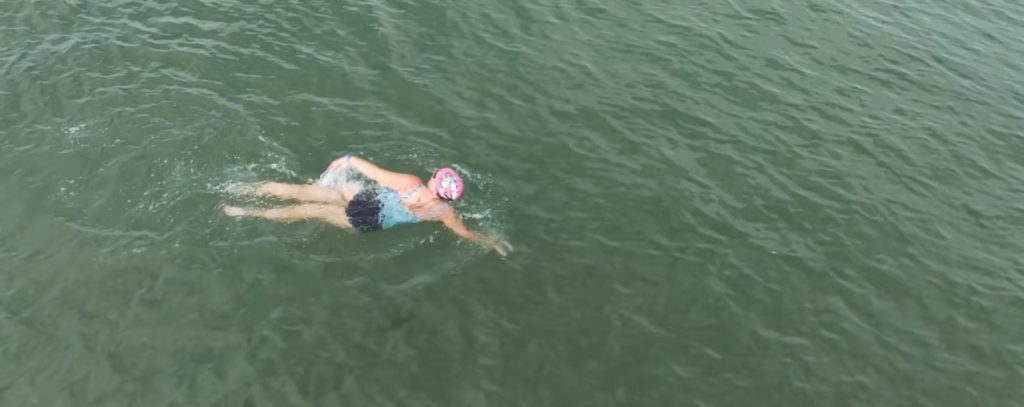
Jo, in the water

From sea swimming to sewage pollution awareness

At the beginning, I knew nothing about sewage pollution, and ignorance really was bliss. I could enjoy the sea without thinking about what might be in it. But over time, that changed. I started seeing alerts warning of sewage discharges into the water. There were days when the sea was unsafe, days when I could not swim, and days when something that had become essential to my wellbeing was taken away from me.

The more I learned about sewage dumping by water companies, the more shocked and angry I became. It was not just occasional incidents. It was frequent, systemic, and deeply damaging. What had started as a personal passion quickly became a source of frustration and concern. Eventually, I reached a point where I felt I could not just stand by and accept it.

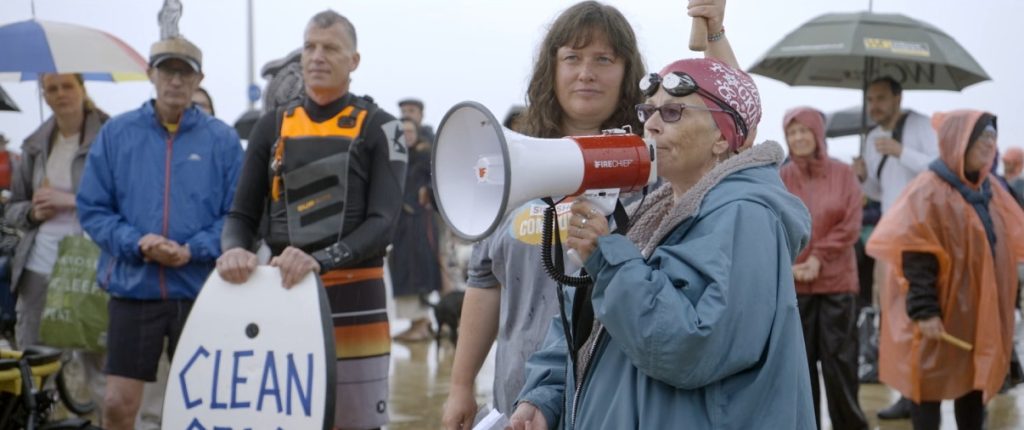
Jo at the March for Clean Water, 2024

Why I took legal action against a water company

In 2024, I decided to take South West Water to court. I filed a claim in the small claims court, seeking compensation for loss of amenity because repeated sewage pollution was preventing me from swimming. The cost to file the claim was £50, and I asked for £379.50 in compensation.

But this was never really about the money. It was about the principle. Why should water companies be allowed to pollute our rivers and seas and face so few consequences?

Water companies often argue that sewage discharges are unavoidable, particularly during heavy rainfall. They say the system cannot cope and that dumping sewage is necessary to prevent worse outcomes. I do not accept that explanation. Rain is not new. The UK has always experienced heavy rainfall. The real issue is decades of underinvestment in infrastructure, combined with a system that has prioritised shareholder payouts over environmental protection.

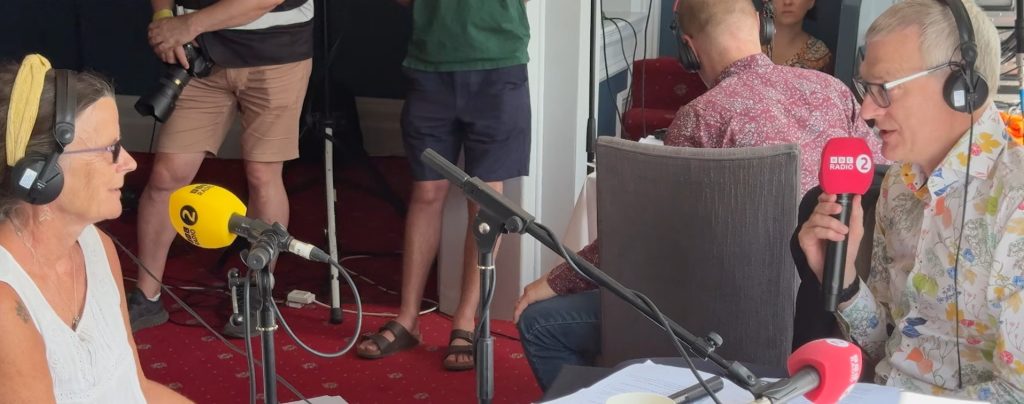
Jo talking to Jeremy Vine on BBC Radio 2

From one legal claim to a growing movement

What happened next was something I never expected. My case resonated with people far beyond Exmouth. What started as a small claim quickly grew into something much larger.

The case is now supported by the law firm Leigh Day and has progressed to the High Court. Alongside this, a group legal action has been launched on behalf of the people of Exmouth, with more than 1,300 claimants taking action against South West Water.

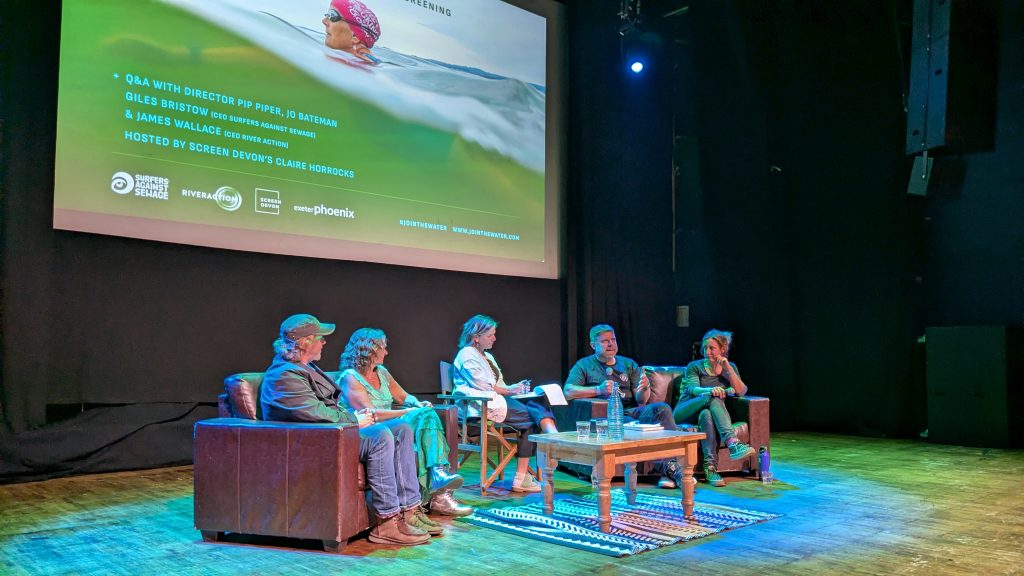
Personally, my life has changed beyond recognition. I have become part of a wider community of people who care deeply about clean water and are willing to speak out and take action. I have gone from being a relatively quiet person to speaking in Parliament, appearing in national media, and addressing large crowds at protests and events. There is even a documentary telling my story (find out more).

‘Jo in the Water’ documentary premiere

Why I am still taking on water companies

Taking on a water company can feel like a David and Goliath battle. These are large, powerful organisations with significant resources. I am just one individual. But I believe this fight is necessary.

Clean water should not be a privilege. It should be a basic right. We should be able to swim in the sea without worrying about sewage pollution. We should be able to trust that water companies are protecting the environment, not harming it.

We live in a world where extraordinary technological achievements are possible. It should not be beyond us to build and maintain a sewage system that does not pollute our rivers and seas. Real change requires accountability. It requires proper enforcement of environmental laws, and it requires water companies to stop putting profit before pollution.

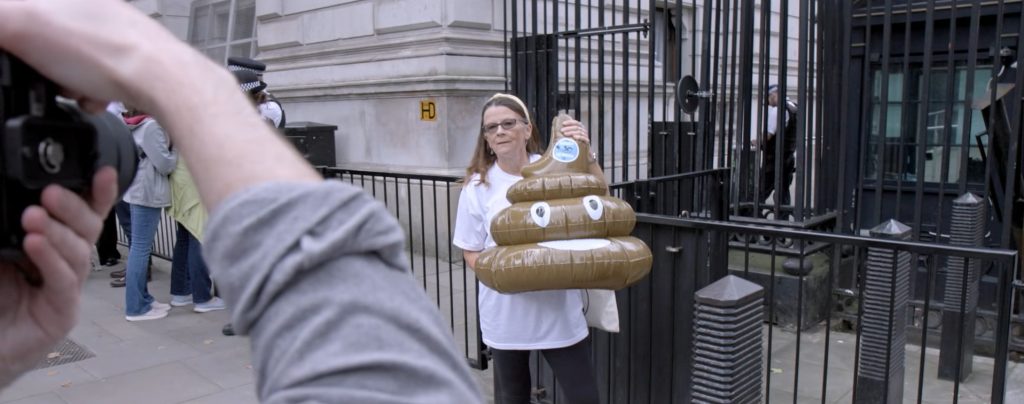
Jo campaigning outside 10 Downing Street

A message to others fighting sewage pollution

If there is one thing I have learned through this experience, it is that individual action matters. You do not have to accept the status quo, and you do not have to stay silent.

There are thousands of people who feel the same way, and together we are far more powerful than we are alone. Collective action can drive change, even in the face of powerful institutions.

This is about all of us. It is about the future of our rivers, our seas, and our environment. And it is a fight we cannot afford to lose.

Because nature needs us.


If you would like to find out more about Jo’s incredible story, you can book a ticket to a screening of her documentary here.

All Ffermio Achub y Cleddau? Gwersi o Dir Pori Sir Benfro

Download PDF
Gan Chloe Peck ac Ellie Roxburgh (River Action)

Wrth i ni yrru i lawr i Sir Benfro yn gynnar ym mis Chwefror, roedd yna deimlad o obaith yn yr awyr, gyda’r cennin Pedr melyn llachar cyntaf i’w gweld yn y cloddiau a’r haul yn adlewyrchu oddi ar fôr gwyllt a garw. Roedd mynd am dro ar draeth caregog yng Nghymru yn sicr yn apelio, ond roedden ni yno ar gyfer mwy na dim ond y golygfeydd. Diben y daith oedd gweld a yw’r nodau uchelgeisiol o gydbwyso maethynnau a ffermio adfywiol yn dal dŵr mewn sefyllfa ymarferol ac fel rhan o weithgareddau bob dydd fferm laeth.

Pont Cleddau, Sir Benfro

Afon Dan Bwysau

Mae’r Cleddau wrth galon tirwedd Sir Benfro, gyda’r Cleddau Ddu a’r Cleddau Wen yn uno cyn llifo i aber dwfn. Mae’n rhan hanfodol o’r ardal, ond yn wynebu pwysau sylweddol ar hyn o bryd. Mae llygredd amaethyddol yn parhau i fod yn un o’r achosion mwyaf o bwysau ar ein hafonydd ledled y DU, a dydy’r Cleddau ddim yn eithriad. Gall maethynnau o wrtaith a thail lifo i’r dyfrffyrdd hyn, gan gyfrannu at ddifrod ecolegol a dirywiad yn ansawdd y dŵr.

Roedden ni yn yr ardal yn benodol i siarad am lygredd maethynnau yn y dalgylch a sut mae ffermwyr eisoes yn gwneud newidiadau ymarferol i arferion rheoli ffermydd, gyda chefnogaeth gan y cadwyni cyflenwi, i wneud gwahaniaeth. Roedden ni hefyd yno i edrych ar yr hyn sydd angen ei wneud. Ar lawr gwlad, mae hyn yn cael ei amlygu gan y newid yn y ffordd mae’r tir a buchesi yn cael eu rheoli. Yn bwysicaf oll o bosib, fe wnaethon ni weld sut mae ffermio “ystyriol o afonydd” yn canolbwyntio ar reoli pori. Drwy symud i ffwrdd o ddulliau dwys traddodiadol tuag at systemau fel pori er lles cadwraeth, mae’n haws i ffermwyr amddiffyn y pridd a’r dŵr sy’n rhedeg drwyddo.

Trefnwyd ein taith gan Ric Cooper, asgwrn cefn ac arweinydd Prosiect y Cleddau. Mae Ric yn un o’r ymgyrchwyr hynny sy’n gallu ymdrin â data cymhleth ar faethynnau un funud, cyn troi ei law at gydlynu gwirfoddolwyr gwyddor dinasyddion, ac yna trafod agweddau ymarferol gyda ffermwyr y funud nesaf. Oherwydd ei fod yn llais lleol mor uchel ei barch, roedd yn gallu’n cyfeirio ni at amrywiaeth eang o safbwyntiau ledled y dalgylch.

O Borthi Dan Do i Dir Pori Agored

Drwy gysylltiadau Ric, trefnwyd i ni gyfarfod â’r ffermwyr lleol Mike Smith ac Andrew Rees fel y gallen ni fynd i lygad y ffynnon a gweld sut maen nhw’n rhoi mesurau ymarferol ar waith i leihau eu heffaith ar yr amgylchedd. Mae’r ddau yn rhan o First Milk, cwmni llaeth cydweithredol ym mherchnogaeth ffermwyr Prydain sy’n canolbwyntio ar systemau adfywiol seiliedig ar bori. Mae’n rhaid i aelodau First Milk ddarparu mynediad at dir pori am o leiaf 120 diwrnod y flwyddyn, gan eirioli dros bori fel dewis amgen hanfodol i borthi dwys dan do.

Mae manteision y dull hwn wedi’u gwreiddio yn y cylch maethynnau lleol. Mewn systemau dan do, mae gwartheg yn aml yn cael eu porthi â bwyd sy’n uchel mewn ffosffadau a nitradau, sy’n aml wedi’i gynhyrchu dramor a’i fewnforio. Mae hyn yn cyflwyno maethynnau “newydd” i’r amgylchedd lleol. Ar y llaw arall, pan fydd gwartheg yn pori ar borfa, maen nhw’n bwyta maethynnau sydd eisoes yn bresennol yn y pridd lleol. Pan fydd y gwartheg yn cynhyrchu slyri, mae’n golygu bod y maethynnau sydd ynddo yn lleol i’r ardal benodol honno. Drwy wasgaru’r slyri hwn ar yr un tir amaethyddol, mae’n cynnal y cydbwysedd maethynnau yn y tir yn hytrach na’i orlethu. Mae’r system dolen gaeedig hon yn hanfodol i amddiffyn ein hafonydd rhag y maethynnau mewn dŵr ffo sy’n arwain at ewtroffigedd – lle mae gormodedd o faethynnau yn achosi gordyfiant algâu, a hynny’n mygu ocsigen ac yn niweidio ecoleg yr afon.

Ond mae mwy i’r gwaith o bontio i ffermio sy’n ystyriol o afonydd na phori yn unig. Trafodwyd amrywiaeth o ddulliau eraill, megis gwell rheolaeth ar faethynnau ac ar wasgaru tail a gwrtaith, sydd yn eu tro’n lleihau’r risg o ddŵr ffo yn llifo i’r Cleddau yn sylweddol. Yn Moor Farm, mae Andrew wedi troi’r model traddodiadol ar ei ben drwy ostwng y defnydd o wrtaith a chemegion yn sylweddol. Mae’n credu bod hynny’n fwy na rhywbeth sy’n “ddymunol” o safbwynt amgylcheddol yn unig; gall cam o’r fath gynnal neu hyd yn oed wella’r elw ac adfer iechyd y tir ar yr un pryd.

Cydweithio ar Draws y Gadwyn Gyflenwi

Fe wnaeth Ric ein cyflwyno hefyd i Christopher ac Emma yn Puffin Produce, cwmni cyflenwi cynnyrch ffres mwyaf Cymru a chydberchnogion Hufenfa Sir Benfro. Mae’r rôl ddeuol hon yn eu rhoi mewn sefyllfa unigryw i ddylanwadu ar gaeau a llaethdai. Maen nhw’n defnyddio’r Rhwydweithiau Mentrau Tirwedd (LENs) i bontio’r bwlch rhwng cyflenwi masnachol ac iechyd yr amgylchedd.

Drwy’r rhwydwaith hwn, maen nhw’n cyd-ariannu atebion ar sail natur sy’n cael eu cynllunio gan y ffermwyr eu hunain. Mae’n ddull pwrpasol: yn hytrach na mandad o’r brig i lawr, mae’n grymuso pob busnes fferm i gynnig yr arferion adfywio penodol a fydd yn diogelu daearyddiaeth unigryw yr ardal leol honno orau.

Y Darlun Mawr: Dyfodol i’r Cleddau

Wrth i ni adael Sir Benfro, roedd yn amlwg bod amddiffyn ein hafonydd yn gofyn am weithredu cydlynol ar draws y system fwyd a ffermio gyfan, o’r ffermwyr a’u tir pori i’r cwmnïau cydweithredol, y manwerthwyr, y rheoleiddwyr a’r llunwyr polisi. Yn galonogol, yn ein sgyrsiau gydag arweinwyr fel Andrew Rees, Mike Smith a’r tîm yn First Milk, gwelsom fod llawer o ffermwyr eisoes yn gweithio i fod yn rhan o’r ateb.

Fodd bynnag, bydd datblygu’r ymdrechion ar raddfa ehangach yn gofyn am fwy na dim ond uchelgais amgylcheddol. Gwelsom fod pontio i ffermio adfywiol yn aml yn cael ei ystyried fel risg sy’n cymryd sawl blwyddyn i’w gwireddu. Er mwyn llwyddo, mae’n rhaid i ni ail-fframio’r ddadl, a dangos y gall ffermio sy’n ystyriol o afonydd fod yn economaidd hyfyw.

Mae ymroddiad amlwg Puffin Produce, First Milk a rhwydwaith gwyddor dinasyddion Ric Cooper yn profi bod newid go iawn yn bosib pan fydd ymddiriedaeth leol a chefnogaeth y gadwyn gyflenwi yn cyd-fynd law yn llaw. Bydd cefnogi a datblygu’r ymdrechion cyfunol hyn ar raddfa ehangach yn hanfodol os ydyn ni am adfer a diogelu iechyd ein hafonydd ar gyfer y cenedlaethau i ddod.


Cyfieithwyd gan Testun Cyf

Can Farming Save the Cleddau? Lessons from the Pembrokeshire Pasture

Download PDF
By Chloe Peck, Senior Engagement Coordinator and Ellie Roxburgh, Policy and Advocacy Manager (River Action)

As we drove down to Pembrokeshire in early February, there was a feeling of hopefulness in the air, with the first bright yellow daffodils popping up along the verges and the sun reflecting off a wild, rough sea. A walk on a pebbly Welsh beach was certainly inviting, but we weren’t just there for the scenery. We were there to see if the ambitious goals of nutrient rebalancing and regenerative farming actually hold water when they meet the daily reality of a working dairy farm.

Cleddau Bridge, Pembrokeshire

A River Under Pressure

The Cleddau is at the heart of Pembrokeshire’s landscape, with the Eastern and Western Cleddau rivers flowing together into a deep-water estuary. It is a vital part of the area, but is currently facing significant pressure. Agricultural pollution remains one of the most significant pressures on rivers across the UK, and the Cleddau is no exception. Nutrient runoff from fertilisers and manure can enter these waterways, contributing to ecological damage and declining water quality.

We went specifically to speak about nutrient pollution in the catchment and how farmers are already making practical changes in farm management, alongside support from supply chains, to make a difference, as well as what more needs to be done. On the ground, this looks like a shift in how the land and herds are managed. Perhaps most importantly, we saw how “river-friendly” farming focuses on grazing management. By moving away from traditional intensive methods toward systems like conservation grazing, farmers can better protect the soil and the water that runs through it. 

Our trip was organised by Ric Cooper, the local linchpin and lead of The Cleddau Project. Ric is the kind of campaigner who is able to navigate complex nutrient data one minute, coordinate citizen science volunteers the next, and then talk practicalities with farmers. Because he is such a trusted local voice, he was able to introduce us to a wide variety of perspectives across the catchment.

From Indoor Housing to Open Pasture

Through Ric’s introductions, we met with local farmers Mike Smith and Andrew Rees to learn firsthand how they are implementing practical measures to reduce their environmental impact. Both are part of the First Milk cooperative, a British farmer-owned dairy co-op focused on regenerative, grazing-based systems. First Milk requires its members to provide at least 120 days of pasture access per year, advocating for grazing as a vital alternative to intensive indoor housing.

The benefits of this approach are rooted in the local nutrient cycle. In indoor systems, cows are often fed imported feed, rich in phosphates and nitrates that were grown elsewhere, sometimes even in another country. This introduces “new” nutrients into the local environment. In contrast, when cows graze on pasture, they are consuming nutrients already present in the local soil. This means that when the cows produce slurry, the nutrients within it are local to that specific area. By spreading this slurry back onto the same farmland, the nutrients remain balanced with the land rather than overwhelming it. This closed-loop system is essential for protecting our rivers from the nutrient runoff that leads to eutrophication – where excess nutrients cause algal blooms that choke the river of oxygen – damaging the ecology of the river.

This transition toward “river-friendly” farming isn’t limited to grazing alone. We discussed a variety of other approaches, such as improved nutrient management and more precise manure and fertiliser control, which can significantly reduce the risk of runoff into the Cleddau. At Moor Farm, Andrew has turned the traditional high-input model on its head by significantly reducing fertilisers and chemicals. He believes that these changes aren’t just an environmental “nice-to-have” lower inputs can actually maintain or even improve profit margins while restoring the health of the land.

Collaboration Across the Supply Chain

Ric also introduced us to Christopher and Emma at Puffin Produce, the largest supplier of Welsh fresh produce and partial owners of the Pembrokeshire Creamery. This dual role puts them in a unique position to influence both the fields and the dairies. They are leveraging the Landscape Enterprise Networks (LENs) to bridge the gap between commercial supply and environmental health.

Through this network, they co-fund nature-based solutions that are designed by the farmers themselves. It’s a bespoke approach: rather than a top-down mandate, it empowers each farm business to propose the specific regenerative practices that will best protect that local area’s unique geography.

The Big Picture: A Future for the Cleddau

As we left Pembrokeshire, it was clear that protecting rivers requires coordinated action across the entire food and farming system, from the farmers in the pasture to the cooperatives, retailers, regulators, and policymakers. Encouragingly, our conversations with leaders like Andrew Rees, Mike Smith, and the team at First Milk showed that many farmers are already working to be part of the solution.

However, scaling these efforts will require more than just environmental ambition. We learned that the transition to regenerative farming is often seen as a risk that takes several years to realise. To succeed, we must shift the frame, to show that “river-friendly” farming can be economically viable.

The commitment we saw from Puffin Produce, First Milk, and Ric Cooper’s citizen science network proves that when local trust and supply chain support align, real change is possible. Supporting and scaling these collective efforts will be essential to restoring and safeguarding the health of our rivers for future generations.

Justice for Lough Neagh: The First Hearing

Download PDF

Written by Christian Fuller, River Action’s Legal Coordinator  

This week, River Action took part in the first hearing of a legal case which, for the first time, asks the court to decide whether the Northern Ireland government is doing enough to tackle the water pollution crisis in Lough Neagh. 

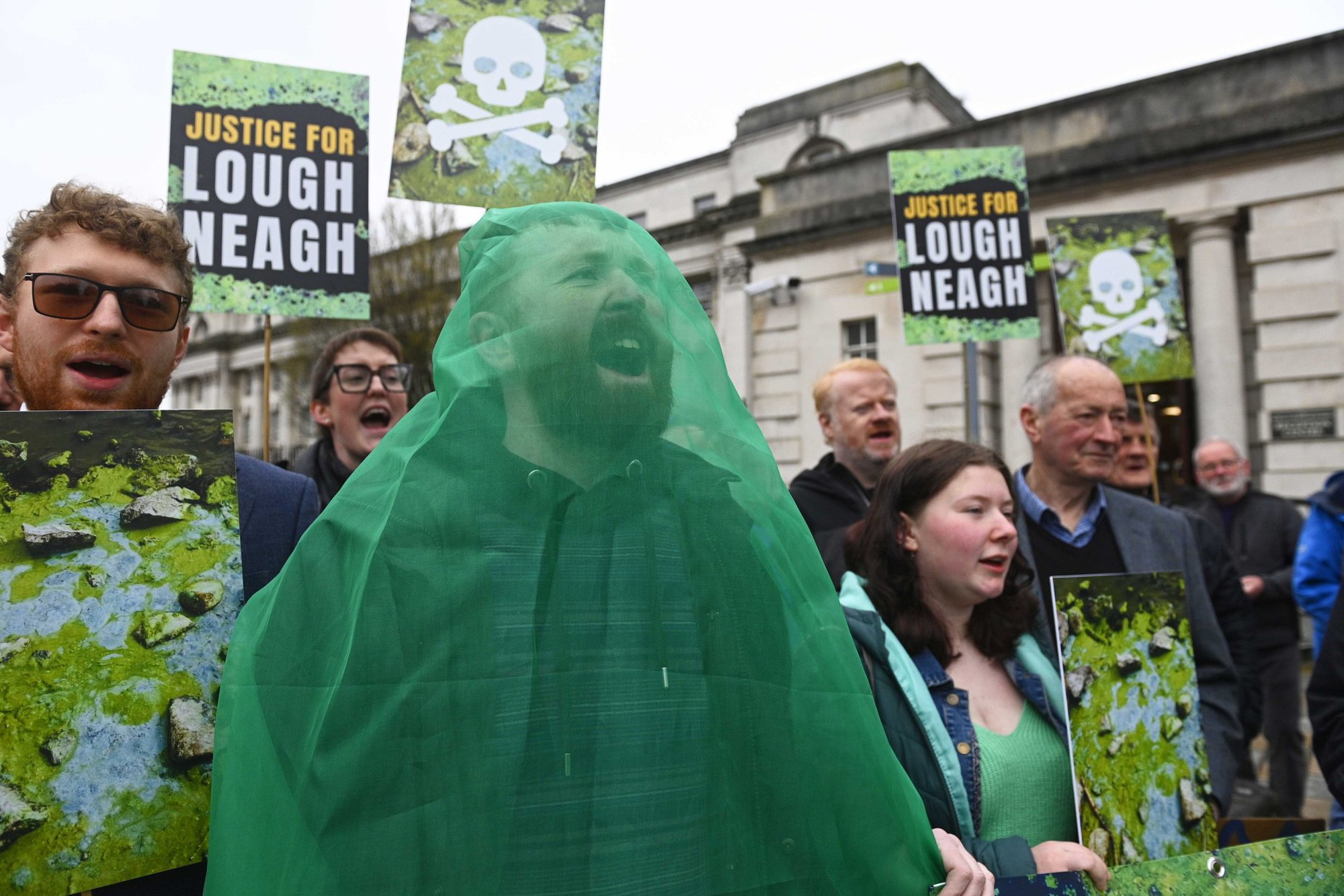
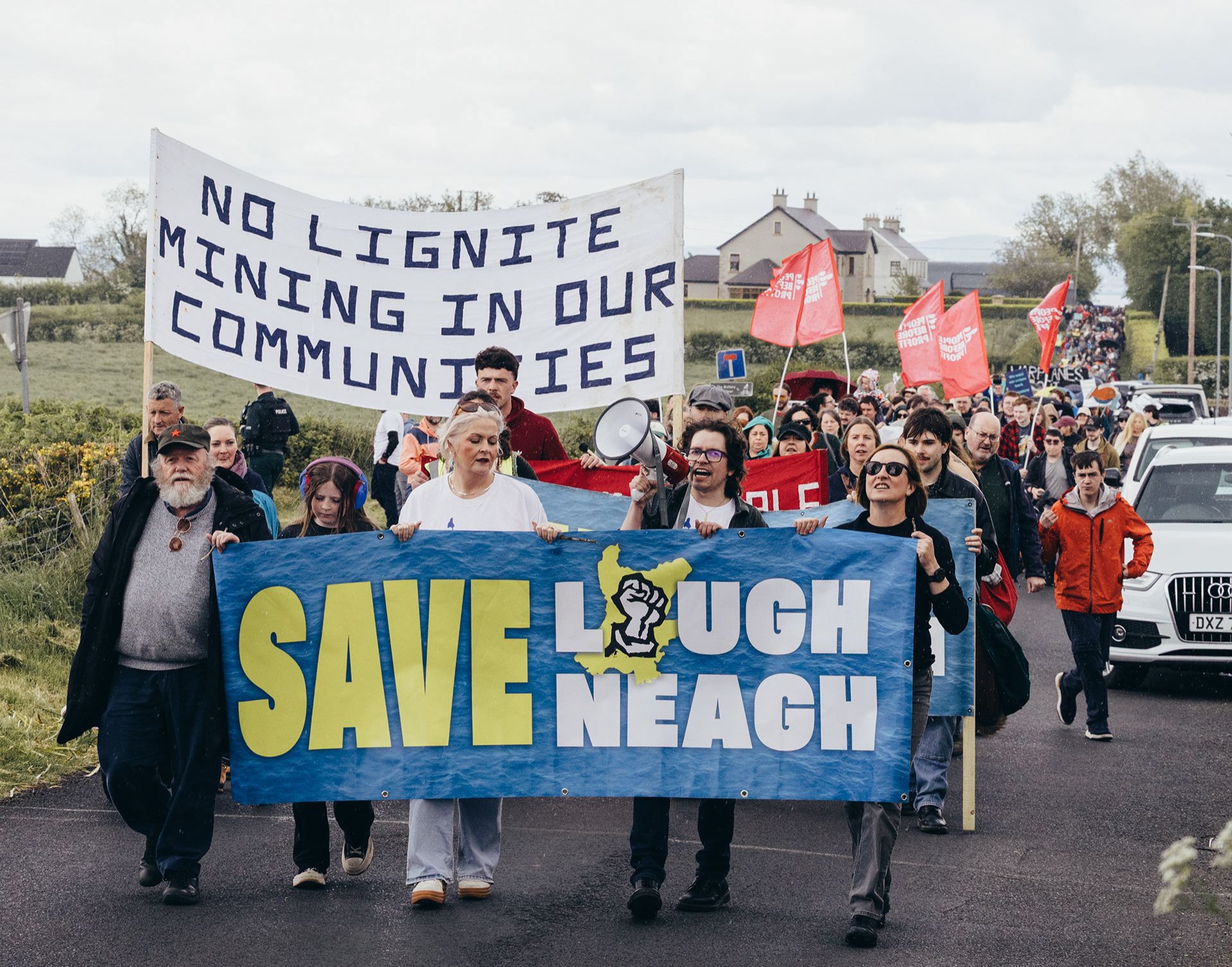
Outside of the Royal Court of Justice in Belfast, clean water campaigners and members of the fishing community gathered to make their point plainly: the Lough is being destroyed by algae. Draped in green and holding placards reading ‘Justice for Lough Neagh’, the peaceful demonstration captured the now-familiar sight of blue-green algal blooms spreading across the water in recent summers.

Inside, representatives for the applicant, the Department of Agriculture, Environment and Rural Affairs (DAERA), Ulster Farmers’ Union, River Action and Friends of the Earth NI were present, with a packed courtroom due to public interest and concern.

The case is being brought by eel fisherman Declan Conlon, whose family has fished Lough Neagh for generations. He is challenging the failure of DAERA to comply with its obligations to safeguard and protect Lough Neagh from agricultural and wastewater pollution on eight legal grounds. The claim challenges the lawfulness of DAERA’s response, including its failure to adopt an adequate or lawful River Basin Management Plan. 

River Action has applied to intervene in Mr Conlon’s case to help the court assess whether DAERA is complying with its legal duties by raising important legal and practical matters. Our focus is on what the law requires and particularly the need for a lawful River Basin Management Plan to include clear actions and measures capable of restoring water quality, following the landmark case of Pickering. Drawing on major legal precedents on agricultural waste and nutrient pollution in which River Action has been involved in England, we hope to establish that DAEERA should put in place stronger measures as part of a lawful plan, including the proper enforcement of regulation to control the spreading of manure and sewage sludge, the implications of the classification of manure as waste following National Farmers’ Union v Herefordshire Council, and the need for planning and permitting to take account of cumulative pollution impacts. We will also seek to provide evidence to help the court understand the scale of the problem and what measures and practices could lead to the necessary reduction in pollution. 

At the hearing, the judge recognised the importance of this case. There were, he observed, no obvious “knockout blows” against the applicant. On the contrary, the judge said that this is “an important matter which will require a considerable amount of time to be devoted to it” and referenced “a significant element of public concern” in the situation with Lough Neagh. 

The judge repeatedly signalled there were a large number of issues and that detailed evidence would be required to “get to the bottom” of what is happening in the Lough. The judge emphasised that it was “important to leave no stone unturned” and that meant ensuring all “relevant players” were before the court.

The case will return to court on 1 May for a further review hearing, where the legal issues will be refined and the roles of additional parties considered. A permission decision will follow (to decide whether the claim is arguable and can proceed), with a substantive hearing anticipated later this year. 

This is the first real opportunity for the court to consider the Government’s response to the severe pollution of Lough Neagh and the applicable legal framework, with the potential to become the most significant water quality case in Northern Ireland for a generation. 

It is a critical opportunity to clarify what the law requires and to ensure that meaningful, urgent action is taken to restore Lough Neagh.

Natural Resources Wales Must Prevent Pollution – Not Pass the Buck as the Wye and Severn Decline

Download PDF

By Emma Dearnaley, River Action’s Head of Legal

Across Wales, rivers that should be a source of pride – places for connection, wildlife and local identity – are in visible decline. 

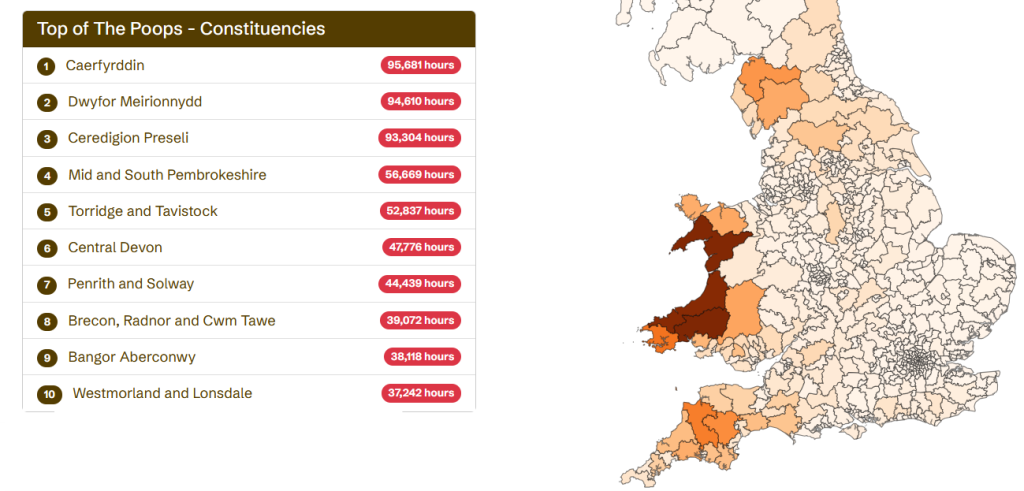
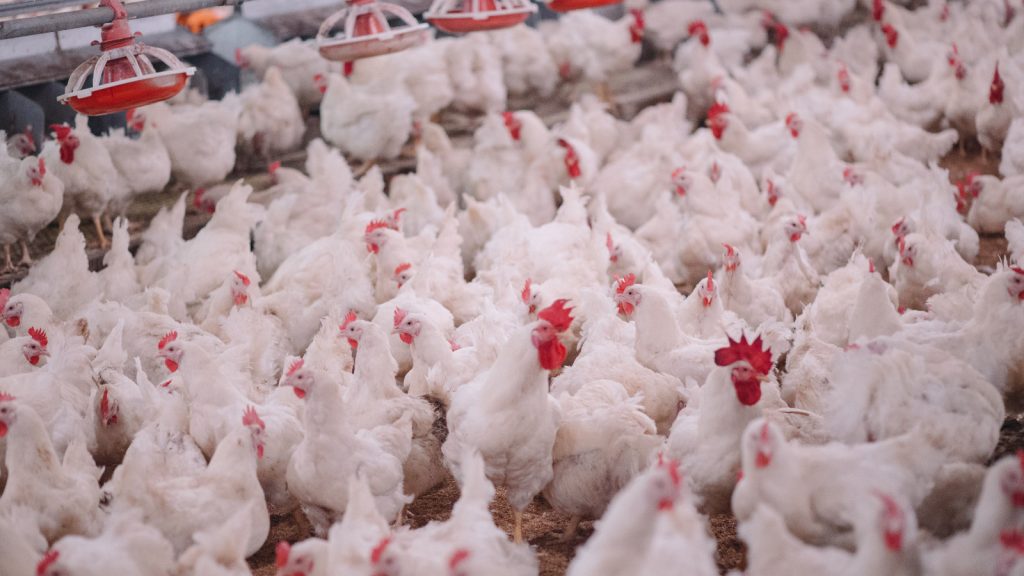
In recent years, much of the public debate has focused on sewage discharges, storm overflows and Victorian infrastructure doing 21st-century damage. That remains an important focus. But if we are serious about restoring our rivers, another very significant source of pollution must be understood and addressed with an equivalent amount of resolve: nutrient pollution linked to intensive livestock production and, in Wales especially, the waste generated by industrial-scale poultry units. 

This is not about farmers trying to do the right thing in challenging circumstances. It is about whether the regulatory system governing intensive agricultural operations is working as Parliament intended and whether regulators are using the powers they have to prevent harm before it occurs. 

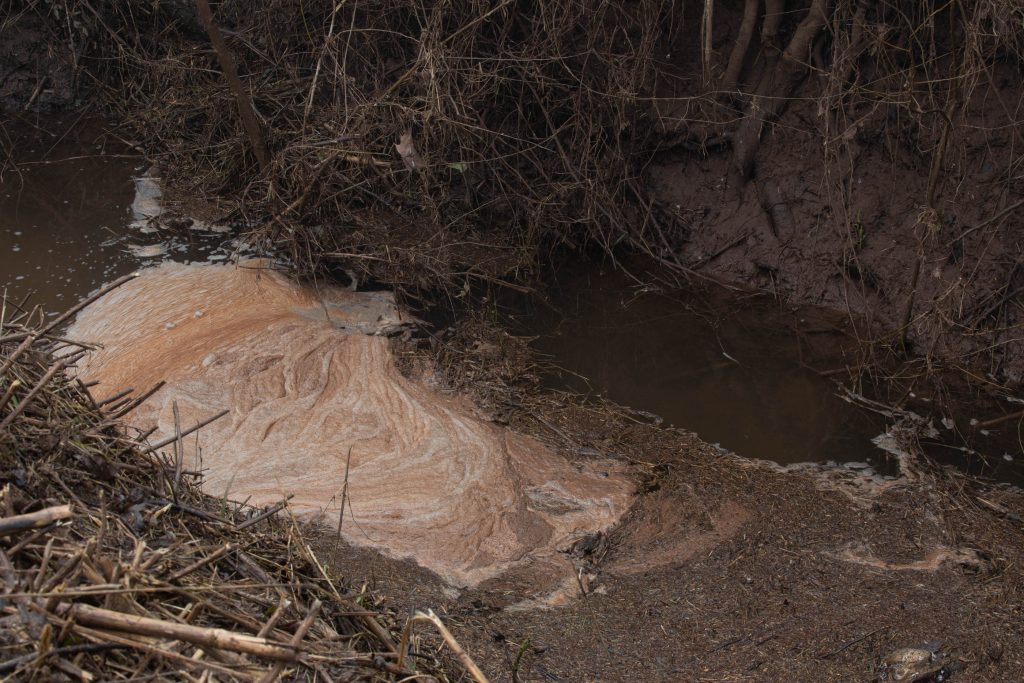
Pollution from intensive poultry production does not usually appear as a dramatic brown slick after heavy rain. Instead, it spreads more quietly. Vast quantities of chicken manure, rich in phosphorus and nitrogen, are being spread on land or exported and spread on other land that in some catchments is already saturated with nutrients. From there, rainfall can wash those excess nutrients into nearby streams and rivers, fuelling algal blooms that choke oxygen from the water, damage wildlife and smother riverbeds. By the time the ecological harm becomes visible, the pollution has already taken hold. 

‘Diffuse’ agricultural pollution comes from widespread activities across a catchment, making it harder to pinpoint and regulate than obvious point-source pollution such as a sewage discharge or a chemical spill. But complexity is not an excuse for inaction: it requires coordinated, consistent, catchment-wide management, not regulatory blind spots. 

That is why River Action has launched a judicial review challenging Natural Resources Wales (NRW)’s decision to approve permit variations allowing three intensive poultry units in Powys to expand. The issue is not whether intensive poultry farming should exist. It is whether Wales’ environmental regulator is properly doing its job by using the legal powers it has to prevent pollution linked to those operations. 

In approving the permit variations, NRW proceeded on the basis that it had no legal power under the Environmental Permitting Regulations 2016 to regulate manure once it leaves the boundary of a permitted poultry unit. On that view, the environmental impacts of manure exported off-site fall outside the permitting regime and are instead matters for the planning system, but without NRW first being satisfied that effective and enforceable pollution controls would in fact be secured elsewhere.

In effect, NRW treated the boundary of the site as the boundary of its regulatory responsibility. Rivers, inconveniently, do not respect such lines.

Manure from intensive poultry farming is a major source of nutrient pollution affecting Welsh rivers, including the Wye and the Severn. This is not theoretical harm. Both rivers are already under severe ecological pressure from excess nutrients, causing declining water quality and damaged habitats.

Environmental permitting exists precisely to prevent unacceptable pollution before it happens. Parliament entrusted NRW, as Wales’ environmental regulator, with assessing whether permitted activities are likely to cause pollution and with imposing conditions to control and stop it. River Action’s case argues that NRW has taken an extraordinarily narrow view of its own powers and misdirected itself in law by excluding the potential off-site impacts of manure from its permitting decisions on the basis it has no legal power to address them. We say that approach is unlawful. The Environmental Permitting Regulations do not stop at the farm gate. If waste arises from a permitted activity and is likely to cause pollution wherever it ends up, NRW as the regulator must assess and, wherever necessary, control those impacts. That is both logical and, we say, what the law requires. Recent court judgments do not say otherwise, despite NRW’s insistence that its hands are tied.

What makes this more troubling is that NRW’s counterpart in England, the Environment Agency, accepts that it must consider and prevent water pollution through the permitting process including impacts that may occur beyond the site boundary. There is no rational basis for Wales’ regulator to do less, especially when making decisions in sensitive and protected catchments on the Welsh border. Environmental protection should not weaken when you cross Offa’s Dyke.

If NRW’s position is allowed to stand, the consequences extend far beyond these three poultry units in Powys. It risks creating a significant regulatory gap, allowing industrial-scale agricultural operations to expand in vulnerable catchments without effective oversight of one of their most environmentally damaging consequences.

This case is not about attributing blame after the damage is done. It is about prevention. Once excess nutrients enter a river system, they are extremely difficult and costly to remove. Rivers such as the Wye cannot be restored while pollution continues upstream without effective regulatory control. 

NRW exists to prevent environmental harm, not to assume that someone else will deal with it. Passing the buck to the planning system on a mistaken understanding of legal powers, without securing robust safeguards elsewhere, won’t wash.  

Wales rightly aspires to environmental leadership. It has strong and progressive environmental frameworks and internationally important rivers. But laws only matter if they are used and followed. 

River Action’s case asks the court to clarify a simple and fundamental point: to confirm that environmental regulation in Wales means what it says, NRW’s interpretation of its powers was wrong, and that pollution prevention does not end at a conveniently drawn boundary line. Our rivers cannot afford another lost decade of buck-passing. If we are serious about protecting and restoring them, we must ensure that those tasked with safeguarding them are equipped – and required – to use their powers in full.

Red Tractor Misleads On Environmental Claims

Download PDF

By Amy Fairman, Head of Campaigns at River Action UK

Britain’s rivers are in terrible shape, and our biggest supermarkets are up to their necks in it. For years, retailers like Tesco and Asda alongside their agribusiness suppliers have relied on the cosy logo of Red Tractor, telling customers their food is “farmed with care… from field to store all our standards are met”. In late 2025, the Advertising Standards Authority (ASA) called time on this charade.

The regulator has ruled that Red Tractor, the UK’s largest farm assurance scheme, misled the public by suggesting its logo guarantees environmental protection. It doesn’t. The most recent Environment Agency data shows a staggering 19,000 breaches across 60% of inspected Red Tractor–certified farms between January 2020 and July 2025, exposing a systemic failure behind the label’s “environmentally friendly” claims.

This isn’t a marginal issue. It goes to the heart of how our food system operates, and how some of the biggest companies in Britain shield themselves from responsibility while rivers and lakes collapse under a deluge of pollution caused by intensive agricultural practices.

Take Tesco. Controlling nearly 30% of the supermarket sector, it is the single most powerful buyer of British farm produce. Its chicken and pork supply chains run through industrial-scale operators like Avara Foods and Moy Park. These are not quaint family farms but subsidiaries of US agribusiness giants Cargill and Pilgrim’s Pride. These companies have been linked to ecological crises such as the collapse of the River Wye and the ongoing algal disaster in Lough Neagh, the UK’s largest freshwater lake.

At a recent Sustainable Food Conference in London, River Action’s Head of Engagement asked Tesco CEO Ken Murphy why the company continued to stock Red Tractor products after the ASA upheld a greenwashing complaint against the scheme. His response was: “That’s an issue for Red Tractor.”

For years, supermarkets have pointed to the Red Tractor logo as their environmental shield. But that line has now been shredded. In a landmark ruling, the UK’s ASA concluded that Red Tractor’s environmental claims were misleading, finding that the advertising exaggerated the scheme’s standards and misled consumers. This is no longer just campaigners or scientists raising the alarm; it is an independent regulator confirming that the reassurance offered by the logo does not stack up. Any retailer still presenting Red Tractor as a marker of good environmental outcomes is not reassuring customers, but risking greenwash.

The data underpinning the ruling is stark. Between January 2020 and July 2025, 7,353 Environment Agency inspections of Red Tractor–certified farms found 4,353 breaches, meaning nearly 60% of farms failed to meet environmental rules. These were not trivial lapses.  Inspectors recorded 19,305 instances of non-compliance, including thousands of breaches intended to stop slurry and fertiliser entering rivers – pollution that fuels algal blooms, kills fish, damages ecosystems, and contaminates drinking water.

This is not just a story about dirty rivers. It is about a food system where the biggest players, multinational agribusinesses and the retailers who buy from them, use weak, industry-controlled assurance schemes to insulate themselves from scrutiny. Red Tractor is not a neutral standard-setter. It is designed by the very interests it is supposed to regulate. And guess who controls it? The majority of seats on Red Tractor’s governing council are held by the UK’s various National Farming Union bodies. Yes, the farming lobby actually controls its own product quality scheme.

Red Tractor’s defenders will say that criticising the scheme means attacking farmers. Let’s be clear, it does not. Many farmers care deeply about the land and waterways that sustain them and us all. They are being undercut by a system that rewards scale, intensification and cutting corners, while paying lip service to environmental protection.

As Martin Lines, CEO of the Nature Friendly Farming Network, has put it: “Consumers and farmers want real sustainability, not a sticker.”

Farmers who are genuinely improving soils, protecting rivers and reducing chemicals see little reward for their efforts. Supermarkets cannot claim ignorance. They have been told repeatedly about the links between their suppliers and river pollution. The Environment Agency rejected Red Tractor’s bid for “Earned Recognitions” precisely because it fails to meet good environmental standards. Yet retailers still rely on the logo as their shield.

This complicity matters because of their sheer market power. When supermarkets demand Red Tractor chicken, vast supply chains, from feed mills to slaughterhouses to contract farmers, are locked into a destructive model. This legitimises the industrial systems polluting our rivers. And when consumers challenge them, they point to the little tractor logo, as if that settles the matter.

The ASA ruling proves it doesn’t.

We now face a choice. Tesco, Asda, Aldi, Lidl, Morrisons and others can continue to sell food tainted with pollution, hiding behind a logo that regulators have called out as misleading on environmental performance. Or they can do the honest thing: demand genuinely high environmental standards from suppliers, pay farmers properly for producing food in ways that don’t wreck our rivers, and support the farming community’s transition to nature friendly farming.

This isn’t just about protecting wildlife or river users such as this nation’s army of wild swimmers. Though that should be enough. It is also about restoring trust in our food system. Consumers deserve to know that when they buy British, they are supporting farming that safeguards our countryside, not destroy it. Farmers deserve a level playing field that rewards those who do right by the land. And companies that profit from selling us food have a duty to ensure their supply chains comply with legal standards, both under the law and broader social responsibility.

For too long, Red Tractor has allowed agribusiness and retail giants to dodge that duty. Thanks to the ASA, the greenwash is now exposed. The question is whether the supermarket giants will finally face up to reality, or whether they will cling to a broken system until public trust collapses.

Britain’s rivers cannot wait. Neither can the farmers who are trying to do the right thing. The time for excuses is over. We hope that conversations like the one with Tesco’s CEO plant a seed and prompt supermarkets to take real responsibility for the food they choose to stock on their shelves.

The “Make a Nuisance” Campaign: Using the Law to Speak Up for Our Rivers

Download PDF
By Chloe Peck, Senior Engagement Coordinator at River Action


When River speaks, what does River say?

When River is harmed, how does a body of water make its cries heard?

And when we step in to speak for River, through our human legal systems, whose voice do we really use?

At River Action, we recently helped amplify a cry for the river through the launch of the ‘Make A Nuisance’ campaign.  The campaign creates a way to speak through the law. Working alongside Friends of the Thames and 15 people from 13 different areas across the Thames catchment, we supported local residents to submit Statutory Nuisance complaints about Thames Water to their local authority. The aim of the campaign is to create a collective noise, which further holds Thames Water to account by enabling community members to take direct action using a powerful legal tool. 

Statutory nuisance law is a long standing area of UK law which requires local councils to investigate harms from pollution or noise. If the pollution is found to be causing a problem, the council enforces the polluter, Thames Water, to seize and desist the action, sewage pollution, through Abatement Notices.

In order to ensure the letters were rooted in real life experiences of pollution, the participants were responsible for gathering stories and data to evidence their complaints. This included photos of sewage smears on rowing boats, data from nutrient and pathogen tests, and testimonies from local people who had become sick from swimming. This was complimented by compelling evidence on failing sewage treatment works gathered by River Action’s Campaigns Analyst  Dr Samir Seddougui. Their letters were accompanied by an attachment outlining the relevant legal procedures, prepared by our Head of Legal, Emma Dearnaley, alongside lawyers from Leigh Day. 

Using statutory nuisance as a campaigning tool is powerful, as it uses the law to allow local people to have their voice heard. This is useful where previously the community’s lived experience of the sewage crisis has been dismissed and sidelined. The campaign challenges this by forcing responsibility back into a system where regulation repeatedly stalls and accountability slips. The process creates formal records, duties, and pressure. It is slow, procedural, and intentional — not a protest stunt – however, it has the potential to make substantial change.

Statutory nuisance as a form of protest offers a unique way to demand action, however, when used to speak for nature, we must consider its limits. Statutory nuisance is unapologetically human-centred. The law exists to protect residents from activities that interfere with their health, comfort, or enjoyment of their home or local environment, and it places a duty on local councils to investigate and act when such interference occurs. It fundamentally is concerned with human’s experience of the environment, not the environment’s own experience. The river has no legal standing without humans.

This is not to say this is the perception across the world. The Whanganui river is often cited in nature writing as an example of a river with legal personhood. The river was granted personhood in 2017 after 140 years of negotiations fought by the Māori group of Whanganui, who consider the river as their ancestor. With personhood status, if the Whanganui river is harmed, the law recognises this as a harm to the Maori group. The group and the river are one connected being. In the UK, we do not have the same recognitions in place; in legal standing what harms nature does not harm us. Lawfully, we are not one and the same with the world around us.

Despite these legal limitations, the people who wrote nuisance complaints are deeply connected to the Thames and its tributaries. They are rowers, swimmers, house boat dwellers, kayakers, and citizen scientists. They rely on the river for community, exercise, business, as well as spiritual and mental wellbeing. And despite its limitations, the campaign is genuinely exciting, as a community-led action, with people taking initiative to use law as something real; not a distant inaccessible tool, but something that propels momentum and possibility for change. 

This connection is reflected in the experience of campaigner Blake Ludwig, who took part in the Make A Nuisance campaign on the River Kennet:

“We have to see that water isn’t simply a dead material for us to use at our leisure, or as a waste receptacle… Through collecting evidence and building a nuisance complaint, I’ve come to understand how invisible pollution can be — and how only long-term relationship, observation and care allow us to really see what’s happening to our rivers.”

What the system of nuisance complaints tells us is that we live in a climate which recognises people and nature as separate. We have not retained the historic kinship between human and nature which the Maori people have. In our social system a person is legible through documents, numbers, and certificates. Personhood is administrative. Within this system, the river’s voice is only heard when it passes through us. So we therefore have a duty to nature to ensure that nature’s voice is heard.

And how do we do that authentically? By knowing a river as we might know a family member, and caring for it as we would a friend. And all the while recognising that a river is not human at all. A river is a living system with its own rhythms, flow, and resilience, deserving of respect not because it resembles us, but because it exists in its own right.

When I talk about sewage pollution, I am often asked by wild swimmers if they should stop their beloved sport. The answer is no. Not because the dangers aren’t present, they are, but because connection matters. By spending time and interacting with the river, we are able to create a deep and intimate relationship with the river. 

The power of the Make a Nuisance campaign has come from people who live entwined, not separate, from the river. So the work, for now, is slow, careful and continuous. Keep swimming, keep connecting, keep being with the river. Speak to the river, and the river may well speak through you.

The Government’s Water White Paper: The Good, the Bad and the Ugly

Download PDF

Written by Ellie Roxburgh, Policy and Advocacy Manager at River Action

This Government’s focus on reforming the water sector is welcome and timely. Recent failings by South East Water and Thames Water have demonstrated that water companies are defective on multiple fronts. The public is mobilised for change and the Government must go further than minor tweaks to the status quo. The current model of profit-driven privatisation has failed, evidenced by the polluted state of our rivers, exploitative ownership models and inadequate regulatory oversight in the water sector. The water pollution caused by agricultural practices, industrial waste and road run-off must also be urgently recognised and addressed. 

The time for change is now. We need a government that is bold in ambition and willing to implement reforms fast enough to deliver the measurable improvements needed to fulfil its election promise to clean up our rivers, lakes and seas.

So, what is a White Paper?

A White Paper is a government document that precedes legislation. It sets out what to expect in the upcoming King’s Speech when the parliamentary agenda is laid down by the King. This White Paper focuses largely on the recommendations made by Sir Jon Cunliffe’s Review of the water sector in 2025. Below, we’ve set out the good, the bad and the ugly of the government’s plans for water reform.

The Good

Tough, independent regulators: For too long, water companies have gotten away unscathed with polluting our rivers. Today’s announcements put some strength into the regulator, including no-notice powers for the regulator to check security and emergency preparedness, Performance Improvement Regimes for failing water companies, and a Chief Engineer to monitor infrastructure.

The government announced a consolidation of water industry regulators into one entity, with oversight of all sectors impacting the water environment. This new regulator will have public health and environmental protection as a key objective, alongside affordable bills, financial resilience of the water sector, and robust oversight of water companies’ infrastructure. This regulator must have enough teeth to hold water companies to account with penalties that stop them polluting. We need a regulatory system that enforces the law and, to do that it must be well-financed.

Democratic decision-making: The government has committed to introducing a regional water planning function by bringing together councils, water companies, farmers and developers, with double the funding for catchment partnerships. The cross-sectoral and target-driven characteristics of the new regional water planning function are welcome. However, while it is important that these actors have a seat at the table, there needs to be an independent authority that makes decisions based on the environmental health of the catchment and the public health of customers.

These authorities need to sit above water companies and other self-interested actors. They need powers to influence local planning authorities decisions over industrial planning applications and permit decisions, based on the ecological health of the river and surrounding habitats. Regional oversight should support a tiered approach to action on water pollution, whereby the most affected areas are prioritised as the focus of rapid action and enforcement (including Scientific Sites of Scientific Interest and chalk streams). This would enable the Secretary of State to enact Water Protection Zones and a potential moratorium on industrial livestock units in areas, such as the River Wye, that are experiencing significant nutrient loading from industrial agriculture.

A long-term water strategy: We are pleased to see the Government taking a long-term view of improving the water sector. However, decisions at local and regional levels must align with and enable the delivery of a national strategy for planning, financing, governing and regulating sewage treatment, water quality and supply to ensure a joined-up approach to securing water and clean rivers, lakes and seas. Measures and targets should be put in place to deliver on commitments within the Environmental Improvement Plan and Water Framework Directive across sectors and regions, to require all actors to contribute towards achieving national targets.

Abolition of self-monitoring: The government has committed to abolishing the self-monitoring of water companies. The White Paper has set out plans for the new regulator to have a Chief Engineer to monitor infrastructure, and for water companies to proactively report on infrastructure conditions. The test will be how regularly the regulators independently test the infrastructural quality and environmental impacts of water company operations.

The Bad

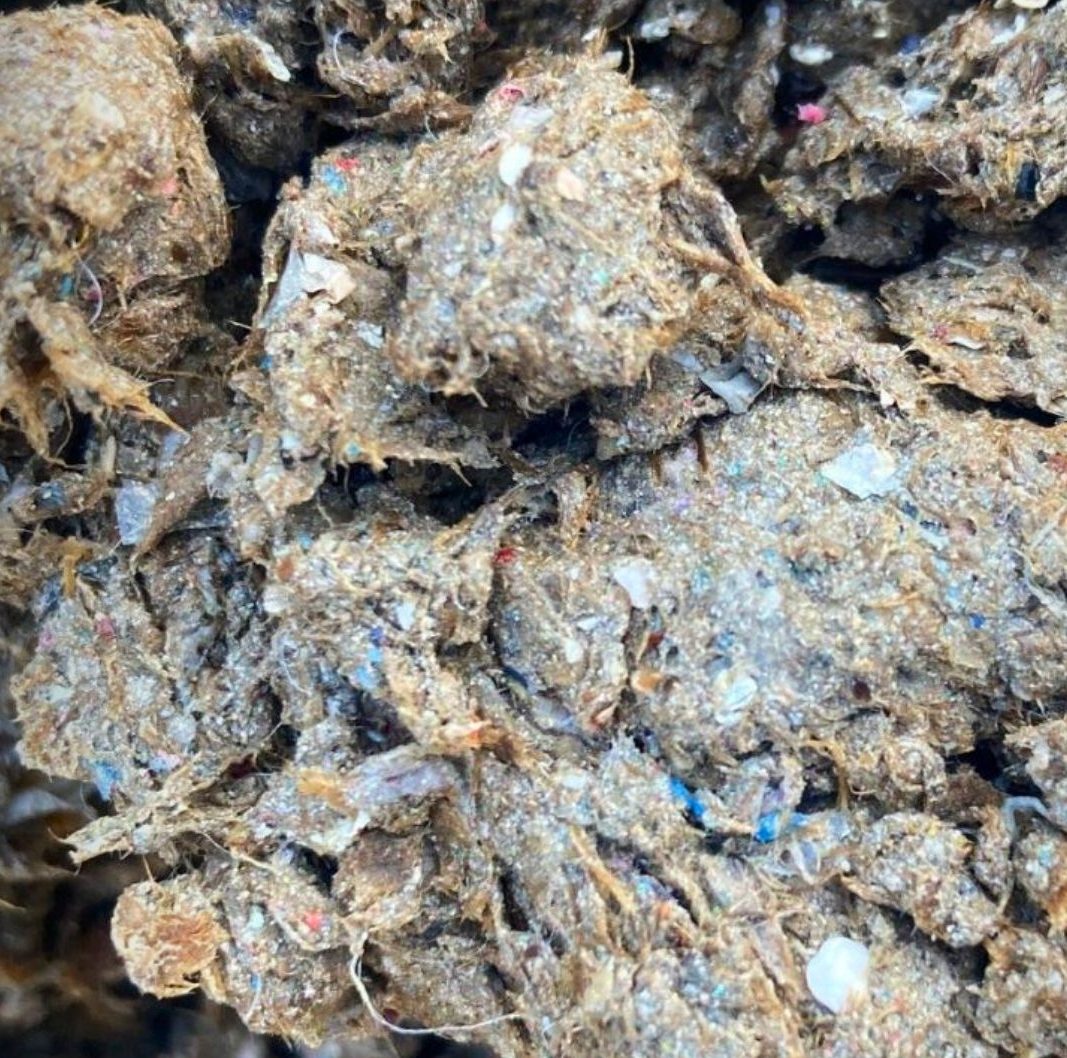
Limited scope on sewage sludge: While we welcome the Government’s commitment to consult on reforms on how sewage sludge use in agriculture is regulated and whether sludge should be included in the Environmental Permitting Regulations, meaningful action is needed that goes beyond end-of-pipe solutions. The Government should investigate whether legislation is needed to stop water companies from selling contaminated sludge to farmers, and as recommended by the Independent Water Commission, the Government must consider Extended Producer Responsibility for all of the contaminant producers across the supply chain.

Nothing new on agricultural water pollution: Agricultural water pollution is on a similar scale to water company pollution and the White Paper recognises this, estimating around 40% of river and groundwater pollution is due to agricultural practices. Yet agriculture has not had equivalent dedicated resources to identify and implement solutions to reduce environmental harm as the water sector. Consolidating agricultural water regulations is welcome, but we also need to see more funding for regulators, greater support for farmers to implement much-needed infrastructure, and a planning system that is empowered to decide when catchments have enough industrial farms. It is critical that environmental permitting is extended to industrial cattle and moves to do this must be swift.

The Ugly

Essential requirements instead of incentives: Today’s announcements start to embed public health and environmental protection in the water system with targets and objectives. Reform of the incentive framework to reward companies for delivering outcomes like public health, the environment and long-term resilience means these outcomes will continue to be seen as optional when they should be essential requirements of operating. 

Continued prioritisation of private interests: Regulation alone cannot fix a deeply privatised system that is designed to put profit first. The White Paper recognises some owners have prioritised “short-term profits over long-term resilience and the environment”. That is exactly why the ownership model must change. However, the White Paper still treats the profit-driven model as the default and focuses on constraining its worst excesses. The approach to ownership change is optional and company-led, which means it is very unlikely to happen. Most critically, the White Paper makes no commitment to a thorough, evidence-led review of alternative ownership models. We want to see a clear move toward public benefit models for water companies, not a slightly better managed private monopoly. A public benefit model would mean that water companies have legal duties to put public health and the environment first, profits and shareholder dividends are secondary, and short-term extraction is ruled out.

And what if water companies continue to fail financial and legal obligations?

New legal powers may be valuable, but the Government and regulator must use the extensive and powerful ones they already have. Performance Improvement Regimes are a step in the right direction, but the Special Administrative Regime has existed under the Water Industry Act 1991 for decades and must now be used by the Government and regulator. When a water company fails to meet its financial or legal obligations, as is unfortunately the case with more than one water company and with Thames Water being the clearest case for such an intervention. The commitment in the White Paper for water companies to establish plans for special administration is welcome, but transparency on when the regime will be triggered by the regulator and the Environment Secretary remains lacking.

Reforming the water environment requires bold and urgent action. We need to see the Government follow through on its reforms with greater ambition.

Privacy Overview

This website uses cookies so that we can provide you with the best user experience possible. Cookie information is stored in your browser and performs functions such as recognising you when you return to our website and helping our team to understand which sections of the website you find most interesting and useful.