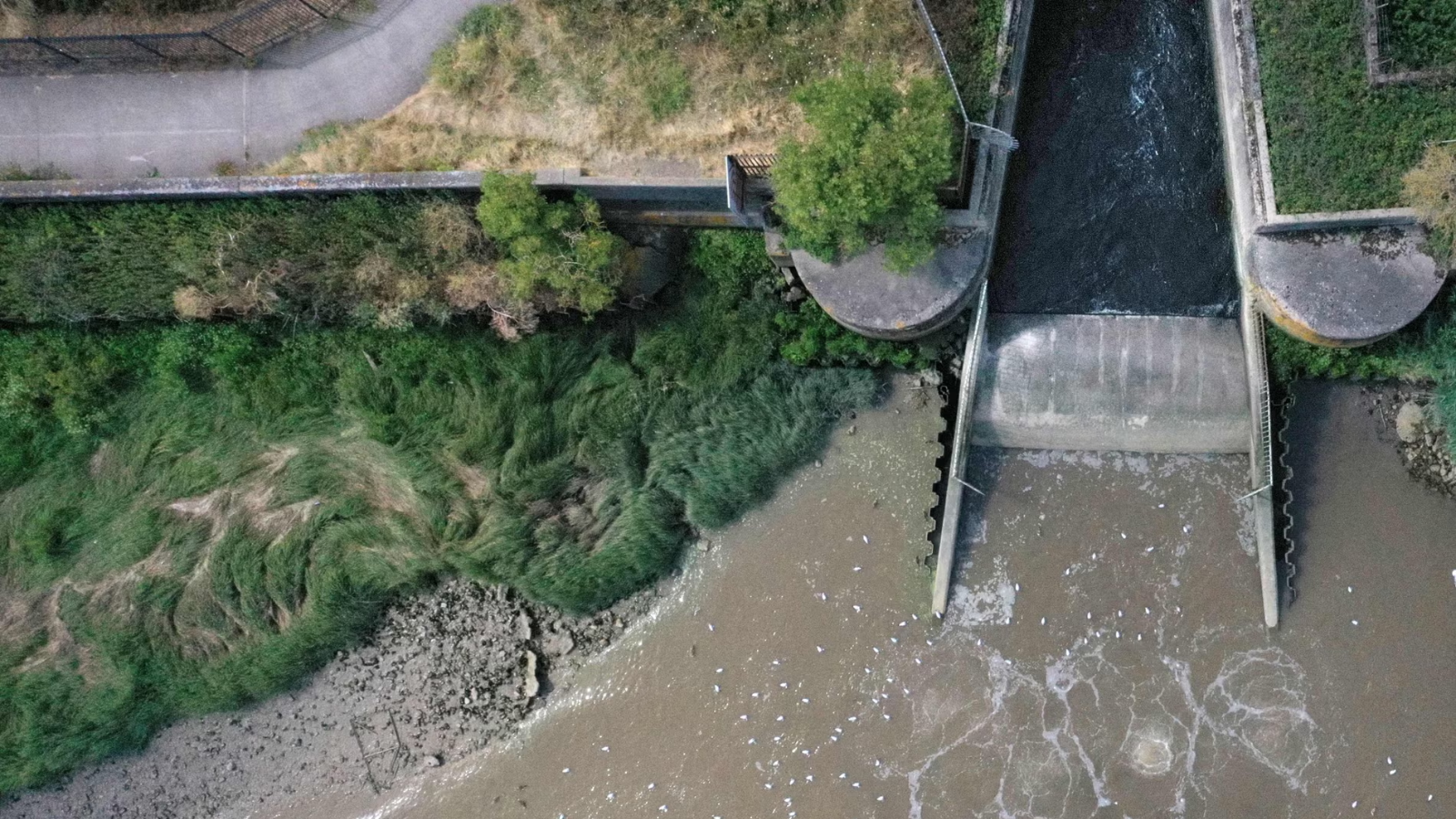
–Following yesterday’s Channel 4 News investigation, which reported that nearly 6,000 Category 1 and 2 pollution incidents involving water companies were downgraded without direct inspection between 2015 and 2025, while prosecution rates for more than 11,400 pollution incidents over the past decade were reportedly around 0.5%, CEO of River Action James Wallace said:
“We are deeply concerned that thousands of the most serious pollution incidents in England have been downgraded without direct inspection over the past decade.
“These findings raise profound questions about the state of environmental enforcement in England and whether regulators are being properly resourced and empowered to uphold the law.
“This is not about the commitment of frontline Environment Agency staff, many of whom are working under immense pressure after years of cuts and underfunding. It is about political failure to provide regulators with the resources, independence and legal backing needed to properly investigate and prosecute environmental offences.
“The consequences are severe. Pollution incidents go unchecked, environmental damage escalates, public confidence collapses, and polluters avoid meaningful accountability while rivers, lakes and coastal waters continue to deteriorate.
“We need an Environment Agency that is properly funded, fully independent and capable of urgently responding to serious pollution incidents. We also need faster prosecutions and penalties severe enough to deter polluters from treating environmental harm as simply another cost of doing business.
“But even with regulatory reform, nothing will change until the privatised water industry has been restructured for public benefit. Anything less risks continuing the normalisation of environmental harm on an industrial scale.”
Notes on River Action’s funding model River Action does not accept funding from the Government or polluters. That independence allows us to hold power to account without fear or favour.
I took a water company to court over sewage pollution. Here’s why I’m still campaigning.
My name is Jo Bateman, and I am taking legal action against South West Water because I am sick of sewage pollution ruining the sea where I swim.
A few years ago, I was living in the Midlands, about as far from the coast as you can get. I loved walking, so I decided to spend a week on the South West Coast Path, from Poole to Lyme Regis. That week changed everything. I fell in love with the sea. Not long after, I handed in my notice, sold my house, and moved to Exmouth to live by the coast.
Then one winter’s day, I was persuaded to get into the sea, reluctantly at first. From that moment, I was hooked. I have been sea swimming year-round ever since. When I am in the water, everything going on in my head gets left behind on the shore. All that exists is me, the sea, and the cold. When I get out, I feel completely transformed. The mental health benefits are huge. It reduces stress, lifts my mood, and gives me a sense of calm I cannot find anywhere else.
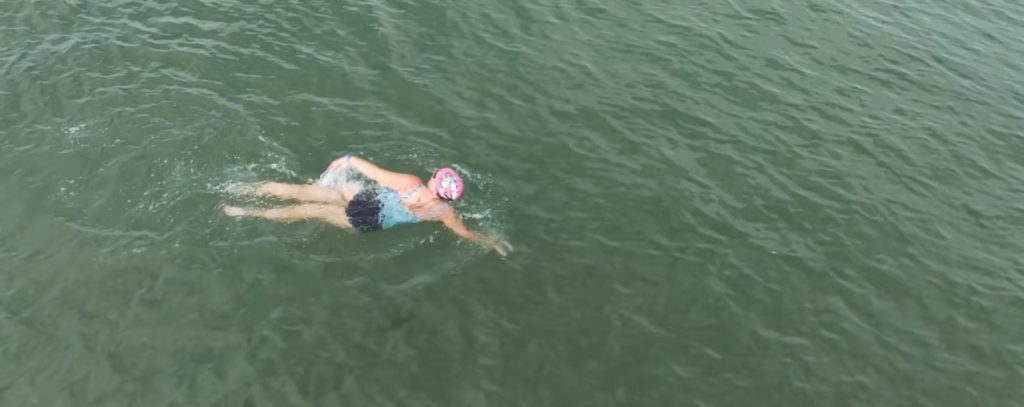
Jo, in the water
From sea swimming to sewage pollution awareness
At the beginning, I knew nothing about sewage pollution, and ignorance really was bliss. I could enjoy the sea without thinking about what might be in it. But over time, that changed. I started seeing alerts warning of sewage discharges into the water. There were days when the sea was unsafe, days when I could not swim, and days when something that had become essential to my wellbeing was taken away from me.
The more I learned about sewage dumping by water companies, the more shocked and angry I became. It was not just occasional incidents. It was frequent, systemic, and deeply damaging. What had started as a personal passion quickly became a source of frustration and concern. Eventually, I reached a point where I felt I could not just stand by and accept it.
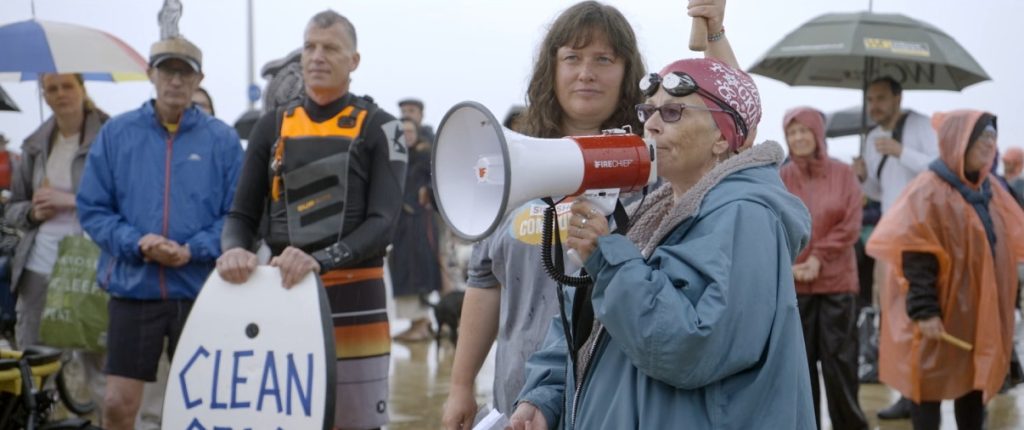
Jo at the March for Clean Water, 2024
Why I took legal action against a water company
In 2024, I decided to take South West Water to court. I filed a claim in the small claims court, seeking compensation for loss of amenity because repeated sewage pollution was preventing me from swimming. The cost to file the claim was £50, and I asked for £379.50 in compensation.
But this was never really about the money. It was about the principle. Why should water companies be allowed to pollute our rivers and seas and face so few consequences?
Water companies often argue that sewage discharges are unavoidable, particularly during heavy rainfall. They say the system cannot cope and that dumping sewage is necessary to prevent worse outcomes. I do not accept that explanation. Rain is not new. The UK has always experienced heavy rainfall. The real issue is decades of underinvestment in infrastructure, combined with a system that has prioritised shareholder payouts over environmental protection.
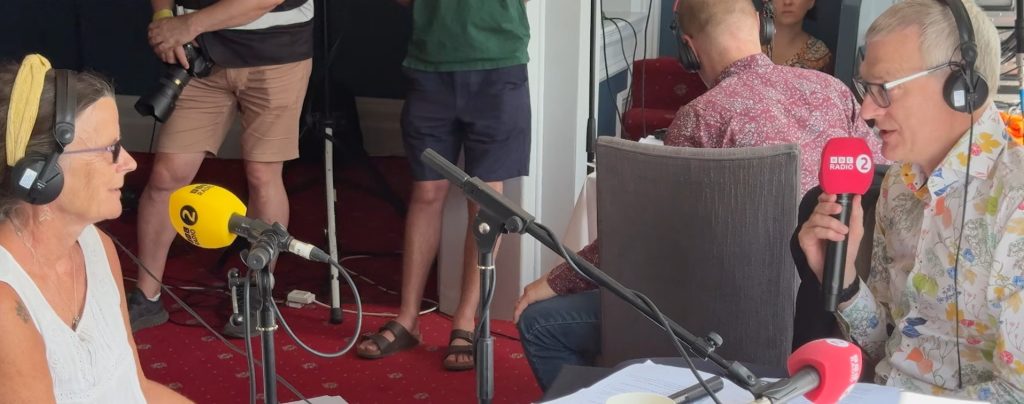
Jo talking to Jeremy Vine on BBC Radio 2
From one legal claim to a growing movement
What happened next was something I never expected. My case resonated with people far beyond Exmouth. What started as a small claim quickly grew into something much larger.
The case is now supported by the law firm Leigh Day and has progressed to the High Court. Alongside this, a group legal action has been launched on behalf of the people of Exmouth, with more than 1,300 claimants taking action against South West Water.
Personally, my life has changed beyond recognition. I have become part of a wider community of people who care deeply about clean water and are willing to speak out and take action. I have gone from being a relatively quiet person to speaking in Parliament, appearing in national media, and addressing large crowds at protests and events. There is even a documentary telling my story (find out more).
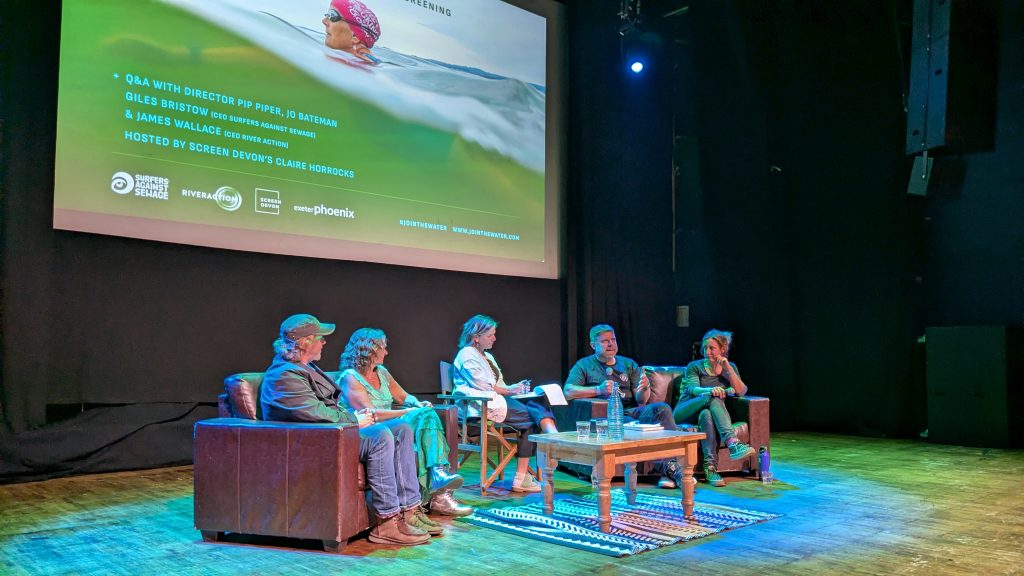
‘Jo in the Water’ documentary premiere
Why I am still taking on water companies
Taking on a water company can feel like a David and Goliath battle. These are large, powerful organisations with significant resources. I am just one individual. But I believe this fight is necessary.
Clean water should not be a privilege. It should be a basic right. We should be able to swim in the sea without worrying about sewage pollution. We should be able to trust that water companies are protecting the environment, not harming it.
We live in a world where extraordinary technological achievements are possible. It should not be beyond us to build and maintain a sewage system that does not pollute our rivers and seas. Real change requires accountability. It requires proper enforcement of environmental laws, and it requires water companies to stop putting profit before pollution.
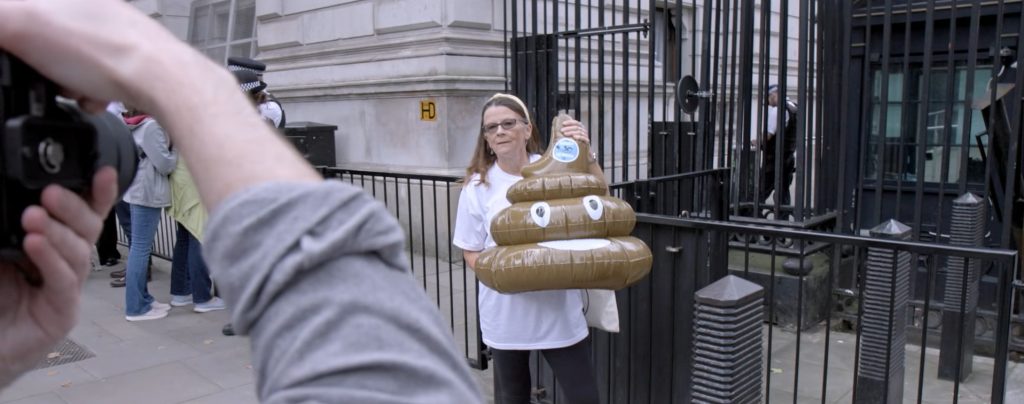
Jo campaigning outside 10 Downing Street
A message to others fighting sewage pollution
If there is one thing I have learned through this experience, it is that individual action matters. You do not have to accept the status quo, and you do not have to stay silent.
There are thousands of people who feel the same way, and together we are far more powerful than we are alone. Collective action can drive change, even in the face of powerful institutions.
This is about all of us. It is about the future of our rivers, our seas, and our environment. And it is a fight we cannot afford to lose.
Because nature needs us.
If you would like to find out more about Jo’s incredible story, you can book a ticket to a screening of her documentary here.
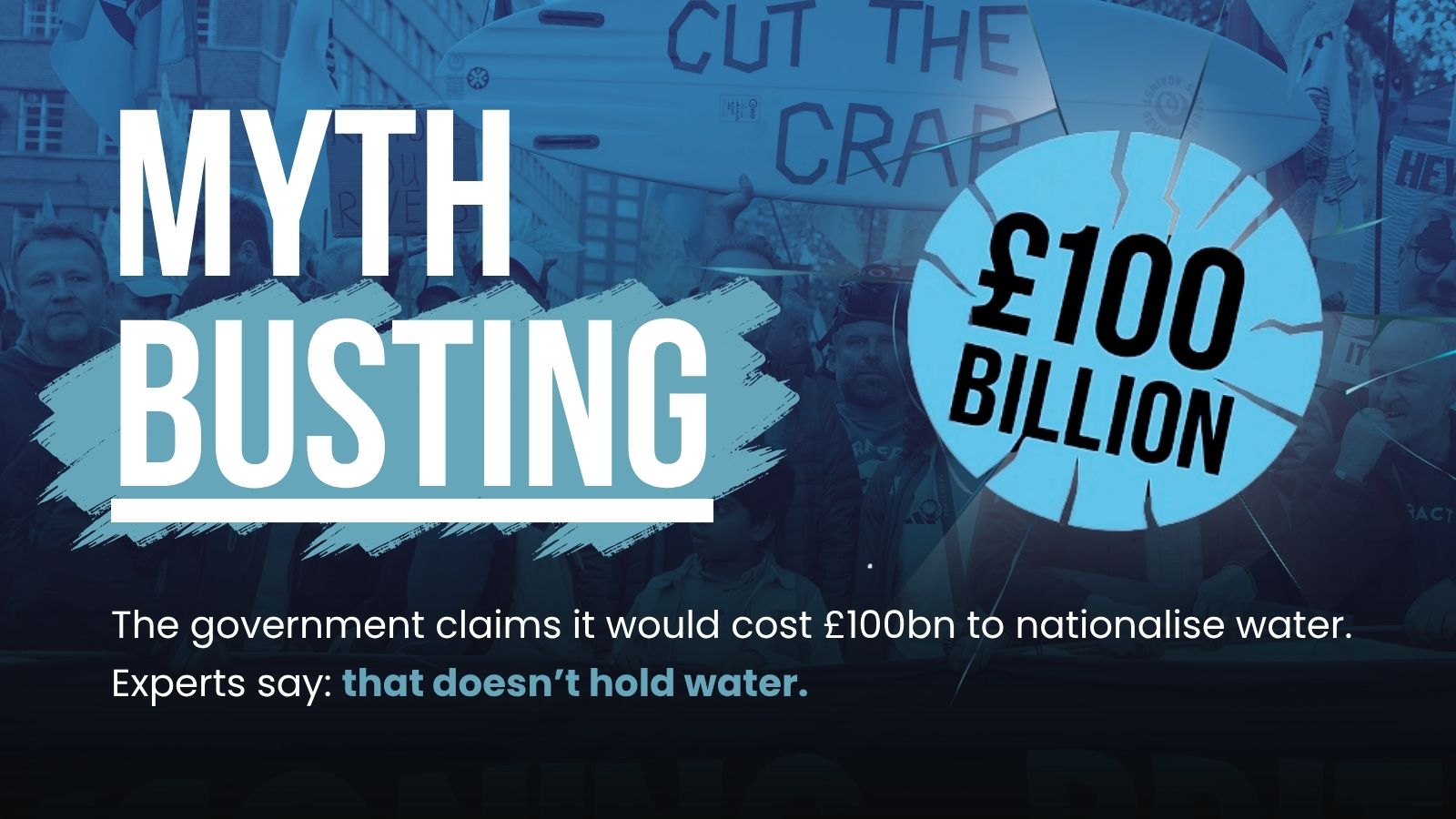
Whenever the conversation turns to the cost of nationalising the water industry or even just exploring public benefit and ownership models instead of continuing with deep privatisation, the government references the scarily high figure of £90-100 billion to dampen public support.
On 16 September, Defra released a short policy paper outlining the rationale behind its estimation that nationalising the water industry would cost approximately £100 billion. A similar number was reached in a 2018 Social Market Foundation report paid for by four water companies (Anglian Water, Severn Trent, South West Water and United Utilities). The Social Market Foundation’s estimation takes the RCV from 2018 which was estimated at £64 billion and then added premiums for acquisition, so presumably their estimation would be even higher now.
Defra based this on three assumptions that:
the value of Water Companies should be tied to their Regulatory Capital Value (RCV);
the government would absorb equity and debt; and
no discounts or premiums should apply.
Inflated Economics?
Let’s be clear: this isn’t rigorous economic analysis. It is a simplistic and unrealistic theory being relied on by the government to justify not taking decisive action in public and environmental interests by putting failing companies like Thames Water into a special administration regime. What it protects are investors and an unsustainable cycle of debt servicing.
Professor Ewan McGaughey, professor of Law at King College London and co-author of the People’s Commission argues that public ownership is an inexpensive solution, contending that the true cost is closer to zero as a more accurate market valuation would account for performance and financial failures.
As Economics Professor Sir Dieter Helm puts it, Defra’s estimate is “misleading, simplistic and wrong”. In his analysis published on 22 September, Helm sets out why each of Defra’s assumptions is wrong and goes on to explain why special administration for a failing water company such as Thames Water would make sure the business continues on a sustainable basis, giving it “breathing space” before, the special administrator would “almost certainly achieve a price which is at a significant discount to the RCV” with debt holders taking a “haircut”.
When valuing a utility company such as Thames Water, RCV is only one factor a buyer would weigh. Helm argues that a company’s failure to maintain assets and its debt levels are central to any realistic valuation. The People’s Commission notes that RCV ignores another glaring reality: water companies have extracted £83 billion in dividends to shareholders. Karol Yearwood at the University of Greenwich has described the privatised water industry as a “cash machine for investors”. Today, the biggest beneficiaries are historic shareholders and debt holders keen to cash in on the roughly £17 billion debt Thames Water has been allowed to rack up.
Since privatisation 32 years ago, Thames Water has handed £7.2 billion pounds to shareholders, while neglecting essential upgrades leaving the public with failing pipes, sewage discharges, and degraded waterways.
Defra also glosses over Thames Water’s massive debt pile and fines including a record-breaking £123 million penalty this year for serious pollution that continues to devastate our rivers. Polluters should foot the bill, not taxpayers. Under a special administration regime, customer payments would flow to court-appointed administrators to fund the operation of essential water services, instead of being paid out to as returns to shareholders who would go to the back of the queue, making the process far less of a financial burden than Defra claims. In fact, as Helm points out, it would exceed the cost of running the business.
The cost of and case for special administration
The Government says that special administration of Thames Water would cost the government £4 billion. This is also overblown: on Helm’s analysis, the Government should recover its costs from the sale of Thames Water which, when offered for sale, would receive bids way in excess of £4 billion. The net cost to the Treasury should be zero.
Helm also explains why special administration is not nationalisation, as it is often misleadingly labelled or conflated as a tactic to avoid having to use it. Special administration is a regime designed specifically to deal with water company failure and it offers the most effective way out of the mess Thames Water is in. It should not be feared but favoured.
Dieter Helm cuts through the noise: “What is needed now is for Defra to put Thames into special administration, instead of putting out simplistic and ill-thought-through “assumptions” to support an implausible, very big round number.”
We are also pursuing a Judicial Review against DEFRA for failing to set out clear thresholds for when a company should be put into SAR. In our view, this failure breaches core public law duties and leaves rivers and communities at the mercy of failing operators. With 16 million customers, some ministers may believe Thames is too big to fail. River Action says it’s too big to be allowed to keep failing. It’s time to put customers and the environment before private profits – by putting Thames Water out of its misery and into a special administration regime.
References
Becky Malby, Kate Bayliss, Frances Cleaver, Ewan McGaughey, “A fair price to the public for water nationalisation.” The Guardian. 3 August 2025. Accessed here.
Defra, “Nationalising the water sector: how we assessed the cost.” Policy Paper, 16 September 2025, accessed here.
The Social Market Foundation, “The cost of nationalising the water industry in England.” February 2018. Accessed here.
Dieter Helm, “The next episode in the Thames Water saga: Defra’s misleading £100 billion cost of nationalisation and flawed board vetting proposals”. 22 September 2025, accessed here.
Ewan McGaughey, “How to Clean Up Our Water: Why Public Ownership in Law Costs Zero”. Common Wealth, 5 June 2025, accessed here.
Kate Bayliss, Frances Cleaver, Becky Malby, “Defra and the £100bn”. The People’s Commission, 18 September 2025, accessed here.
Karol Yearwood, “The Privatised Water Industry in the UK. An ATM for investors.” University of Greenwich, September 2018, accessed here.
Tainted Water, “Where Your Money Goes”, Goldsmiths, University of London, 2024, accessed here.
Sandra Laville, Anna Leach, & Carmen Aguilar García, “In charts: how privatisation drained Thames Water’s coffers”, The Guardian, 30 June 2023, accessed here.
Sandra Laville, “Thames Water fails to complete 108 upgrades to ageing sewage works”, The Guardian, 10 July 2024, accessed here.
Environment, Food and Rural Affairs Committee, “Reforming the Water Sector”, House of Commons, 9 September 2025, accessed here.
Eleanor Shearer & Ewan McGaughey, “Deep Trouble: Fixing Our Broken Water System”, Common Wealth, 11 July 2024, accessed here.
Sarah Olney MP, “Thames Water: Contingency Plans”, House of Commons, 15 March 2024, accessed here.
Alex Lawson, “The fate of Thames Water hangs in the balance. So what are its options?”. The Guardian, 22 March, 2024, accessed here.
River Action, “River Action launches legal challenge against the Government over Thames Water failures”, 30 July 2025, accessed here.
At the end of July, the Independent Water Commission released it’s final reporton the state of our water industry with recommendations on how the industry could be fixed. River Action, alongside Surfers Against Sewage, has analysed the recommendations against our five core principles for real reform.
Our conclusion? While the Commission makes some useful noises about reform, it ultimately ducks the bold changes needed to end sewage pollution and protect people and nature.
Here’s how the Commission performed when measured against our principles – and why government must now go much further with its upcoming White Paper.
1. Operating for Public Benefit
The Commission’s approach accepts the profit-driven privatised model of water companies as a given. Instead of rethinking this broken system, it focuses primarily on tighter regulation.
This is not enough. Decades of evidence show that shareholder-first models drain money out of the system while rivers fill with sewage. The Commission ignored credible international evidence that public benefit ownership models – like those in much of Europe – deliver lower bills, more investment, and cleaner rivers.
Without a fundamental redesign of ownership, governance, and financing, alongside regulatory reform the crisis will continue.
2. Democratic Decision-Making
The Commission’s proposal for Regional Water Authorities is a step forward, hinting at more democratic oversight. But as drafted, these bodies risk being toothless talking shops.
Real reform requires municipal-level oversight, with local authorities, communities, and environmental groups holding real power over how water companies invest, operate, and deliver. Without this, decisions will remain in the hands of profit-driven boards.
3. Protecting Public and Environmental Health
The Commission acknowledges sewage pollution is a major public health crisis – but stops short of the urgent action needed.
Taskforces and reviews won’t protect the thousands of people falling ill after using polluted rivers and seas. We need immediate legal duties for all water companies, regulators, and government to protect public and environmental health, backed by stronger permits and updated Bathing Water Regulations that safeguard everyone, year-round, from emerging pollutants like ‘forever chemicals’ and microplastics.
4. Tough, Independent Regulators
The Commission rightly diagnoses regulatory failure. But renaming regulators without changing their powers, duties, and resources will not fix the problem.
We need a strong, independent regulator with a clear duty to protect public and environmental health – not water company profits. And where companies fail, government must use the Special Administration Regime to reset them around public benefit principles, starting with Thames Water.
5. Transparency
The Commission calls for more monitoring – which we welcome – but still clings to the discredited model of operator self-monitoring, where water companies mark their own homework.
That system has failed. Independent monitoring, citizen science, and full real-time transparency are the only way forward. People deserve to know what’s happening in their rivers and seas.
The Bottom Line
The Water Commission’s report was a once-in-a-generation opportunity to reset a failing system. Instead, it tinkers at the edges, leaving the profit-driven model intact and communities exposed to sewage, debt, and declining water quality.
Government must now go further. The upcoming White Paper must:
Restructure water companies to deliver public benefit, not private profit.
Embed democratic oversight at local and regional levels.
Put public and environmental health at the heart of water law and regulation.
Create a tough, well-funded regulator with the power to act.
End operator self-monitoring and deliver full transparency.
Anything less will leave us trapped in the cycle of pollution, public anger, and political failure.
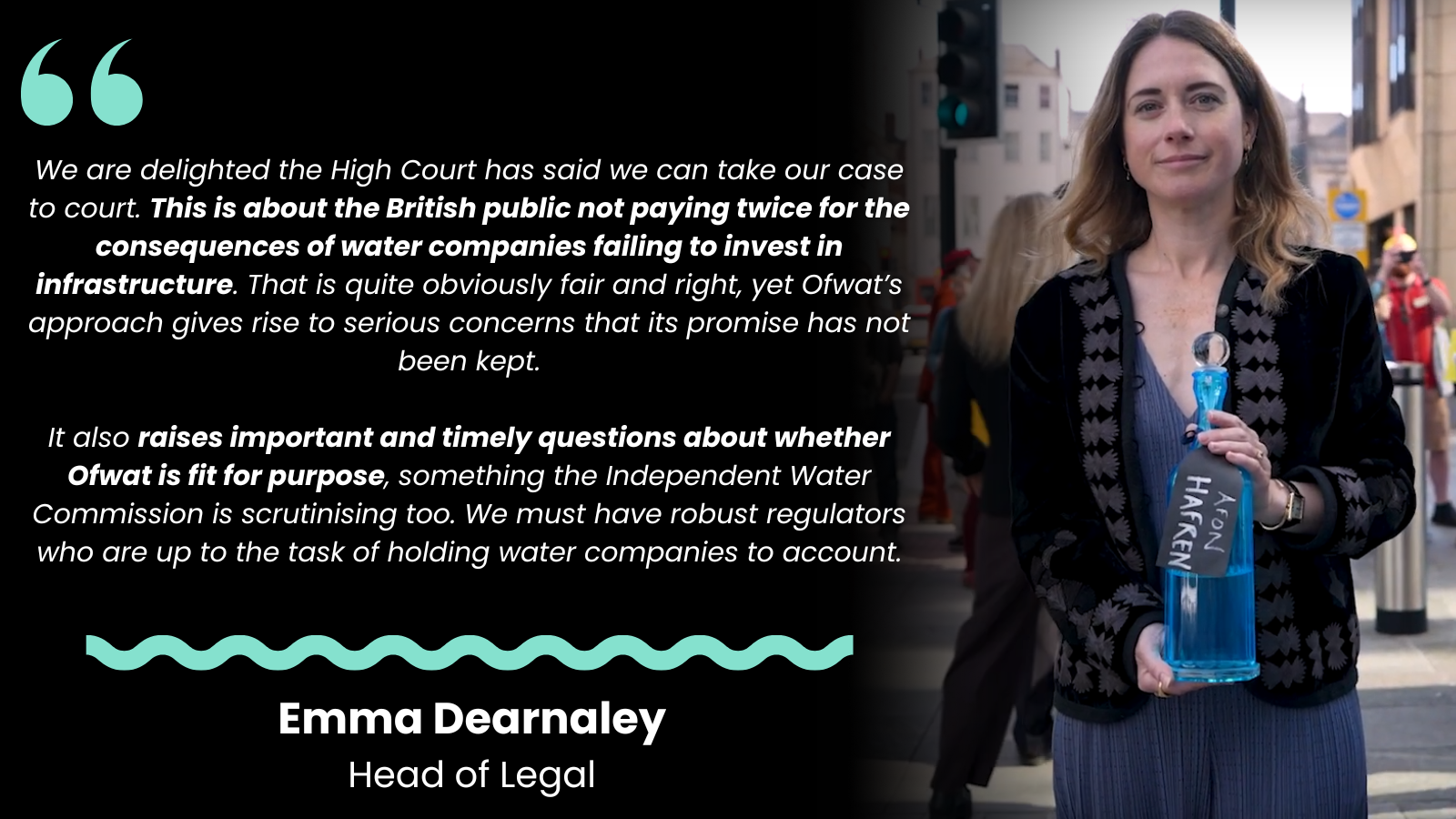
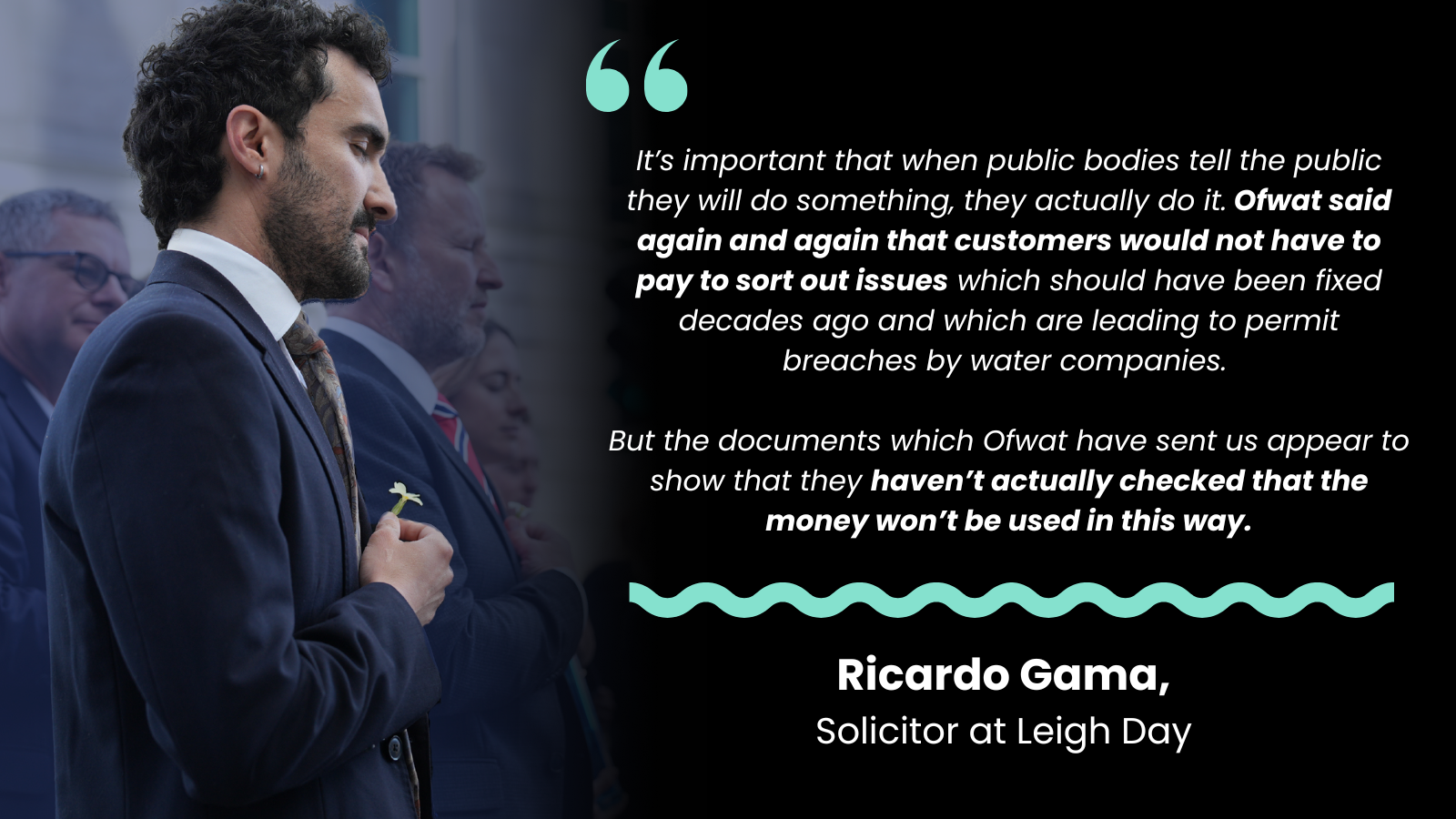
Ofwat has forced customers to pay twice for water industry failures – and we are calling for urgent regulatory reform
Weare taking water regulator Ofwat to a full court hearing, to challenge the approach Ofwat took when it set the price that water companies like United Utilities can charge their customers.
Ofwat’s approach was unlawful and, as a result of regulatory failings, the financial burden of water industry infrastructure neglect has been pushed onto customers – rather than those responsible.
The case is proceeding amid intensified calls for an overhaul of Ofwat, with growing scrutiny from the Independent Water Commission, led by Sir Jon Cunliffe, into whether the regulator is fit for purpose. We are calling for a reform of the regulator and, in particular, for Ofwat to stop water companies passing the costs of failures on to the public.
Water bill hikes – with no guarantees for the future
At the heart of the case is Ofwat’s 2024 Price Review (PR24), which approved above-inflation water bill increases, including an average annual rise of £123 per household, without guaranteeing the money will be spent on new infrastructure rather than plugging the gaps left by decades of underinvestment.
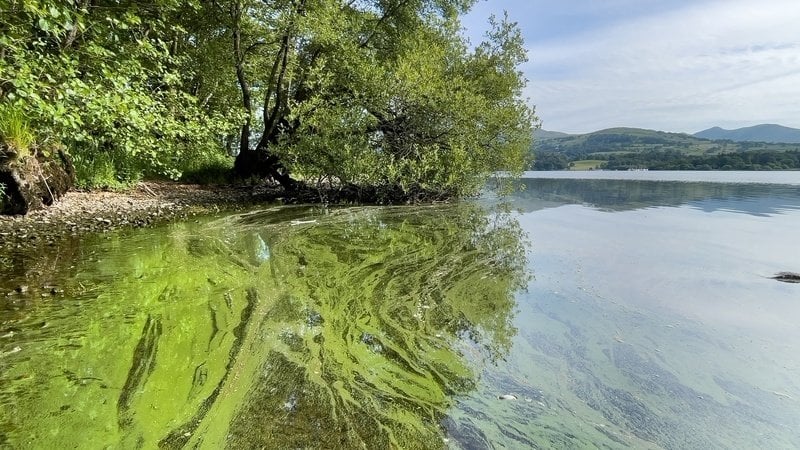
The legal challenge follows investigations by campaigners Matt Staniek and Windrush Against Sewage Pollution (WASP), which exposed chronic sewage pollution in the Lake Windermere area and regulatory failings around PR24.
While the claim focuses on the PR24 determination for United Utilities in relation to water works in and around Lake Windermere, River Action thinks it exposes fundamental failures in Ofwat’s approach – with national implications.
The regulator’s decision allows water companies, such as United Utilities, to charge customers twice: first for water bills that should have covered infrastructure maintenance and then again through new hikes aimed at fixing the same problems.
In August 2024, United Utilities was granted “enhanced funding” to upgrade sewage treatment works around Windermere. This approval came despite evidence submitted to Ofwat showing over 6,000 hours of raw sewage discharges in the lake in a single year. Ofwat ignored this data in favour of hydraulic simulation modelling, which fails to reflect on-the-ground conditions.
Legal grounds: flawed modelling, weak enforcement
Permission has been granted for all of our three grounds. Represented by law firm Leigh Day, we will argue that:
Ground 1: Ofwat approach to its own “not paying twice” policy was unlawful because it relied on theoretical hydraulic simulation modelling instead of the reality on the ground as seen in evidence provided to Ofwat.
Ground 2: Ofwat lacks a meaningful clawback mechanism if water companies misuse funds.
Ground 3: Ofwat failed to conduct legally adequate investigations into whether its approach is adequate.
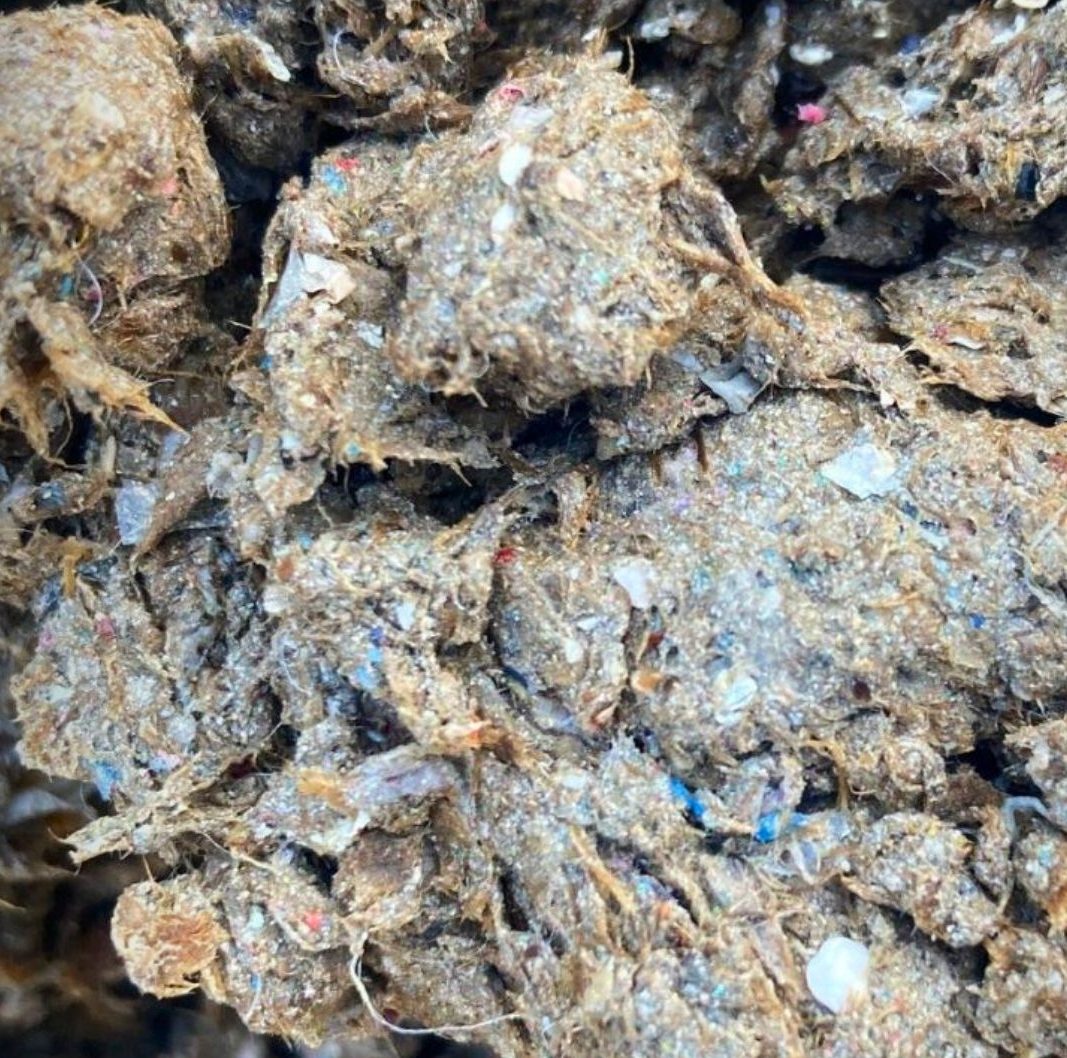
Across the UK, millions of tonnes of toxic sewage sludge is being dumped on our farmland every year. Marketed as “fertiliser,” this hazardous waste produced by water companies can contain a cocktail of microplastics, heavy metals, and dangerous “forever chemicals” that persist in the environment and accumulate over time. Shockingly, around 90% of this sewage sludge is ending up on the land that grows our food, leaching pollution into our soils and rivers.
This isn’t just a failure of transparency, it’s a ticking environmental time bomb that could even lead to soils becoming unable to support crop growth.
Thanks to our legal challenge against the Environment Agency, the Government is finally under pressure to confront this scandal head-on. And behind the scenes, water companies are panicking. A recent investigation by Unearthed has exposed their growing fears: if new regulations come into force to stop this reckless sludge spreading, they’ll be left with millions of tonnes of waste without a home.
And their plan? To make you, the public, pay for the clean-up. Again.
A broken system
Sewage sludge is the solid material left behind after wastewater is treated. It’s a necessary part of managing sewage. However, this sludge is not harmless compost. It’s laced with toxic pollutants, including PFAS (forever chemicals linked to cancer and infertility), microplastics, and heavy metals that poison the land and waterways. Yet water companies have been quietly offloading this waste onto UK farmland for decades, with little accountability and woefully inadequate oversight.
What’s worse, the water industry has not been upfront about what this sludge contains. Farmers have unknowingly spread this material across their fields, and regulators have turned a blind eye. Shockingly, the Environment Agency has axed its pledge to test sewage sludge for microplastics and ‘forever chemicals’ – an issue exposed recently by Fighting Dirty in its legal challenge.
But now the pressure is mounting for the Government to step up.
River Action’s legal push for change
Last year, we launched a legal challenge against the Environment Agency and the Government for failing to enforce the rules on sewage sludge spreading. Our case argued that the authorities were breaching their legal duties to protect human health and the environment by allowing excessive muck spreading that exceeds the immediate soil and crop nutrient needs, leading to nutrient runoff into waterways.
The result? The Government is now reviewing its enforcement guidance, a crucial step toward stopping the spread of toxic waste on our land and rivers. This could force water companies to find safer, cleaner ways to manage their sludge. But there’s a catch: if that happens, they’re already warning they’ll ask Ofwat for an emergency rise in water bills to cover the cost.
Let’s be clear: the public should not foot the bill for the water industry’s environmental negligence. We’ve already paid the price through polluted rivers, poisoned soil, and mounting ecological damage. The companies responsible must be made to clean up their own mess.
This is a defining moment. For too long, the water industry has prioritised profit over public health and environmental protection. That must end.
Together with Greenpeace, we are calling on the new Secretary of State for Environment, Steve Reed, to take urgent action:
Stop the spreading of toxic sewage sludge on farmland
Make water companies pay the full cost of disposing of this waste safely
Introduce proper regulation and legal limits on the content of sludge used in agriculture
Sign the petition today and demand the Government puts an end to this toxic scandal. Let’s hold water companies accountable and ensure our land, rivers, and future are protected from pollution.
By Henry Shepherd, Community Campaigns Coordinator, River Action
Twisting and turning more than the Thames itself
As the boat race weekend approaches, Thames Water has gone on the offensive – not to clean up the Thames, but to spin the facts and put the public at risk.
Yesterday, we revealed that our 40+ water tests along the Boat Race course over the past month show the Thames would be classified as ‘poor water quality’ according to the Environment Agency regulations, with 29.5% of our samples exceeding safe limits for entering the water. This is despite it being the driest March in over 100 years….if they can’t keep the river clean in these conditions, how can they be trusted?
In a response statement, Thames Water attempted to cite ‘excellent’ water quality results, referencing data from a boat club in Hammersmith.
But here’s what they didn’t tell you.
That testing wasn’t done with Thames Water. The testing was carried out by our friends at Fulham Reach Boat Club and was actually funded by River Action. Thames Water conveniently cherry-picked a subset of this data, and, unbeknownst to them, we funded it!
Additionally, the data they selected came from a single weekly test at only one point along the course (4 tests in total). In contrast, our data, revealed yesterday, consisted of over 40 tests across the entire length of the Boat Race course from 10th March.
In short: Thames Water carefully curated the one stat that suited their PR and presented distorted information, putting public health at risk.
Thames Water simply cannot be trusted to tell the truth about basic water quality risks, and have once again willingly put river users’ health at risk, prioritising misleading headlines rather than fixing pipes.
The 2025 boat race course with River Action test sites
The Kew cover-up
It gets worse.
On Tuesday, we were alerted to the possibility of a burst sewage pipe near Kew Bridge, with sewage reportedly spilling directly into the river just upstream of the Boat Race finish line.
We immediately called Thames Water’s pollution hotline to enquire about the issue, but were assured there were no problems to report. However, after investigating the site ourselves, we found Thames Water vans and huge sewage tankers stationed on the riverbank at Kew Bridge. After speaking with the crew, they confirmed the incident. At that time, it appeared that sewage was simply entering the river, just a mile upstream of the Boat Race finish line.
Thames Water’s initial denial of the problem highlights their true priorities: managing headlines, not public health. How much sewage has been allowed to flow into the river without the public being informed?
This issue is compounded by a separate sewage pipe even closer to the Boat Race finish line, downstream at Kew Transfer. The monitoring system for that pipe had been offline since January 19th, mysteriously coming back online the day we published our testing results (how convenient?) This means that no one knows how much sewage has been flowing into the river unchecked from that sewage overflow.
When people, including hundreds of junior rowers, and professional boat race crews, rely on this critical information to stay safe, it’s not just unacceptable – it’s dangerous.
Thames Water vans and sewage tankers near Kew Bridge on Tuesday
A failure of infrastructure, regulation, and honesty
With almost no rain recently, this pollution isn’t just a result of outdated infrastructure and unmonitored storm overflows. It reveals a much deeper issue: that even after treatment, final discharged waste water from sewage works is still far from safe. Treated effluent has no legal limit on E. Coli levels, so it frequently contains high levels of dangerous contaminants, including fecal matter and bacteria. The treatment process used by Thames Water, though permitted, falls far short of the standards needed to protect public health and the environment.
The real issue lies in the regulatory framework – unless a waterway has “bathing water status,” is home to a fish farm, or serves as a place of abstraction, there are no legal obligations to ensure that treated sewage is free from harmful substances. That’s why we’re campaigning for sewage treatment plants to be upgraded, better water quality monitoring, and enforceable limits on water quality – something that bathing water status would require.
But even with this, the Tideway Tunnel – which Thames Water touts as the solution – won’t protect us. The Tunnel is designed to manage storm overflows, not the continuous discharge of untreated or poorly treated sewage. It’s a temporary fix for a much deeper, systemic problem, and only reduces downstream pollution, which for half of the Boat Race course is irrelevant. The other half of the course – upstream of Hammersmith – is exposed to all the sewage pollution flowing along the Thames accumulated from the upstream catchment.
It is no surprise that all our tests taken upstream of the Tideway Tunnel show high levels of E.coli. This is the end of the Boat Race course and why we implore the Oxford and Cambridge teams not to throw their cox in the water. It is not safe.
Time for accountability
This isn’t just about rowing. This is about whether people can trust water companies to keep them safe. Thames Water has failed across the board:
They haven’t invested in modern monitoring systems.
They’ve lobbied for billions in bailouts while paying bonuses to executives.
They’ve allowed infrastructure to rot – and lied about it when questioned.
We believe Thames Water has forfeited its social licence to operate. It’s time to put the company into Special Administration, restructure it in the public interest, and end the cycle of pollution-for-profit.
River Action will continue exposing Thames Water’s spin – not just this week, but every time they attempt to dodge accountability. This is your river, not theirs.
The Environment Agency (EA) has released its latest Event Duration Monitoring (EDM) data, revealing that sewage spills in 2024 remain alarmingly high. Despite some claims of progress, the figures show that little has changed – with sewage pollution still devastating Britain’s rivers, lakes, and coastlines.
Sewage Crisis by the Numbers
The latest data highlights:
Total spill duration hit record high – Sewage spilled into waterways for 3.6 million hours
Slight drop in average spills per overflow – While the number of spills per overflow have fallen slightly, there have been a shocking 450,000 spills which is 50% higher than 2022
Highest number of monitored overflows – With more EDM devices commissioned, the scale of the problem is becoming clearer.
Same Scandal, Another Year
River Action’s CEO, James Wallace condemned the figures, calling them further proof of a broken and corrupt water industry:
“We sound like a broken record—but that’s because nothing has changed. The water industry is still broken. A year on from last year’s catastrophic pollution figures, the true scale of the UK’s water crisis is only now coming to light, thanks to increased real-time monitoring. The numbers are staggering: 3.6 million hours of sewage spills from 450 thousand discharges. That’s equivalent to 412 continuous years of sewage polluting our rivers, lakes and seas”
He specifically called out Thames Water, the country’s largest water company, which discharged raw sewage for a shocking 298,081 hours with a 51% increase in sewage spills hours since 2023.
“Yet, despite this environmental catastrophe, they’ve been given the green light to saddle a company on the brink of collapse with an additional £3 billion in debt.”
Unmonitored Failings and Toxic Effluent
The CEO also warned that the true scale of the problem is even worse, as much of the industry’s pollution goes unreported:
“About 30% of Thames Water’s infrastructure is unmapped, meaning vast sections remain a mystery to both the company and regulators. On top of this, most sewage treatment permits don’t require the removal of dangerous pathogens, meaning even ‘treated’ effluent still poses a huge threat to public health and wildlife.”
The Public Pays the Price
Despite the ongoing sewage scandal, regulators have signed off on massive bill increases for customers, forcing them to pay for the industry’s failings.
“Instead of tackling this scandal, the water regulator has signed off massive bill increases for the public, while water company bosses continue to pocket obscene salaries and investors reap profits while costly debts soar. A third of my water bill services junk debt. It’s madness.”
River Action Calls for Special Administration and Reform
River Action is calling on the Government to place Thames Water into special administration to prevent further financial and environmental damage. The Water Commission, led by Sir Jon Cunliffe, must also deliver a radical new model for the industry—one that prioritises people and the planet over profit.
“Rather than fixing leaky pipes and investing in infrastructure, these companies have treated our rivers and coastlines like an open sewer—and regulators have let them get away with it. The Water Commission must put an end to this failed privatisation experiment and force real reform of the industry and regulators. We need to learn from our European neighbours, and use finance and governance models that put people and nature before investors.”
Enough Excuses—It’s Time for Action
The latest sewage spills data proves that the water industry continues to fail the public and the environment. With the Water Commission’s recommendations looming, the UK stands at a crossroads:
Will we continue to tolerate pollution-for-profit, or
Will we demand a fair, public-first water system that protects our rivers and coastlines?
The public deserves more than excuses—it’s time for genuine reform.
Local Residents Gather to Demand Action Against Sewage Pollution in Christchurch Harbour
On Tuesday, 25th March, over 150 concerned residents gathered outside Bournemouth, Poole, and Christchurch (BPC) Civic Centre, demanding an end to the devastating sewage pollution choking Christchurch Harbour. The crowd called for the immediate implementation of a new Harbour Protection Policy to safeguard the area’s fragile ecosystem
The demonstration followed the submission of a powerful petition signed by over 4,400 Christchurch residents, which forced BCP Council to debate the proposal. Councillor Vanessa Ricketts, also Secretary of the Christchurch Harbour & Marine Society, presented the policy at the council meeting. She stressed the need for robust mitigation measures to prevent pollution from new developments from further harming the harbour’s unique species and ecological habitats.
Ricketts highlighted the success of a similar policy in Poole Harbour, urging the council to adopt the same protections to “prevent the demise of this beautiful, natural estuary.” The council responded decisively, unanimously supporting the petition—a significant victory for the community.
Ricketts celebrated the result, stating:
“It was amazing to have the unanimous support of the council and for them to recognise the urgent need to protect Christchurch Harbour.”
Christchurch Harbour: A Natural Treasure Under Threat
Christchurch Harbour, designated a Site of Special Scientific Interest (SSSI), is an essential ecological hotspot. It connects to the River Avon Special Area of Conservation (SAC) and plays a vital role in the life cycles of several endangered fish species, including:
Sea Lamprey (critically endangered)
Atlantic Salmon
European Eel
The harbour also serves as a breeding and nursery ground for species such as sea bass and mullet and provides key habitats for migratory water birds.
However, despite its environmental significance, the harbour is under relentless assault from sewage pollution. In 2023 alone, Wessex Water discharged:
32,577 hours of untreated sewage into the River Avon
9,634 hours into the River Stour
These figures more than doubled compared to the previous year. The 2024 Environment Agency data, expected later this month, is likely to reveal even more alarming levels of pollution. Combined with agricultural run-off from the river catchments, the harbour’s water quality has rapidly deteriorated, triggering frequent algal blooms that deplete oxygen levels and suffocate wildlife.
Ricketts added:
“Thank you to everyone for your support in helping to make our rivers and harbour safe, clean, and thriving spaces for conservation, recreation, and natural beauty.”
Protest with a Splash: Community Creativity and Politeness
The demonstration was described by councillors as the “politest protest” they had ever witnessed. Protesters creatively incorporated “please” into their chants, while many turned up in water sports attire, donning wetsuits, snorkels, and Dry Robes. Residents also brought handmade banners and signs, sending a powerful yet courteous message to the council.
Experts Sound the Alarm
Charles Watson, Founder and Chair of River Action, voiced strong concerns over the ongoing sewage crisis:
“In recent years, Christchurch Harbour has become the toilet bowl of Bournemouth. Huge quantities of raw sewage are regularly discharged into the River Stour from the wastewater treatment works serving the Bournemouth area. When combined with even greater discharges from the Avon, the harbour at times resembles a literal cesspit. Urgent action is needed to protect this incredibly important area of biodiversity.”
Martin Stewart, Chair of the Christchurch Harbour & Marine Society, echoed these sentiments:
“Christchurch Harbour is a vital habitat for endangered species like Atlantic Salmon, Sea Lamprey, and European Eel. It’s also a major hub for leisure activities such as angling, sailing, kayaking, paddleboarding, wild swimming, and birdwatching. The horrendous pollution levels we’re witnessing now pose a massive threat to both nature and human health. BCP Council must urgently step up to protect this long-suffering ecosystem.”
Community Action: The Time Is Now
The resounding message from the protest is clear: the community will no longer tolerate inaction. With sewage pollution threatening both nature and public health, residents have made their voices heard. The unanimous support for the Harbour Protection Policy is a significant step, but the fight is far from over.
The people of Christchurch have spoken—and they demand clean waters, not excuses.
The Court of Appeal has decided to uphold Thames Water’s £3 billion rescue plan. This is a devastating blow to both the River Thames and its millions of customers. Instead of prioritising urgent investment in tackling pollution and infrastructure failures, this bailout will see a third of bill increases swallowed by massive interest payments, as highlighted by River Action’s CEO, James Wallace:
“Customers will now have to pay the price for the failing water company with about a third of their increased water bills paying for massive interest payments while our rivers remain choked with sewage”
WHY WAS THIS RULING IMPORTANT?
Sewage continues to pour into our rivers, and Thames Water customers are left footing the bill for a broken, profit-driven system that has failed to deliver the basic services they pay for. This ruling effectively rewards financial mismanagement while leaving our waterways in crisis.
“This is not just about managing a crisis; it’s about fixing a broken system that has allowed private companies to profit at the expense of public well-being.”
WHAT HAPPENS NEXT?
River Action believes the Government must immediately place Thames Water into Special Administration to prevent further financial and environmental harm. Instead of propping up an unsustainable model, the independent Water Commission must propose a governance and financial framework that puts people and the environment first. This is not just about rescuing a single company, it’s about ending a system that has allowed private firms to profit while rivers die and communities suffer.
“Maintaining the status quo will only perpetuate this corporate takeover of the lifeblood of our economy and land. The government can and should step in now”



 The Commission’s approach accepts the profit-driven privatised model of water companies as a given. Instead of rethinking this broken system, it focuses primarily on tighter regulation.
 The Commission’s proposal for Regional Water Authorities is a step forward, hinting at more democratic oversight. But as drafted, these bodies risk being toothless talking shops.