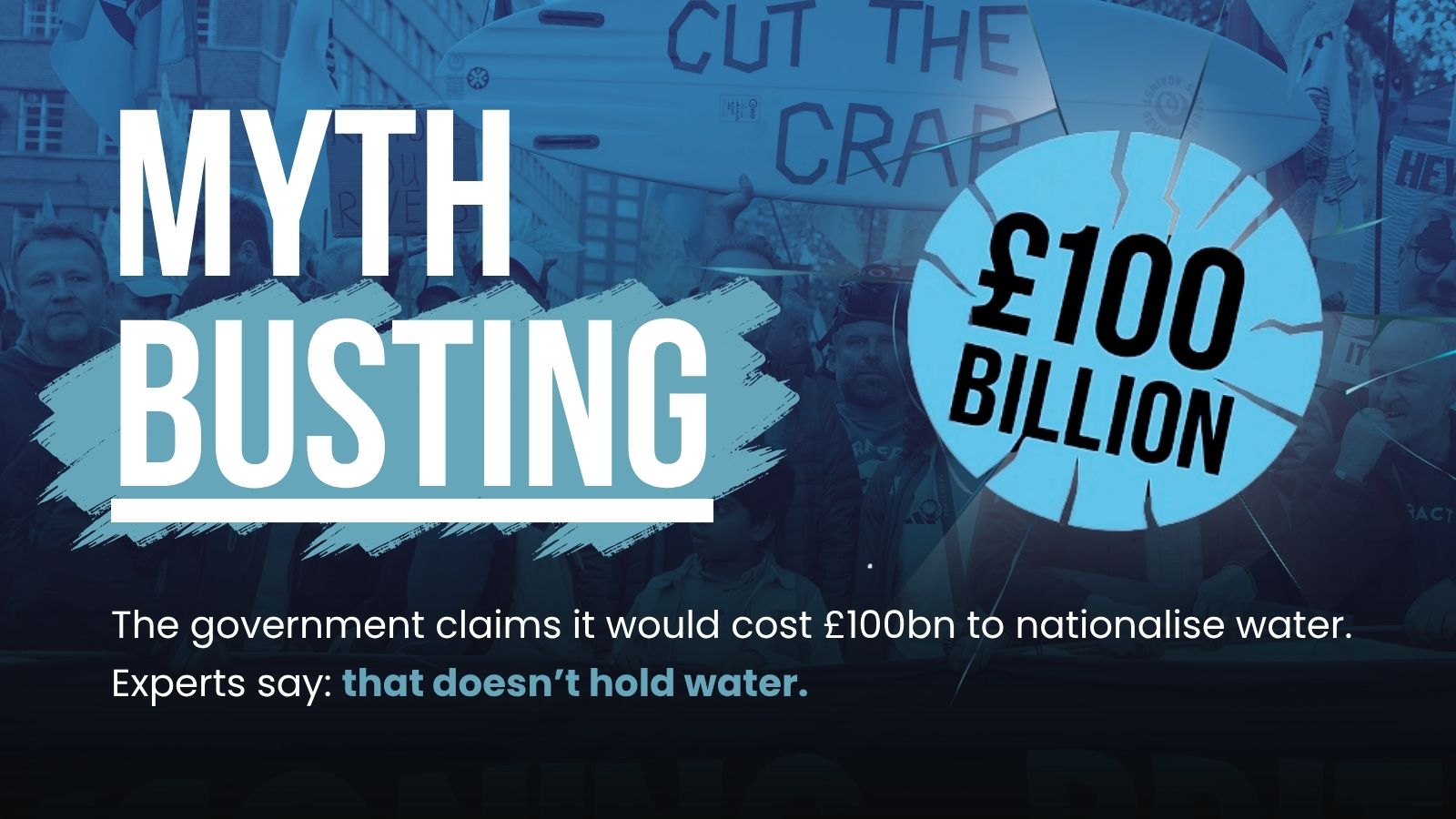
Myth Busting: Would it really cost £100 billion to bring water utilities into public ownership?

Download PDF

By Dr Samir Seddougui

Whenever the conversation turns to the cost of nationalising the water industry or even just exploring public benefit and ownership models instead of continuing with deep privatisation, the government references the scarily high figure of £90-100 billion to dampen public support. 

On 16 September, Defra released a short policy paper outlining the rationale behind its estimation that nationalising the water industry would cost approximately £100 billion. A similar number was reached in a 2018 Social Market Foundation report paid for by four water companies (Anglian Water, Severn Trent, South West Water and United Utilities). The Social Market Foundation’s estimation takes the RCV from 2018 which was estimated at £64 billion and then added premiums for acquisition, so presumably their estimation would be even higher now.

Defra based this on three assumptions that: 

  1. the value of Water Companies should be tied to their Regulatory Capital Value (RCV); 
  2. the government would absorb equity and debt; and 
  3. no discounts or premiums should apply. 


Inflated Economics? 

Let’s be clear: this isn’t rigorous economic analysis. It is a simplistic and unrealistic theory being relied on by the government to justify not taking decisive action in public and environmental interests by putting failing companies like Thames Water into a special administration regime. What it protects are investors and an unsustainable cycle of debt servicing. 

Professor Ewan McGaughey, professor of Law at King College London and co-author of the People’s Commission argues that public ownership is an inexpensive solution, contending that the true cost is closer to zero as a more accurate market valuation would account for performance and financial failures.

As Economics Professor Sir Dieter Helm puts it, Defra’s estimate is “misleading, simplistic and wrong”. In his analysis published on 22 September, Helm sets out why each of Defra’s assumptions is wrong and goes on to explain why special administration for a failing water company such as Thames Water would make sure the business continues on a sustainable basis, giving it “breathing space” before, the special administrator would “almost certainly achieve a price which is at a significant discount to the RCV” with debt holders taking a “haircut”. 

When valuing a utility company such as Thames Water, RCV is only one factor a buyer would weigh. Helm argues that a company’s failure to maintain assets and its debt levels are central to any realistic valuation. The People’s Commission notes that RCV ignores another glaring reality: water companies have extracted £83 billion in dividends to shareholders. Karol Yearwood at the University of Greenwich has described the privatised water industry as a “cash machine for investors”. Today, the biggest beneficiaries are historic shareholders and debt holders keen to cash in on the roughly £17 billion debt Thames Water has been allowed to rack up. 

Since privatisation 32 years ago, Thames Water has handed £7.2 billion pounds to shareholders, while neglecting essential upgrades leaving the public with failing pipes, sewage discharges, and degraded waterways.

Defra also glosses over Thames Water’s massive debt pile and fines including a record-breaking £123 million penalty this year for serious pollution that continues to devastate our rivers. Polluters should foot the bill, not taxpayers. Under a special administration regime, customer payments would flow to court-appointed administrators to fund the operation of essential water services, instead of being paid out to as returns to shareholders who would go to the back of the queue, making the process far less of a financial burden than Defra claims. In fact, as Helm points out, it would exceed the cost of running the business.


The cost of and case for special administration 

The Government says that special administration of Thames Water would cost the government £4 billion. This is also overblown: on Helm’s analysis, the Government should recover its costs from the sale of Thames Water which, when offered for sale, would receive bids way in excess of £4 billion. The net cost to the Treasury should be zero. 

Helm also explains why special administration is not nationalisation, as it is often misleadingly labelled or conflated as a tactic to avoid having to use it. Special administration is a regime designed specifically to deal with water company failure and it offers the most effective way out of the mess Thames Water is in.  It should not be feared but favoured.

Dieter Helm cuts through the noise: “What is needed now is for Defra to put Thames into special administration, instead of putting out simplistic and ill-thought-through “assumptions” to support an implausible, very big round number.” 

We are also pursuing a Judicial Review against DEFRA for failing to set out clear thresholds for when a company should be put into SAR. In our view, this failure breaches core public law duties and leaves rivers and communities at the mercy of failing operators. With 16 million customers, some ministers may believe Thames is too big to fail. River Action says it’s too big to be allowed to keep failing. It’s time to put customers and the environment before private profits – by putting Thames Water out of its misery and into a special administration regime. 


References

  • Becky Malby, Kate Bayliss, Frances Cleaver, Ewan McGaughey, “A fair price to the public for water nationalisation.” The Guardian. 3 August 2025. Accessed here.
  • Defra, “Nationalising the water sector: how we assessed the cost.” Policy Paper, 16 September 2025, accessed here.
  • The Social Market Foundation, “The cost of nationalising the water industry in England.” February 2018. Accessed here.
  • Dieter Helm, “The next episode in the Thames Water saga: Defra’s misleading £100 billion cost of nationalisation and flawed board vetting proposals”. 22 September 2025, accessed here.
  • Ewan McGaughey, “How to Clean Up Our Water: Why Public Ownership in Law Costs Zero”. Common Wealth, 5 June 2025, accessed here.
  • Kate Bayliss, Frances Cleaver, Becky Malby, “Defra and the £100bn”. The People’s Commission, 18 September 2025, accessed here.
  • Karol Yearwood, “The Privatised Water Industry in the UK. An ATM for investors.” University of Greenwich, September 2018, accessed here.
  • Tainted Water, “Where Your Money Goes”, Goldsmiths, University of London, 2024, accessed here.
  • Sandra Laville, Anna Leach, & Carmen Aguilar García, “In charts: how privatisation drained Thames Water’s coffers”, The Guardian, 30 June 2023, accessed here.
  • Sandra Laville, “Thames Water fails to complete 108 upgrades to ageing sewage works”, The Guardian, 10 July 2024, accessed here.
  • Environment, Food and Rural Affairs Committee, “Reforming the Water Sector”, House of Commons, 9 September 2025, accessed here.
  • Eleanor Shearer & Ewan McGaughey, “Deep Trouble: Fixing Our Broken Water System”, Common Wealth, 11 July 2024, accessed here.
  • Sarah Olney MP, “Thames Water: Contingency Plans”, House of Commons, 15 March 2024, accessed here.
  • Alex Lawson, “The fate of Thames Water hangs in the balance. So what are its options?”. The Guardian, 22 March, 2024, accessed here.
  • River Action, “River Action launches legal challenge against the Government over Thames Water failures”, 30 July 2025, accessed here.

Caution to Steve Reed: Don’t betray the public with Thames Water

Download PDF

In response to recent developments, we have written to Environment Secretary Steve Reed to welcome recent steps to prepare for placing Thames Water into a Special Administration Regime. BUT we’ve warned that writing off Thames Water’s debts only to sell the company to another private foreign investor would be a profound betrayal of the public

It follows news reports that the Government is preparing to take control of Thames Water, wipe its debts, and sell it to a Chinese infrastructure company, CKI.

READ THE LETTER

In the letter, we urge the Government to use Thames Water’s Special Administration Regime not as a prelude to another overseas takeover, but as an opportunity to restructure the utility so it is run for public benefit, transparency, and long-term environmental protection.

River Action’s Head of Campaigns Amy Fairman said: 

“Writing off Thames Water’s debts only to sell it to another foreign investor would be a betrayal. 

“This crisis is a chance to rebuild it for public benefit, not private profit. Labour campaigned hard during last year’s election on promises to get a grip on the water crisis and act tough on failing water companies. This is a chance to chart a new course, not repeat the mistakes of the past by selling to overseas buyers eyeing a bargain.

This is a moment for leadership, not short-term expediency. Running Thames Water for public benefit rather than private profit is the surest route to cleaner rivers and satisfying public demands. The Thames and its tributaries are a lifeline for millions – and their health is inseparable from the wellbeing of our environment, economy, and public health,”

The letter outlines the decades of failure that have left Thames Water in crisis: spiraling debt, chronic underinvestment in infrastructure, worsening pollution of rivers, and repeated breaches of environmental law. 

Repeated changes of ownership – often to opaque overseas private investment groups – have consistently prioritised shareholder returns and high-cost debt over safe, clean water and the health of our waterways.

Our key demands to Government:

  1. Rule out the sale of Thames Water to another foreign-owned private investor and ensure a public benefit ownership, investment and governance structure
  2. Use the special administration process to fundamentally restructure Thames Water’s finances and operations to invest in infrastructure that will secure water and protect the environment
  3. Ensure the public does not bail out private investors during the special administration regime and dispel the myth that Thames Water is worth tens of billions
  4. Write-off the current high-interest debt and use Government-backed bonds to significantly lower the burden and attract low-risk, low return, long-term investors
  5. Use the Special Administration Regime for Thames Water as an opportunity to design a permanent public benefit test model for water utilities


It’s clear that the public patience is exhausted and that repeating the same failed privatisation model would undermine trust further.


River Action launches legal challenge against the Government over Thames Water failures

Download PDF

River Action launches legal challenge over Government’s failure to explain when it will trigger special administration for Thames Water


We have filed a legal claim over Environment Secretary Steve Reed’s failure to explain when he will trigger special administration for Thames Water and other failing water companies – despite having the legal mechanism to take action, serious breaches by Thames Water, rising harm to customers and rivers, and calls from the Independent Water Commission for a clearer policy.

Our legal challenge is simple: we say that the Environment Secretary has acted unlawfully by failing to have or publish a policy on when he will use his power to ask the High Court to put a water company in the Special Administration Regime (SAR) – a mechanism under existing legislation specifically designed to enable the government to take action to deal with failing water companies.

This comes amid the deepening crisis at Thames Water, which has repeatedly breached environmental law, mismanaged its finances, failed to invest adequately in infrastructure, and shattered investor confidence and customer trust. Thames Water is on the brink of collapse with £20 billion in debt and widely regarded as no longer investable, with customers and the environment paying the price.

Steve Reed as Environment Secretary or Ofwat as water regulator (with his approval) have the power under section 24 of the Water Industry Act 1991 to ask the High Court to place a water company in special administration on either financial or performance grounds.

Special administration is a temporary insolvency and restructuring process for companies that provide essential public services like water, energy or transport. It is designed to ensure continuity of service while the company is stabilised and restructured. There is a bespoke special administration regime for the water industry, created in 1991 and designed to prioritise customers and services, putting financial interests second. Where water companies are failing, special administration can provide better, fairer and more sustainable outcomes – with the major benefit that it gives the water company the ability to recover and refinance with the opportunity for funds to be redirected away from investor profits towards the urgent infrastructure improvements needed to solve the ongoing sewage crisis, all without exposing its customers and at little cost to the public purse. Yet special administration has never been used for the water industry.

Thames Water has breached its duties and violated its licence conditions, seriously and repeatedly. It is the clearest possible case for special administration.

River Action’s legal challenge

The judicial review is concerned with the legal requirement for the Environment Secretary to have a policy for when he will trigger special administration for water companies. The claim challenges two key failings by the Government:

  1. Failure to publish a policy, breaching core public law duties.
  2. Failure to develop a policy at all, breaching obligations under the Habitats Regulations and other planning and environmental law.

Special administration is not limited to insolvency. It can also be used to protect customers and the environment when a water company is failing to meet performance standards. Our claim focuses on the Government’s approach to triggering a performance-based special administration process.

Under section 24 of the Water Industry Act 1991, special administration can be triggered by a water company’s failure to meet performance standards and a breach of its statutory or licence duties in ways that are “serious enough to make it inappropriate for the company to continue to hold its licence”. We believe that Thames Water clearly meets this threshold and has done so for years.

Independent Water Commission on Special Administration 

Last week, the Independent Water Commission, chaired by former Bank of England Deputy Governor Sir Jon Cunliffe said that “the policy around SAR assessment should be set out more clearly”.  The Commission also said that “SAR should be a practical option for the regulator and government” and stressed the importance of water companies preparing a plan for SAR now.

A route to public benefit models

We believe that special administration represents the most effective and immediate means of addressing the failures within the water industry. We see special administration as the first step toward meaningful and necessary systemic reform including providing the opportunity for a shift to a public benefit model of water ownership, governance and financing, of the type seen successfully implemented across Europe.

We are calling for the urgent use of special administration procedures for Thames Water as a tool to stabilise and reset using public benefit principles, with other failing water companies to follow as necessary.


Frequently Asked Questions


What is the Water Industry Special Administration Regime (SAR)?

The Water Industry Special Administration Regime (SAR) was introduced in England and Wales under the Water Industry Act 1991, with detailed procedures governed by the Water Industry (Special Administration) Rules 2009 and a comprehensive modernisation of the regime in early 2024. The legislative intent behind this regime is to protect consumers, public health and the environment in the event that a regulated water or sewerage company becomes insolvent (an insolvency SAR) or fails to carry out its statutory functions or licensed activities to such an extent that it is inappropriate for it to continue to hold its appointment or licence (a performance SAR).

An application for special administration of a water company may only be made by the Secretary of State or Ofwat with the Secretary of State’s consent. This contrasts starkly with normal administration under the Insolvency Act 1986 which can be applied for by creditors, the company or a director.

Special administration allows the Government to:

  • Appoint independent special administrators;
  • Restructure failing companies and their debt (the focus of an insolvency SAR);
  • Restore and maintain performance standards (the focus of a performance SAR);
  • Ensure water and wastewater services continue without interruption.

Importantly, the special administration regime is designed to keep services running using the company’s own revenues – from ongoing customer bills – not taxpayer funding. It is intended as a mechanism for accountability and  reform, not a bailout.

What are the details of the judicial review claim?

On 7 March 2025, we wrote to the Secretary of State for Environment, Food and Rural Affairs (“SSEFRA”) to ask whether the SSEFRA or the SSEFRA’s ministers had given consideration to whether it would be appropriate to exercise their discretionary power to apply to the High Court to have Thames Water placed into special administration in light of the contraventions of its “principal duties” in accordance with section 24 of the Water Industry Act 1991.

In response, the SSEFRA has refused to provide details of any such policy and has simply contended that there was no requirement to have a “written document or policy”.

Accordingly, we have three grounds of review:

  • Ground 1: Failure to publish a policy. The SSEFRA has a policy on the circumstances in which he will exercise his discretion pursuant to section 24 WIA and has acted unlawfully in failing to publish that policy.
  • Ground 2: Failure to have a policy. If, contrary to Ground 1, the SSEFRA does not have such a policy, that is in breach of Regulation 9(3) of the Conservation of Offshore Marine Habitats and Species Regulations 2017 (the Habitats Regulations).
  • Ground 3: Failure to have a policy. If, contrary to Ground 1, the SSEFRA does not have such a policy, that is in breach of section 85(A1) of the Countryside and Rights of Way Act 2000, as amended by section 245 of the Levelling-Up and Regeneration Act 2023.

We are seeking a mandatory order that SSEFRA either provides details of any policy or, if there is no policy, requires a policy to be developed and published.

Why does Thames Water need to be brought into Special Administration?

  • Persistent failures: Thames Water has a long record of breaching environmental, financial, and regulatory obligations.
  • Record fine: In May 2025, Thames Water was fined nearly £123 million by water regulator Ofwat for breaches of rules relating to its wastewater operations (£104.5 million) and breaches of rules relating to dividend payments (£18.2 million). This is the largest penalty Ofwat has ever issued.
  • Investor confidence collapsing: KKR, Thames Water’s preferred buyer, pulled out of negotiations leaving its various existing lenders as the only option.  Thames Water’s creditors have reportedly demanded that the company and its management be granted immunity from prosecution for serious environmental crimes as a condition of their restructuring proposals, without which Thames Water has said it would not be “investable”.
  • Inflated cost claims: The Treasury has claimed placing Thames Water into special administration could cost up to £4 billion – with reports it told DEFRA that it would have to meet these costs from DEFRA’s annual budget totalling £4.6 billion. Independent experts such as Professor Ewan McGaughey and Professor Dieter Helm believe the £4 billion figure is overstated and politically driven, with the likely costs being much lower and likely to be recouped by the Government on exit from administration.


What is the Independent Water Commission’s view on Special Administration?

On 21 July 2025, Sir Jon Cunliffe’s Independent Water Commission published its 88 final recommendations to the UK and Welsh governments for the reform of the water sector.

Two recommendations were made in relation to the special administration regime:

  • Recommendation 46: The regulator in England and Wales should continue to adopt an evidence-based process to consider, on a case-by-case basis, whether it would be appropriate for a water company to transition to an alternative ownership model where they request to do so or following a Special Administration Regime.
  • Recommendation 59: The regulator in England and Wales should develop and consult on a framework for ensuring companies are prepared for SAR.

In relation to Recommendation 59, the Commission said:

“793. The Commission believes the SAR should be a practical option for the regulator and government but that it should be very much a last resort. However well prepared, a SAR would be a major exercise which carries some risk of disruption to the company’s operation. The Commission notes that lowering the threshold for SAR would increase costs to customers through higher financing given the increased risk on investors. The Commission is also mindful of the risks in creating automatic triggers – experience in insolvency and similar regimes in other sectors, including financial services, is that conditions and circumstances of individual cases vary widely and cannot be anticipated. There is a need for broad, judgement based tests within a clear policy, that has been set out in advance, of how the regulator will assess failing companies against these tests, the factors it will take into account and the indicators it will consider. In the Commission’s view the two current tests for entry into SAR effectively balance objective and subjective factors and include an appropriate level of judgement.  It believes, however, that the policy around making the SAR assessment should be set out more clearly.

794. The Commission believes that further practical steps can be taken to ensure the SAR is a credible, but low probability, threat. In particular, as part of the SAR policy set out above, the regulator should develop and consult on a framework for ensuring companies prepare a plan for SAR. This should consider what the practical barriers to SAR might be, and how these can be mitigated in advance.”

Although the Commission’s recommendations focus on the regulator, its comments around the need for a clearer policy for special administration logically apply to both Ofwat as regulator and SSEFRA, as the two authorities with the power to petition the High Court for a special administration order.

Thames Water is Gaslighting the Public – Here’s the Truth

Download PDF
By Henry Shepherd, Community Campaigns Coordinator, River Action


Twisting and turning more than the Thames itself

As the boat race weekend approaches, Thames Water has gone on the offensive – not to clean up the Thames, but to spin the facts and put the public at risk.

Yesterday, we revealed that our 40+ water tests along the Boat Race course over the past month show the Thames would be classified as ‘poor water quality’ according to the Environment Agency regulations, with 29.5% of our samples exceeding safe limits for entering the water. This is despite it being the driest March in over 100 years….if they can’t keep the river clean in these conditions, how can they be trusted?

In a response statement, Thames Water attempted to cite ‘excellent’ water quality results, referencing data from a boat club in Hammersmith.

But here’s what they didn’t tell you.

That testing wasn’t done with Thames Water. The testing was carried out by our friends at Fulham Reach Boat Club and was actually funded by River Action. Thames Water conveniently cherry-picked a subset of this data, and, unbeknownst to them, we funded it!

Additionally, the data they selected came from a single weekly test at only one point along the course (4 tests in total). In contrast, our data, revealed yesterday, consisted of over 40 tests across the entire length of the Boat Race course from 10th March.

In short: Thames Water carefully curated the one stat that suited their PR and presented distorted information, putting public health at risk.

Thames Water simply cannot be trusted to tell the truth about basic water quality risks, and have once again willingly put river users’ health at risk, prioritising misleading headlines rather than fixing pipes.

The 2025 boat race course with River Action test sites

The Kew cover-up 

It gets worse.

On Tuesday, we were alerted to the possibility of a burst sewage pipe near Kew Bridge, with sewage reportedly spilling directly into the river just upstream of the Boat Race finish line.

We immediately called Thames Water’s pollution hotline to enquire about the issue, but were assured there were no problems to report. However, after investigating the site ourselves, we found Thames Water vans and huge sewage tankers stationed on the riverbank at Kew Bridge. After speaking with the crew, they confirmed the incident. At that time, it appeared that sewage was simply entering the river, just a mile upstream of the Boat Race finish line.

Thames Water’s initial denial of the problem highlights their true priorities: managing headlines, not public health. How much sewage has been allowed to flow into the river without the public being informed?

This issue is compounded by a separate sewage pipe even closer to the Boat Race finish line, downstream at Kew Transfer. The monitoring system for that pipe had been offline since January 19th, mysteriously coming back online the day we published our testing results (how convenient?) This means that no one knows how much sewage has been flowing into the river unchecked from that sewage overflow.

When people, including hundreds of junior rowers, and professional boat race crews, rely on this critical information to stay safe, it’s not just unacceptable – it’s dangerous.

Thames Water vans and sewage tankers near Kew Bridge on Tuesday

A failure of infrastructure, regulation, and honesty

With almost no rain recently, this pollution isn’t just a result of outdated infrastructure and unmonitored storm overflows. It reveals a much deeper issue: that even after treatment, final discharged waste water from sewage works is still far from safe. Treated effluent has no legal limit on E. Coli levels, so it frequently contains high levels of dangerous contaminants, including fecal matter and bacteria. The treatment process used by Thames Water, though permitted, falls far short of the standards needed to protect public health and the environment.

The real issue lies in the regulatory framework – unless a waterway has “bathing water status,” is home to a fish farm, or serves as a place of abstraction, there are no legal obligations to ensure that treated sewage is free from harmful substances. That’s why we’re campaigning for sewage treatment plants to be upgraded, better water quality monitoring, and enforceable limits on water quality – something that bathing water status would require.

But even with this, the Tideway Tunnel – which Thames Water touts as the solution – won’t protect us. The Tunnel is designed to manage storm overflows, not the continuous discharge of untreated or poorly treated sewage. It’s a temporary fix for a much deeper, systemic problem, and only reduces downstream pollution, which for half of the Boat Race course is irrelevant. The other half of the course – upstream of Hammersmith – is exposed to all the sewage pollution flowing along the Thames accumulated from the upstream catchment.

It is no surprise that all our tests taken upstream of the Tideway Tunnel show high levels of E.coli. This is the end of the Boat Race course and why we implore the Oxford and Cambridge teams not to throw their cox in the water. It is not safe.

Time for accountability

This isn’t just about rowing. This is about whether people can trust water companies to keep them safe. Thames Water has failed across the board:

  • They haven’t invested in modern monitoring systems.
  • They’ve lobbied for billions in bailouts while paying bonuses to executives.
  • They’ve allowed infrastructure to rot – and lied about it when questioned.

We believe Thames Water has forfeited its social licence to operate. It’s time to put the company into Special Administration, restructure it in the public interest, and end the cycle of pollution-for-profit.

River Action will continue exposing Thames Water’s spin  – not just this week, but every time they attempt to dodge accountability. This is your river, not theirs.

“Don’t Throw the Cox In”: Sir Steve Redgrave & River Action Warn of Failed Water Quality Standards

Download PDF

River Action warns university boat race stretch fails basic water quality standards – Sir Steve Redgrave calls for urgent clean-up

As the iconic Boat Race between Oxford and Cambridge approaches this weekend, river campaigners have warned that water quality for the stretch of the River Thames set to host the event would be classified as ‘poor’ under environmental regulations if it were designated as a ‘bathing water’ site. New testing on the course from River Action raises fresh concerns about water quality, with rowing legend Sir Steve Redgrave backing calls for urgent action to clean up the river.

While wet weather often exacerbates pollution through increased sewage discharges, recent conditions tell a different story. Since River Action’s E.coli testing started on 10th March, there has been just 1 day of rain, yet the river champions found that 29.5% of samples exceeded safe limits for entering the water, almost three times the threshold for bathing waters rated ‘poor’. River Action worked alongside Fluidion and Planet Ocean to do the testing whilst using the Alert One system. Fludion further validated the results.

Campaigners highlight that treated wastewater from sewage treatment plants, which currently face no legal limits on E.coli levels, is a major but overlooked contributor to the pollution of the River Thames.

Our Senior Communities Coordinator, Chloe Peck testing for E-Coli on the River Thames

Paying Twice for Polluted Water?

Revealed: Out-of-service sewage overflow monitor on water used for the Boat Race 

Despite public outrage, the construction of the Tideway Tunnel (which won’t resolve upstream pollution), a £3bn financial bailout plan, and Thames Water executives receiving massive salaries and bonuses, the company has failed to maintain its ageing infrastructure. Regulators have also failed to hold them accountable.

Immediately upstream of the boat race finishline, the monitoring system on the combined sewage overflow pipe at Kew (Kew Transfer) has been offline since 17 January, undermining the legal requirement for all sewage outfalls to be monitored. It is not known how much this pipe may have been discharging sewage into the Thames, near to the boat race finish line.

Campaigners are now demanding that Thames Water be taken back into public hands through Special Administration, branding the failing company a ‘busted flush.’


River Action’s Head of Communities, Erica Popplewell, said:

“The Mayor of London’s vision for clean and healthy rivers is simply a pipe dream without systematic reform of the water industry and its regulators. Right now, if the stretch of the Thames used for the Boat Race were an official bathing site it would be graded poor, the lowest possible rating. The government’s own advice for such water is ‘do not swim.’ So, we strongly suggest that the winning team on Sunday think twice before throwing their cox in the Thames.”

We would also urge all rowers to follow the ‘Guidance for Rowing When Water Quality is Poor’ safety guidelines to mitigate risk.  The Boat Race should be about sporting excellence—not about worrying if you’ll get sick from being dunked – and attracting people to take up water sports as a healthy activity.

“The public demands Thames Water and regulators act now to improve sewage treatment infrastructure. Thames Water has profited from pollution for years whilst the Government have failed to enforce the law. It’s time to refinance the company without burdening bill payers and end pollution-for-profit. The decades-long water industry privatisation experiment has been a disaster. Thames Water should be put into Government hands and operated for public benefit. That process could start tomorrow with the right political will by putting Thames Water into Special Administration and restructuring the company.”

Erica Popplewell at the River Ver last month giving an interview for BBC News on how Thames Water’s sewage releases have impacted the Chalk Stream

Sir Steve Redgrave leads calls from the rowing community for action:

Leading figures, including Sir Steve Redgrave, are demanding urgent intervention to protect river users, including competitors in Sunday’s race.

“It’s a real worry that in 2025, unsafe water quality in the Thames is still a concern, Rowers, river users, and the public deserve better.”

Olympic champion rower Imogen Grant added:

“As rowers, we train on these waters every day, and the health and climate risks are deeply concerning. It’s unacceptable that we have to compete on a river with such an unavoidable threat to health”

Last month, Sir Steve Redgrave handed in a letter to Secretary of State for the Environment, addressing the need for urgent action to address the river’s pollution.

Thames Water dodging accountability

Thames Water, responsible for London’s wastewater, continues to evade responsibility.  Instead of prioritising infrastructure upgrades, the company:

  • Went to the High Court to beg for £3bn to avoid going bust, while rewarding executives with excessive bonuses.
  • Allows unchecked raw sewage discharges, despite mounting public and political pressure.
  • Fails to invest in sustainable solutions, leaving the Thames in environmental freefall.

“Thames Water is a failing company, propped up by creditors while customers pay for a crappy service—literally,” added Erica Popplewell from River Action. “We need urgent reform—this is a scandal.”

With the Water Commission, led by Sir Jon Cunliffe, underway and due to report its recommendations in the summer, campaigners demand an end to the broken privatisation model and a complete regulatory overhaul to stop the destruction of UK rivers. Watch River Action’s water commission themed animated film – ‘Water: A Story of Hope’ – narrated by Deborah Meaden.


Athlete safety at risk

Boat Race organisers are aware of water quality concerns on the Thames, making safety a priority. British Rowing, The Rivers Trust, and River Action are ensuring competitors are informed of risks.

Participants have received Guidance for Rowing When Water Quality is Poor safety guidelines.


Time to act

River Action urges policymakers, regulators, and the public to take immediate action. Thames Water must be held accountable, and tougher regulations enforced to prevent further environmental destruction.

“This isn’t just about rowing—it’s about the future of our rivers and the communities that rely on them,” says Ms Popplewell from River Action. “We cannot let water companies continue to get away with this.”

To help change the future of our waterways, you can make your voice heard by responding to the Water commission’s call to evidence. We’ve provided guidance for each question to help you get started.

Sir Steve Redgrave calls on the Government to clean up the Thames, ahead of Schools’ Head of the River Race

Download PDF

As nearly 3,000 young rowers gather for the Schools’ Head of the River Race, all-time Olympic rowing champion Sir Steve Redgrave calls for urgent action to clean up the River Thames. In a letter to Secretary of State for the Environment Steve Reed, Sir Redgrave stresses the need for urgent action to address the river’s pollution.

The letter was delivered to Defra, as schools from across the country gather to take part in the UK’s largest processional rowing race for school-aged participants.

The action is being coordinated by environmental charity River Action, which is leading efforts to protect the river from severe pollution caused by sewage discharges. In the letter, Sir Steve Redgrave calls on the Secretary of State to:

  • End pollution for profit by water companies and take firm action to ensure Thames Water cleans up its infrastructure.
  • Give environmental regulators the power and tools to do their job so polluters are held to account.

Sir Steve Redgrave said, “This is not just about rowing. It’s about all river users’ public health. It’s about our environment. It’s about the future of one of the world’s most iconic rivers. We won’t sit quietly while this catastrophe continues.”

River campaigners urge rower safety on poor quality water

In response to growing concerns over water quality across Britain’s rivers , British Rowing, River Action, and The Rivers Trust have developed official guidelines to help rowers minimise the risk of illness due to exposure to polluted water.

The ‘Guidance on rowing when water quality is poor’ advises rowers to cover cuts, grazes, and blisters with waterproof dressings, avoid swallowing river water, wear suitable footwear when launching or recovering boats, and thoroughly clean all equipment after use.

Sir Steve Redgrave emphasised the importance of taking protective measures:

“The Schools’ Head of the River Race is a fantastic event, but rowers need to be aware of the serious health risks posed by polluted water. By following these safety guidelines, we can help minimise the risk, but this situation is completely unacceptable. We need urgent action to stop sewage discharges and protect the health of everyone using our rivers.”

Erica Popplewell, River Action’s Head of Communities, added:

“We are thrilled that so many young people are getting out on the water, but their health must not be put at risk. We urge every rower, coach, and participating school to follow our guidance to stay safe. But guidance alone is not enough—we need the Government to take decisive action to clean up the UK’s polluted rivers, and Thames Water must be stopped from polluting for profit.”

Water quality testing

Water quality testing conducted by River Action last year on the stretch of the Thames used for the Boat Race between the Universities of Oxford and Cambridge (also used for the Schools’ Head of the River Race) revealed dangerously high levels of E.coli bacteria caused by sewage pollution.

Tests using a World Health Organization-verified E.coli analyser recorded contamination levels up to ten times higher than the Environment Agency’s threshold for ‘poor’ designated bathing waters—where the Government advises against swimming.

Furthermore, River Action can reveal that in the last 6 months, Thames Water allowed 133 hours of human sewage to enter the section of the Thames used for the Schools Head of the River Race.

River Action continues to call for immediate intervention, including placing Thames Water into special administration, to prevent further environmental damage and protect river users.

Court of Appeal upholds Thames Water’s £3 billion rescue plan – “This decision is a disaster for Thames Water bill payers and the environment”

Download PDF

WHAT HAPPENED?

The Court of Appeal has decided to uphold Thames Water’s £3 billion rescue plan. This is a devastating blow to both the River Thames and its millions of customers. Instead of prioritising urgent investment in tackling pollution and infrastructure failures, this bailout will see a third of bill increases swallowed by massive interest payments, as highlighted by River Action’s CEO, James Wallace:

“Customers will now have to pay the price for the failing water company with about a third of their increased water bills paying for massive interest payments while our rivers remain choked with sewage”

WHY WAS THIS RULING IMPORTANT?

Sewage continues to pour into our rivers, and Thames Water customers are left footing the bill for a broken, profit-driven system that has failed to deliver the basic services they pay for. This ruling effectively rewards financial mismanagement while leaving our waterways in crisis.

“This is not just about managing a crisis; it’s about fixing a broken system that has allowed private companies to profit at the expense of public well-being.”

WHAT HAPPENS NEXT?

River Action believes the Government must immediately place Thames Water into Special Administration to prevent further financial and environmental harm. Instead of propping up an unsustainable model, the independent Water Commission must propose a governance and financial framework that puts people and the environment first. This is not just about rescuing a single company, it’s about ending a system that has allowed private firms to profit while rivers die and communities suffer.

“Maintaining the status quo will only perpetuate this corporate takeover of the lifeblood of our economy and land. The government can and should step in now”

Thames Water’s £3bn bailout signals urgent need for Government action on failing water companies

Download PDF

STATEMENT:

Responding to the Court of Appeal’s decision to uphold Thames Water’s £3bn rescue plan River Action’s CEO said:

This decision is a disaster for Thames Water bill payers and the environment. Customers will now have to pay the price for the failing water company with about a third of their increased water bills paying for massive interest payments while our rivers remain choked with sewage.”

“Instead of allowing this interim plan to cause further financial and environmental damage, the Government must urgently seize the opportunity to place Thames Water into Special Administration before even more investor-centric restructuring plans are rolled out later this year. The current privatised system is a failed experiment, putting financial interests ahead of the needs of consumers and the health of our environment. Maintaining the status quo will only perpetuate this corporate takeover of the lifeblood of our economy and land. The government can and should step in now. 

“The onus is now on the independent Water Commission to propose a viable alternative financial and governance model for the water industry that puts people and the planet first. This is not just about managing a crisis; it’s about fixing a broken system that has allowed private companies to profit at the expense of public well-being.”

ENDS

For media enquiries, contact Amy Fairman at media@riveractionuk.com

‘A National Scandal’: High Court greenlights Thames Water’s £3bn bailout amid financial and environmental ruin

Download PDF

Responding to the High Court’s decision to approve Thames Water’s £3bn rescue plan— in a legal case in which neither DEFRA nor OFWAT opted to participate —River Action chair and founder Charles Watson said:

“This national scandal is a disaster for Thames Water bill payers and the environment. Instead of recognising now is the time for a special administration of Thames Water, the decision saddles customers with the responsibility for funding billions of junk-rated debt while its executives, investors and shareholders escape responsibility. Customers will now bear the brunt of massive interest payments through higher water bills, paying for corporate failure while our rivers remain choked with sewage.”

“We are extremely surprised that neither the Government nor the water regulator, Ofwat, chose to give evidence in court to support the public interest—leaving it instead to Charlie Maynard MP and campaigners Windrush Against Sewage Pollution to represent us.

“The Government cannot stand by and allow this reckless bailout to continue. It must step in, take back control of Thames Water, and put an end to years of environmental destruction and financial mismanagement – ahead of the even more expensive restructuring that Thames Water has planned.”

“The public’s outrage, as seen at the recent March for Clean Water, makes it clear—people have had enough. The Government must not only take back control of Thames Water but also pass the strongest possible Water Bill to ensure polluters pay and our rivers are properly safeguarded. The Government must recognise that clean rivers and healthy communities aren’t a barrier to economic growth—they enable it.”

Campaigners urge government control of Thames Water, warning Mayor of London swimmable Thames a ‘pipe dream’ under polluting for profit utility

Download PDF

As Thames Water’s top brass meet with the Greater London Authority to explore ways to make the capital’s waterways swimmable, the failing utility is simultaneously seeking High Court approval for a £3 billion rescue plan—prompting campaigners to demand that the Government take back control of the water company.

They warn that “a swimmable Thames is a pipe dream with Thames Water in tatters” and reveal dangerously high levels of E. coli were detected last week near to the site of today’s London Assembly meeting, underscoring the urgent need for accountability and action.

Giving evidence at today’s public hearing is CEO of River Action James Wallace. He says, “We applaud the Mayor of London for his bold and commendable actions aimed at making London’s waterways swimmable. His commitment to ensuring cleaner, healthier waterways for Londoners demonstrates strong leadership that will benefit generations to come. We have seen him take a firm stand against corporate interests pushing for a third runway at Heathrow due to air pollution concerns—now we need him to double down on tackling the water pollution crisis by standing up to yet more corporate polluters.

“Let’s be clear, until Thames Water is held accountable as the main polluter of the River Thames and made to invest in clearing up the mess of decades of profiteering and polluting, nothing will change and the Mayor’s ambition will remain a pipedream.

“As evidenced by soaring levels of debt and sky high interest rates, the privatisation experiment has failed. The only solution is for the Government to take back ownership of Thames Water and write off the bad debt that stains customer bills and the river. We call upon the Mayor of London and the Greater London Authority to pressure the Government to put Thames Water in special administration and restructure its finances prioritising the  people and the environment, not private profit.”


Revealed: 2025 sewage discharges and E.coli testing on the Thames


Since the start of 2025, Thames Water has dumped at least 784 hours and 58 minutes of sewage directly into the Thames, from its source at Cricklade to its mouth at Long Reach—wreaking havoc on vital ecosystems and endangering public health.

Now campaigners can reveal that last week water quality testing by River Action citizen scientists using a Fluidion World Health Organization WHO accredited verified E.Coli analyser, found dangerously high levels of pollution from sewage pollution along the River Thames at Greenwich near to today’s Assembly meeting. Between January 27 and January 31,  River Action conducted eight water quality tests and found levels of E.coli up to 15 times higher than the Environment Agency considers the minimum acceptable level for designated bathing waters. The levels found were far in excess of what is considered ‘safe’ by the environmental regulator.

Protest led by Friends of the Thames Friends of the Thames, a newly formed not-for-profit seed-funded by River Action and directed by clean river advocate Laura Reineke, today leads a protest outside of the public hearing on making the Thames a swimmable river.

From 9am, paddlers, swimmers, rowers and community groups will demand a cleaner, healthier capital river for all; pointing the finger at Thames Water for persistent and often illegal discharges of sewage that pose a serious threat to human health, water security and wildlife.

Laura Reineke, co-founder of Friends of the Thames, said: “The Thames is more than just a river; it is an iconic symbol of our country and provides the water that sustains our capital’s economy. Its persistent pollution is unacceptable, and Friends of the Thames is here to ensure that action is taken, and promises are kept.  We as a country have become disconnected from our nature and countryside; I’d love to see all communities reconnect with the Thames, and foster a love for her that flows through generations to come.

“We will present Thames Water’s representative with a vial of river water—a stark reminder that their duty is to protect the Thames, a living, breathing river they are suffocating with raw sewage.”Wildlife biologist and broadcaster Liz Bonnin added, “I join River Action in calling for the Mayor of London to hold Thames Water to account for decades of unchecked pollution in the name of profit, devastating this important riverine ecosystem and threatening public health. The company’s plans to increase customer bills, despite paying out £158.3 million in dividends last year alone, speaks volumes. We must make the polluter pay and transform the industry so that it serves people and the planet, as it always should have.”


ENDS

  Notes to editor

  • Between January 27 and January 31, River Action conducted 8 tests on the River Thames at Drawdock Slipway, Greenwich. Tests results indicate an average of 8,233 E.coli colony forming units (CFU) per 100ml of water. To meet bathing water quality standards, this level should be below 900 CFU per 100ml to meet the lowest water quality deemed safe for swimming. Our highest recorded spike reached 15,000 CFU, more than fifteen times the acceptable limit.
  • Dedicated to uniting communities along the Thames, Friends of the Thames will advocate for 1) restoration; 2) hold polluters accountable; 3) build a citizen science network to monitor water quality from source to sea.
  • Friends of the Thames will connect communities from source to sea and closely monitor the Mayor of London’s commitment to delivering on promises to clean up the capital’s lifeblood river. The grassroots campaign group will build alliances with river users across the Thames catchment, spanning urban areas and the commuter belt. It will bring together existing citizen scientists and data and establish a network of new citizen scientists to fill in any gaps from the source of the nation’s capital river in Gloucestershire to the Thames Estuary at Southend-on-Sea.
  • Friends of the Thames will reach out to councils across the Thames catchment area, inviting them to sign a Rights of the River Thames  embedding the rights of the Thames as a valuable and irreplaceable ecosystem, and giving the river a voice. This pledge will emphasise the shared responsibility of communities, authorities, and corporations to protect the nation’s capital river for future generations, and begin the process of changing the way we interact with the river, from using and over managing her, to a living, breathing artery that feeds us and the nature that calls her home.


For more information, please contact Laura Reineke friendsofthethames@gmail.com, 07989396210 .

  • High-resolution images and interviews are available upon request.
Privacy Overview

This website uses cookies so that we can provide you with the best user experience possible. Cookie information is stored in your browser and performs functions such as recognising you when you return to our website and helping our team to understand which sections of the website you find most interesting and useful.