The Government’s Water White Paper: The Good, the Bad and the Ugly

Download PDF

Written by Ellie Roxburgh, Policy and Advocacy Manager at River Action

This Government’s focus on reforming the water sector is welcome and timely. Recent failings by South East Water and Thames Water have demonstrated that water companies are defective on multiple fronts. The public is mobilised for change and the Government must go further than minor tweaks to the status quo. The current model of profit-driven privatisation has failed, evidenced by the polluted state of our rivers, exploitative ownership models and inadequate regulatory oversight in the water sector. The water pollution caused by agricultural practices, industrial waste and road run-off must also be urgently recognised and addressed. 

The time for change is now. We need a government that is bold in ambition and willing to implement reforms fast enough to deliver the measurable improvements needed to fulfil its election promise to clean up our rivers, lakes and seas.

So, what is a White Paper?

A White Paper is a government document that precedes legislation. It sets out what to expect in the upcoming King’s Speech when the parliamentary agenda is laid down by the King. This White Paper focuses largely on the recommendations made by Sir Jon Cunliffe’s Review of the water sector in 2025. Below, we’ve set out the good, the bad and the ugly of the government’s plans for water reform.

The Good

Tough, independent regulators: For too long, water companies have gotten away unscathed with polluting our rivers. Today’s announcements put some strength into the regulator, including no-notice powers for the regulator to check security and emergency preparedness, Performance Improvement Regimes for failing water companies, and a Chief Engineer to monitor infrastructure.

The government announced a consolidation of water industry regulators into one entity, with oversight of all sectors impacting the water environment. This new regulator will have public health and environmental protection as a key objective, alongside affordable bills, financial resilience of the water sector, and robust oversight of water companies’ infrastructure. This regulator must have enough teeth to hold water companies to account with penalties that stop them polluting. We need a regulatory system that enforces the law and, to do that it must be well-financed.

Democratic decision-making: The government has committed to introducing a regional water planning function by bringing together councils, water companies, farmers and developers, with double the funding for catchment partnerships. The cross-sectoral and target-driven characteristics of the new regional water planning function are welcome. However, while it is important that these actors have a seat at the table, there needs to be an independent authority that makes decisions based on the environmental health of the catchment and the public health of customers.

These authorities need to sit above water companies and other self-interested actors. They need powers to influence local planning authorities decisions over industrial planning applications and permit decisions, based on the ecological health of the river and surrounding habitats. Regional oversight should support a tiered approach to action on water pollution, whereby the most affected areas are prioritised as the focus of rapid action and enforcement (including Scientific Sites of Scientific Interest and chalk streams). This would enable the Secretary of State to enact Water Protection Zones and a potential moratorium on industrial livestock units in areas, such as the River Wye, that are experiencing significant nutrient loading from industrial agriculture.

A long-term water strategy: We are pleased to see the Government taking a long-term view of improving the water sector. However, decisions at local and regional levels must align with and enable the delivery of a national strategy for planning, financing, governing and regulating sewage treatment, water quality and supply to ensure a joined-up approach to securing water and clean rivers, lakes and seas. Measures and targets should be put in place to deliver on commitments within the Environmental Improvement Plan and Water Framework Directive across sectors and regions, to require all actors to contribute towards achieving national targets.

Abolition of self-monitoring: The government has committed to abolishing the self-monitoring of water companies. The White Paper has set out plans for the new regulator to have a Chief Engineer to monitor infrastructure, and for water companies to proactively report on infrastructure conditions. The test will be how regularly the regulators independently test the infrastructural quality and environmental impacts of water company operations.

The Bad

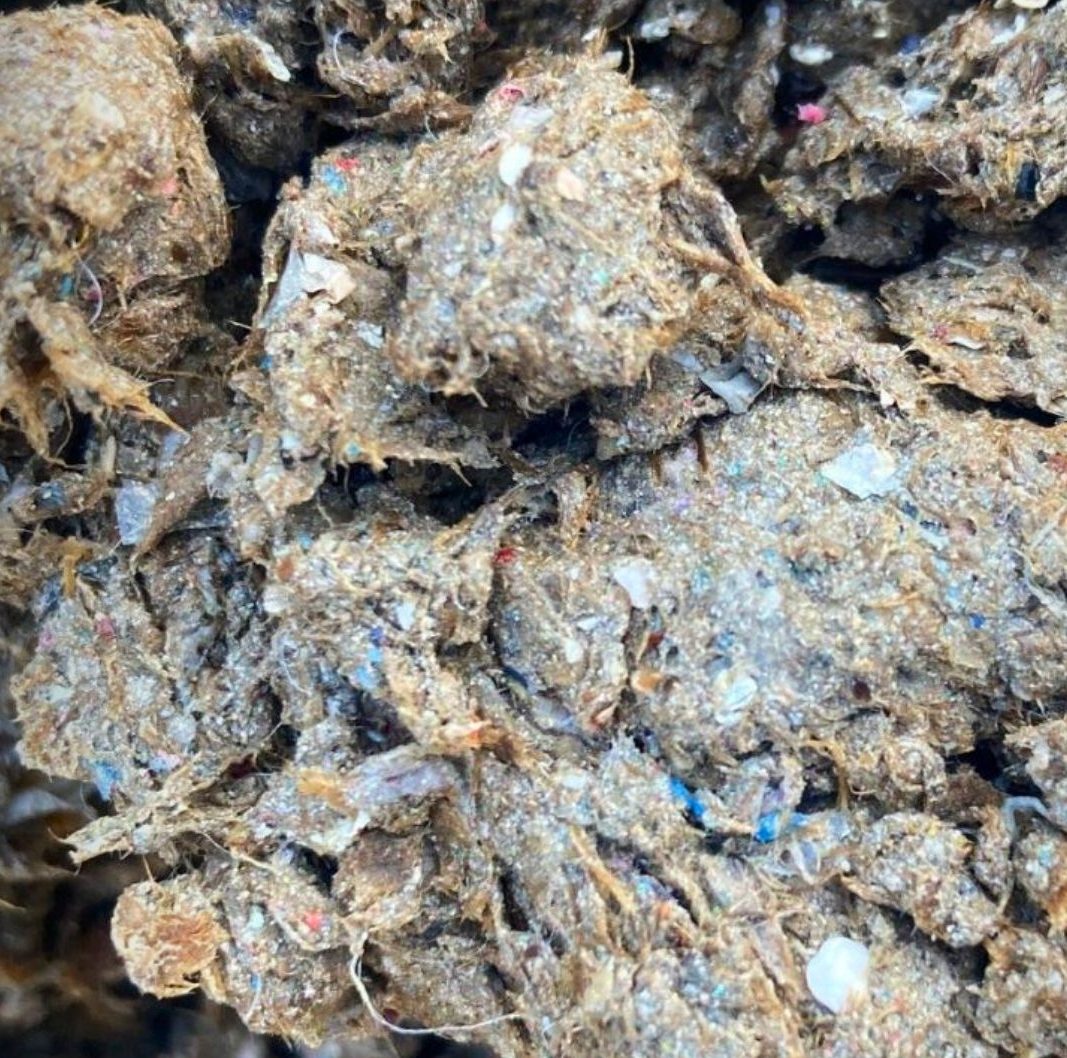
Limited scope on sewage sludge: While we welcome the Government’s commitment to consult on reforms on how sewage sludge use in agriculture is regulated and whether sludge should be included in the Environmental Permitting Regulations, meaningful action is needed that goes beyond end-of-pipe solutions. The Government should investigate whether legislation is needed to stop water companies from selling contaminated sludge to farmers, and as recommended by the Independent Water Commission, the Government must consider Extended Producer Responsibility for all of the contaminant producers across the supply chain.

Nothing new on agricultural water pollution: Agricultural water pollution is on a similar scale to water company pollution and the White Paper recognises this, estimating around 40% of river and groundwater pollution is due to agricultural practices. Yet agriculture has not had equivalent dedicated resources to identify and implement solutions to reduce environmental harm as the water sector. Consolidating agricultural water regulations is welcome, but we also need to see more funding for regulators, greater support for farmers to implement much-needed infrastructure, and a planning system that is empowered to decide when catchments have enough industrial farms. It is critical that environmental permitting is extended to industrial cattle and moves to do this must be swift.

The Ugly

Essential requirements instead of incentives: Today’s announcements start to embed public health and environmental protection in the water system with targets and objectives. Reform of the incentive framework to reward companies for delivering outcomes like public health, the environment and long-term resilience means these outcomes will continue to be seen as optional when they should be essential requirements of operating. 

Continued prioritisation of private interests: Regulation alone cannot fix a deeply privatised system that is designed to put profit first. The White Paper recognises some owners have prioritised “short-term profits over long-term resilience and the environment”. That is exactly why the ownership model must change. However, the White Paper still treats the profit-driven model as the default and focuses on constraining its worst excesses. The approach to ownership change is optional and company-led, which means it is very unlikely to happen. Most critically, the White Paper makes no commitment to a thorough, evidence-led review of alternative ownership models. We want to see a clear move toward public benefit models for water companies, not a slightly better managed private monopoly. A public benefit model would mean that water companies have legal duties to put public health and the environment first, profits and shareholder dividends are secondary, and short-term extraction is ruled out.

And what if water companies continue to fail financial and legal obligations?

New legal powers may be valuable, but the Government and regulator must use the extensive and powerful ones they already have. Performance Improvement Regimes are a step in the right direction, but the Special Administrative Regime has existed under the Water Industry Act 1991 for decades and must now be used by the Government and regulator. When a water company fails to meet its financial or legal obligations, as is unfortunately the case with more than one water company and with Thames Water being the clearest case for such an intervention. The commitment in the White Paper for water companies to establish plans for special administration is welcome, but transparency on when the regime will be triggered by the regulator and the Environment Secretary remains lacking.

Reforming the water environment requires bold and urgent action. We need to see the Government follow through on its reforms with greater ambition.
Campaign update: Our legal action against Ofwat

Download PDF

We took Ofwat to court to protect customers from paying twice and our rivers from sewage pollution


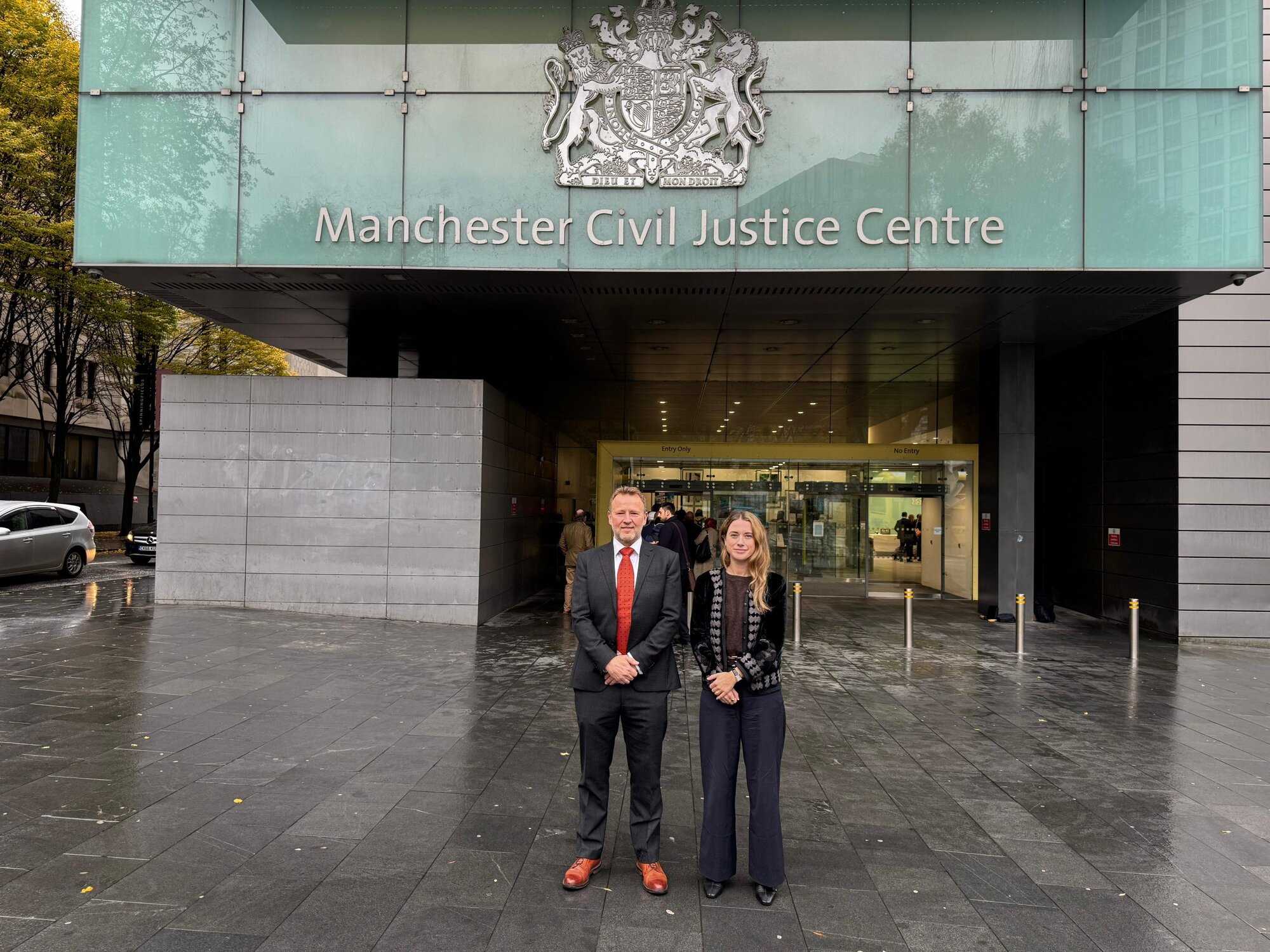
This week, the High Court finished hearing our legal challenge of Ofwat’s approach to its ‘not paying twice’ policy in its latest price review (PR24). The hearing took place over three days on 4, 5 and 17 November.

River Action, working with Leigh Day and expert barristers David Wolfe KC and Nicholas Ostrowski, brought this case to address our serious concerns about Ofwat’s approach. We argued that Ofwat’s current methods could allow water companies to charge billpayers again for environmental improvement works that they have already paid for, despite its promise that customers should not pay twice. We challenged Ofwat’s failure to require water companies to demonstrate compliance with environmental regulations as part of its price control exercise, as it said it would. We also highlighted flaws and gaps in Ofwat’s “clawback” mechanism, intended to prevent double funding when water companies fail to meet their environmental obligations.

Ofwat defended its approach, arguing that it never intended to look at actual compliance by water companies as part of its price-setting process and said that this was a reasonable approach to take given its regulatory function.  Ofwat said that its clawback mechanism did not need to be explained in PR24 and that it intended to develop a more detailed framework.

During the hearing, the court considered detailed evidence on Ofwat’s PR24 process and methodologies, including exchanges between campaigner Matt Staniek of Save Windermere and Ofwat’s CEO. The court also looked at Windrush Against Sewage Pollution’s evidence of illegal sewage discharges into Lake Windermere by United Utilities, the case study at the heart of the claim.

We think that this case has uncovered significant issues with Ofwat’s regulatory approach to its ‘not paying twice’ policy, with internal documents released in response to the claim revealing gaps in Ofwat’s understanding and enforcement of water company compliance with environmental law. As well as Ofwat’s approach likely allowing some form of double funding, these shortcomings are contributing to the ongoing sewage pollution crisis.

Due to the complexity of the issues, a judgment is not expected for several weeks. We will provide a further update as soon as the judgment is handed down.

Regardless of the legal outcome, we will continue to push for regulatory reform to ensure that billpayers do not pay twice for urgently needed infrastructure improvements and that water companies are properly held to account to stop sewage polluting our rivers.

TIMMMBBEEERRRRRR….will the Government ever let Thames Water fall?

Download PDF
By Dr Samir Seddougui, Campaign Researcher at River Action

I have recently been wading deep into the details of our legal action against the Government for failing to have a policy for when it will place Thames Water into special administration. Every now and then I would come across the phrase ‘Project Timber’ which piqued my curiosity. What could the Government be referring to when they use ‘Project Timber’ in internal documents? Digging around the Government website and several search engines yielded scant results. So I decided to conduct my own investigation.

It turns out that for over a year now, rumours have been circulating through the corridors of power (Parliament & the press) about the Government’s codename for its plan to put Thames Water out of its misery and into a special administration regime. This mysterious plan is called Project Timber. It was developed by the previous Government and was first mentioned in Parliament in March 2024. During a Parliamentary debate on Thames Water contingency plans, Richmond Park MP Sarah Olney said “what is currently a secret is Project Timber, which I understand is a contingency plan should Thames Water be unable to operate.” 18 months later and Project Timber is still a mystery.

The first thing that needs to be asked is why is there so much secrecy around this? What is the Government trying to hide? These questions are outside of the parameters of Freedom of Information (FOI) or Environment Information Regulation (EIR) requests, so instead I requested a copy of the Project Timber document or any internal documents that reference Project Timber. Defra came back to us with a rather confusing response.

It turns out Project Timber is so secret, Defra can ‘Neither Confirm Nor Deny’ its existence. They also argued that releasing information on Project Timber would threaten international relations and national security. What is so secretive about a contingency plan for a failing water company, that this Government won’t even admit whether it exists or not. With the ‘neither confirm nor deny’ a betting person would put money on Project Timber’s existence, which then leads to the question why doesn’t Defra want to make it public? But here’s the catch: how can something simultaneously not exist and pose a security risk if disclosed? It can’t be both.

Without transparency from the Government, we are left to scratch our heads and try to speculatemake some informed guesses about what Project Timber, is and why the Government is being so secretive about it. The metaphor of a falling tree having implications for the surrounding environment is not lost on me but rather ironic, given the current environmental impact from allowing Thames Water to continue to fail and pollute our rivers. “Timber” is usually a warning, but special administration would be a positive step for the water industry, which for decades has been getting rewarded for systemic failure across all metrics.

Special administration allows for a more sustainable ownership, financing and governance model guided by public benefit, not private profits. Transparency from the Government regarding their contingency plans for Thames Water would let the public understand and properly scrutinise their (in)action so far. This is why we are appealing the Government’s ‘neither confirm nor deny’ response, due to the weight of public interest on the matter. Afterall, it is the public who are most affected by this. Timber, the material, is solid, dependable and the backbone of many structures. Unfortunately the same cannot be said about Thames Water.

River Action is now urging the Government to provide much-needed transparency on when it will act. Yes, these documents might contain market-sensitive information but Defra could redact those sections while still making contingency plans and policies public. That would allow proper scrutiny and help to rebuild public trust in the water sector.

What do you think is in Project Timber? And why do you think the Government is holding back?….

River Action launches legal challenge against the Government over Thames Water failures

Download PDF

River Action launches legal challenge over Government’s failure to explain when it will trigger special administration for Thames Water


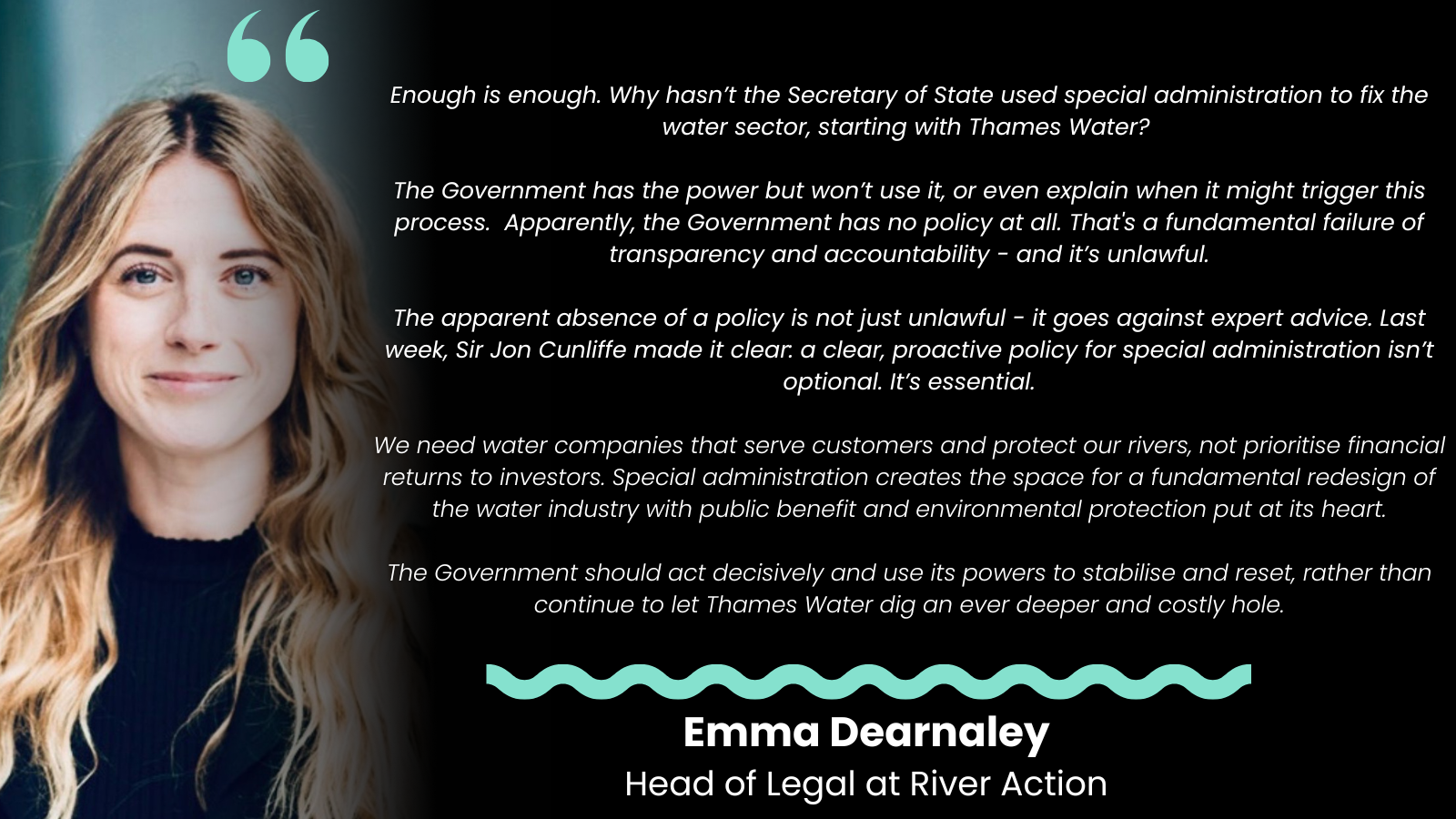
We have filed a legal claim over Environment Secretary Steve Reed’s failure to explain when he will trigger special administration for Thames Water and other failing water companies – despite having the legal mechanism to take action, serious breaches by Thames Water, rising harm to customers and rivers, and calls from the Independent Water Commission for a clearer policy.

Our legal challenge is simple: we say that the Environment Secretary has acted unlawfully by failing to have or publish a policy on when he will use his power to ask the High Court to put a water company in the Special Administration Regime (SAR) – a mechanism under existing legislation specifically designed to enable the government to take action to deal with failing water companies.

This comes amid the deepening crisis at Thames Water, which has repeatedly breached environmental law, mismanaged its finances, failed to invest adequately in infrastructure, and shattered investor confidence and customer trust. Thames Water is on the brink of collapse with £20 billion in debt and widely regarded as no longer investable, with customers and the environment paying the price.

Steve Reed as Environment Secretary or Ofwat as water regulator (with his approval) have the power under section 24 of the Water Industry Act 1991 to ask the High Court to place a water company in special administration on either financial or performance grounds.

Special administration is a temporary insolvency and restructuring process for companies that provide essential public services like water, energy or transport. It is designed to ensure continuity of service while the company is stabilised and restructured. There is a bespoke special administration regime for the water industry, created in 1991 and designed to prioritise customers and services, putting financial interests second. Where water companies are failing, special administration can provide better, fairer and more sustainable outcomes – with the major benefit that it gives the water company the ability to recover and refinance with the opportunity for funds to be redirected away from investor profits towards the urgent infrastructure improvements needed to solve the ongoing sewage crisis, all without exposing its customers and at little cost to the public purse. Yet special administration has never been used for the water industry.

Thames Water has breached its duties and violated its licence conditions, seriously and repeatedly. It is the clearest possible case for special administration.

River Action’s legal challenge

The judicial review is concerned with the legal requirement for the Environment Secretary to have a policy for when he will trigger special administration for water companies. The claim challenges two key failings by the Government:

  1. Failure to publish a policy, breaching core public law duties.
  2. Failure to develop a policy at all, breaching obligations under the Habitats Regulations and other planning and environmental law.

Special administration is not limited to insolvency. It can also be used to protect customers and the environment when a water company is failing to meet performance standards. Our claim focuses on the Government’s approach to triggering a performance-based special administration process.

Under section 24 of the Water Industry Act 1991, special administration can be triggered by a water company’s failure to meet performance standards and a breach of its statutory or licence duties in ways that are “serious enough to make it inappropriate for the company to continue to hold its licence”. We believe that Thames Water clearly meets this threshold and has done so for years.

Independent Water Commission on Special Administration 

Last week, the Independent Water Commission, chaired by former Bank of England Deputy Governor Sir Jon Cunliffe said that “the policy around SAR assessment should be set out more clearly”.  The Commission also said that “SAR should be a practical option for the regulator and government” and stressed the importance of water companies preparing a plan for SAR now.

A route to public benefit models

We believe that special administration represents the most effective and immediate means of addressing the failures within the water industry. We see special administration as the first step toward meaningful and necessary systemic reform including providing the opportunity for a shift to a public benefit model of water ownership, governance and financing, of the type seen successfully implemented across Europe.

We are calling for the urgent use of special administration procedures for Thames Water as a tool to stabilise and reset using public benefit principles, with other failing water companies to follow as necessary.


Frequently Asked Questions


What is the Water Industry Special Administration Regime (SAR)?

The Water Industry Special Administration Regime (SAR) was introduced in England and Wales under the Water Industry Act 1991, with detailed procedures governed by the Water Industry (Special Administration) Rules 2009 and a comprehensive modernisation of the regime in early 2024. The legislative intent behind this regime is to protect consumers, public health and the environment in the event that a regulated water or sewerage company becomes insolvent (an insolvency SAR) or fails to carry out its statutory functions or licensed activities to such an extent that it is inappropriate for it to continue to hold its appointment or licence (a performance SAR).

An application for special administration of a water company may only be made by the Secretary of State or Ofwat with the Secretary of State’s consent. This contrasts starkly with normal administration under the Insolvency Act 1986 which can be applied for by creditors, the company or a director.

Special administration allows the Government to:

  • Appoint independent special administrators;
  • Restructure failing companies and their debt (the focus of an insolvency SAR);
  • Restore and maintain performance standards (the focus of a performance SAR);
  • Ensure water and wastewater services continue without interruption.

Importantly, the special administration regime is designed to keep services running using the company’s own revenues – from ongoing customer bills – not taxpayer funding. It is intended as a mechanism for accountability and  reform, not a bailout.

What are the details of the judicial review claim?

On 7 March 2025, we wrote to the Secretary of State for Environment, Food and Rural Affairs (“SSEFRA”) to ask whether the SSEFRA or the SSEFRA’s ministers had given consideration to whether it would be appropriate to exercise their discretionary power to apply to the High Court to have Thames Water placed into special administration in light of the contraventions of its “principal duties” in accordance with section 24 of the Water Industry Act 1991.

In response, the SSEFRA has refused to provide details of any such policy and has simply contended that there was no requirement to have a “written document or policy”.

Accordingly, we have three grounds of review:

  • Ground 1: Failure to publish a policy. The SSEFRA has a policy on the circumstances in which he will exercise his discretion pursuant to section 24 WIA and has acted unlawfully in failing to publish that policy.
  • Ground 2: Failure to have a policy. If, contrary to Ground 1, the SSEFRA does not have such a policy, that is in breach of Regulation 9(3) of the Conservation of Offshore Marine Habitats and Species Regulations 2017 (the Habitats Regulations).
  • Ground 3: Failure to have a policy. If, contrary to Ground 1, the SSEFRA does not have such a policy, that is in breach of section 85(A1) of the Countryside and Rights of Way Act 2000, as amended by section 245 of the Levelling-Up and Regeneration Act 2023.

We are seeking a mandatory order that SSEFRA either provides details of any policy or, if there is no policy, requires a policy to be developed and published.

Why does Thames Water need to be brought into Special Administration?

  • Persistent failures: Thames Water has a long record of breaching environmental, financial, and regulatory obligations.
  • Record fine: In May 2025, Thames Water was fined nearly £123 million by water regulator Ofwat for breaches of rules relating to its wastewater operations (£104.5 million) and breaches of rules relating to dividend payments (£18.2 million). This is the largest penalty Ofwat has ever issued.
  • Investor confidence collapsing: KKR, Thames Water’s preferred buyer, pulled out of negotiations leaving its various existing lenders as the only option.  Thames Water’s creditors have reportedly demanded that the company and its management be granted immunity from prosecution for serious environmental crimes as a condition of their restructuring proposals, without which Thames Water has said it would not be “investable”.
  • Inflated cost claims: The Treasury has claimed placing Thames Water into special administration could cost up to £4 billion – with reports it told DEFRA that it would have to meet these costs from DEFRA’s annual budget totalling £4.6 billion. Independent experts such as Professor Ewan McGaughey and Professor Dieter Helm believe the £4 billion figure is overstated and politically driven, with the likely costs being much lower and likely to be recouped by the Government on exit from administration.


What is the Independent Water Commission’s view on Special Administration?

On 21 July 2025, Sir Jon Cunliffe’s Independent Water Commission published its 88 final recommendations to the UK and Welsh governments for the reform of the water sector.

Two recommendations were made in relation to the special administration regime:

  • Recommendation 46: The regulator in England and Wales should continue to adopt an evidence-based process to consider, on a case-by-case basis, whether it would be appropriate for a water company to transition to an alternative ownership model where they request to do so or following a Special Administration Regime.
  • Recommendation 59: The regulator in England and Wales should develop and consult on a framework for ensuring companies are prepared for SAR.

In relation to Recommendation 59, the Commission said:

“793. The Commission believes the SAR should be a practical option for the regulator and government but that it should be very much a last resort. However well prepared, a SAR would be a major exercise which carries some risk of disruption to the company’s operation. The Commission notes that lowering the threshold for SAR would increase costs to customers through higher financing given the increased risk on investors. The Commission is also mindful of the risks in creating automatic triggers – experience in insolvency and similar regimes in other sectors, including financial services, is that conditions and circumstances of individual cases vary widely and cannot be anticipated. There is a need for broad, judgement based tests within a clear policy, that has been set out in advance, of how the regulator will assess failing companies against these tests, the factors it will take into account and the indicators it will consider. In the Commission’s view the two current tests for entry into SAR effectively balance objective and subjective factors and include an appropriate level of judgement.  It believes, however, that the policy around making the SAR assessment should be set out more clearly.

794. The Commission believes that further practical steps can be taken to ensure the SAR is a credible, but low probability, threat. In particular, as part of the SAR policy set out above, the regulator should develop and consult on a framework for ensuring companies prepare a plan for SAR. This should consider what the practical barriers to SAR might be, and how these can be mitigated in advance.”

Although the Commission’s recommendations focus on the regulator, its comments around the need for a clearer policy for special administration logically apply to both Ofwat as regulator and SSEFRA, as the two authorities with the power to petition the High Court for a special administration order.

Spending Review: Boost for farmers, blow for regulators

Download PDF

Spending Review: Good news for farm payments – but not for regulation as DEFRA budget reduced

We welcome the government’s commitment to significantly increase funding for Environmental Land Management Schemes (ELMS) – with the budget set to rise by 150% from £800 million in 2023/24 to £2 billion by 2028/29. This substantial investment offers a vital opportunity to support farmers in restoring nature, improving soil health, and reducing agricultural pollution in our rivers and streams. But is it enough?

In a difficult fiscal period, DEFRA needs all the support it can get to increase funding for the transition to nature-friendly farming. However, the Spending Review raises serious concerns about the Government’s ability to protect river health. DEFRA’s overall budget has been reduced by 2.3% in real terms – continuing over a decade-long decline in funding. As a result, it remains under-resourced to enforce environmental laws at scale, limiting regulators’ ability to hold polluters, including water companies, to account.

Water bill payers across the country expect their water companies to be held responsible for pollution – not rewarded for failure. Weakening the watchdogs that should be protecting the UK’s rivers and water supply is unwanted by the public.

Growth for who?: The true cost of water pollution

Download PDF
By Henry Shepherd, Communities Coordinator, River Action

“Economic growth is the number one mission of this government” says Rachel Reeves.

Yet, as rivers fill with sewage and budgets for environmental protection are slashed, many small businesses and communities that rely on clean water are being left behind – or worse, shut down.

Across the UK, water pollution is no longer just an environmental and public health issue – it’s an economic one. Behind every brown plume, fish kill, or no-swim warning, there’s a person whose livelihood is taking a hit.

These aren’t abstract numbers or distant disasters, these are real people – watersports instructors, anglers, B&B hosts, event workers – who depend on rivers being clean, safe, and healthy. However, as the toxic cocktail of agricultural runoff, raw sewage, and chemicals continues to flood our waterways, and environmental oversight is gutted, many are finding themselves on the losing end of the government’s “growth” agenda.

“I’ve been shut down and unable to sell my product due to sewage spills upstream… I’m now effectively without a source of income”

Calvin, watercress farmer from Hampshire


The new Labour government has made no secret of its intention to turbocharge economic growth. This growth is achieved via cutting environmental budgets, and stripping regulators of the resources they need to hold polluters accountable. Those who end up winning are corporate shareholders – and the losers are small, local businesses that are being slowly drowned in polluted waterways. This has knock-on effects across entire local economies – the pint in the pub, the B&B, and the stop at the shop after your fishing trip hit local communities in ways we can’t always measure.

“Once a thriving business, I now haven’t taken on a customer in 12 months.”

Angela Jones, watersports business owner on the River Wye


It’s a bitter irony: the very communities that should be benefiting from Labour’s pursuit of ‘growth’ are being stifled by the fallout of short-term thinking and insufficient regulation. River-dependent businesses losing trade due to smell and stigma – cancelled sports events  and family holidays – river users unable to work after getting sick. Entire local economies are being dragged down by the stink of polluted rivers.

This is a symptom of a system that values profit margins over public health, investor returns over infrastructure, and “growth” over anything remotely sustainable. That’s why we’ve written to the Prime Minister and the Chancellor to urge them to end the era of cuts to Defra.

“We rely on membership subs for our Rowing club to survive … .if you don’t want to get sick, why would you pay to row on a nasty river?”

Tom, Club Captain at Durham University Rowing Club


Until water is protected like the public asset it is – not a dumping ground or a corporate cash cow – these stories will keep piling up. And so will the pollution. As the government finalises its spending plans on 11 June, we’re forced to ask:

Growth for who?

Privacy Overview

This website uses cookies so that we can provide you with the best user experience possible. Cookie information is stored in your browser and performs functions such as recognising you when you return to our website and helping our team to understand which sections of the website you find most interesting and useful.