13 March 2024 – Today, River Action is proud to be partnering with British Rowing, The Rivers Trust and Aquascope to help support and empower rowing communities to rescue Britain’s rivers.
“We are in a freshwater emergency that demands urgent action. Our rivers are in crisis, dying at the hands of poorly regulated polluters including the water companies and industrial-scale agriculture. That’s why we are proud to partner with British Rowing to help clean up the nation’s rivers. This will involve training rowers, including Olympic medal hopefuls gearing up for the summer games in Paris, to conduct water quality testing that will help us understand the risks to human health and the extent of the problem we face. Together with British Rowing, we will be supporting rowers and communities to pressure polluters and the Government to act with urgency.”
We are delighted to welcome Nick Woolgrove as our new Campaigns Analyst to the River Action team. In our latest blog, we get to know more about Nick and the role that he will play to help rescue Britain’s rivers.
Q1. Tell us about yourself
Hello, very excited to join River Action as the new Campaigns Analyst! I’m originally from Sussex and I have travelled a fair bit for work, but finally settled in beautiful Cornwall as my home. I’m a devoted advocate of everything nature and at my happiest when wild camping, swimming, and walking. I also play folk music.
Q2. How did you become interested in river protection?
I was brought up in Sussex and spent a lot of time walking and swimming in the outdoors. I was well aware from an early age that our local rivers and coastal areas were ‘toxic’. I’ve since spent many years living in Cornwall where I’m a frequent swimmer and all too aware of the horrific discharges into our waterways – it’s daily check of the SAS map to see if we can even swim at our local beaches in Falmouth!
I grieve the increasing loss of the natural world. If trees are the lungs of the earth, then waterways are the veins and arteries; home to immensely important habitats and providers of essential ecosystem services without which our society simply could not function. More than this, rivers are things of wonder and beauty. They inspire us to create, to travel, to play, as they meander their ancient ways through the ever-changing landscape. It is shameful how rivers have been abused and neglected by successive governments, companies, and regulators who appear unable to comprehend their true value and importance. I’m proud to now work for a campaign organisation who are committed to providing powerful new voice for rivers which has been so long overdue.
Q3. You have a wealth of experience working in research. What have you enjoyed most about your work and what have been its biggest challenges?
My career so far has really been motivated by working on projects which try and make a difference. My PhD is reflective of a deep curiosity around local and national policy decisions associated with the environment, specifically to bring a better understanding of how nature recovery can also lead to more prosperous local communities. The joy of research is transforming abstract data into meaningful narratives which connect with people and bring about real change. Transitioning from academia to campaigning is incredibly exciting, though perhaps the greatest challenge is the pace at which newly released data needs to be turned around into a compelling story that engages a wide audience.
Q4. Tell us about your new role as Campaigns Analyst at River Action…what can we expect to see from your role in 2024?
My role in River Action is to provide the strong and compelling data driven evidence to support our campaigns and communications. In particular, this involves analysing emerging government and industry data, pollution statistics, legal cases, policy papers, and FOIs to build a nuanced picture of the challenge and ensure our outputs are robust and evidence-based. A particular focus moving forward is interpreting often complex emerging data in the most engaging way for the general public and media.
Q5. Finally, in your opinion, what is further needed/what needs to change to rescue Britain’s rivers?
We need regulators who regulate. Empowered communities. Farmers who are financially supported to deliver sustainable change to their practices. Industries who consider nature recovery an unnegotiable cornerstone of their business models. Water companies to start taking serious social and financial responsibility. And a government who recognises the disastrous state of our rivers and is committed to immediate action and investment. So, not much . . .
What better genre to tell the horror story of the national river pollution scandal than folk horror?
Cathy Wippell’s offer to River Action to be Executive Producer on her new film (she wrote it and stars in it too), Black Samphire, was a welcome surprise. She hooked me with her creativity and drive to tell a cautionary environmental story.
Together we discussed how impossible it is to ignore the news of rising water pollution levels. I recall Cathy, a keen open water swimmer, telling me that nowadays instead of just launching into the water, there are questions of hygiene and health to consider. She said, “That’s one of the horrible things about pollution; it makes people distrust the environment they themselves are destroying.”
And so we signed on and armed with a tiny budget and the creative juices of budding young filmmakers and actors. Black Samphire extracts a chilling tale from the stinking cesspool of our waterways that takes our shared mission to rescue Britain’s rivers to new audiences.
In the film, enveloped by the dark hues and eerie sounds of a ghostly marshland, a couple find themselves drawn to the strange black samphire whose tasty leaves are tinged by the effluent of a local sewage pipe.
A subtle, unsettling tale of insidious creeping horror unfolds; screaming darkly to an audience forewarned by folklore, and public outcry across the media of failing water companies, greedy multi-national agri-business and captured environmental regulators. While one character, Mari battles with an impatient boss – thank you Stephen Fry for lending your voice – Isla retreats from reality towards an ending of unwitting violence upon the love that sustains her.
The story cleverly mirrors the pernicious demise of the lifeblood of our land, turning healthy vital waterways into poison coursing through our national veins. Alongside Cathy (Mari), Ishtar Currie-Wilson (Isla) leads the tale, bringing her genre presence, crafted in the Netflix hit, Lockwood & Co, and honed in the new Omen prequel about to hit cinemas.
Noting how much she enjoyed working on Black Samphie, actor Ishtar Currie-Wilson told me, “I think that horror has always been the leading genre in making significant and accessible cultural commentary and with our current climate crisis there has never been a more important time to bring these stories to the big screen. I would expect to see a lot more environmentally focused films within the years to come.”
These two actors are going somewhere. But what about our rivers? Every single one in Britain is polluted with a toxic cocktail of agricultural run-off, raw sewage, micro-plastics and forever chemicals. By supporting this film, River Action raises the deathly spectre of the collapse of our rivers and wildlife to show viewers that this catastrophe is real and affects us all. From health risks and wildlife depletion to food production and the economy, we all need healthy rivers and abundant clean water.
A thought-provoking new tool in our campaigning box, Black Samphire adds a novel dimension to help take our powerful message to the victims of these crimes; the voting and consuming public, and perpetrators, greedy corporations as well as our failing environmental regulators. In the words of our Vice Chair, Feargal Sharkey, “We have been ripped off for too long. It’s time for urgent regulatory reform and polluting industries to clean up their mess. END RIVER POLLUTION NOW!!”
Black Samphire is a chilling, British folk horror short film that circulates the theme of pollution, our complex relationships with our own environment and the consequences of ignoring the signs.
Co-produced by Silicon Gothic and River Action, the film is scheduled for release in March 2024.
Q1. Tell us about yourself
I’m a writer and actor working primarily in bringing female-led, environmental and socio-political stories to the thriller and horror genres in film. I have a background in activism, having co-founded the SAFER campaign whilst studying at the University of Manchester, which went on to be featured in BBC News, the Today Show and referenced extensively in parliament debates.
I started acting professionally after I graduated in 2021, and discovered writing and producing through my work in screen acting. My first short film, Bloom, interrogated sexual assault without ever actually explicitly mentioninging it and was created with an all-female cast and crew. The film was featured in Film Stories magazine.
Q2. In April, 2022, you co-founded the production company, Silicon Gothic Ltd with director and producer, Joseph Archer. What was the inspiration behind creating Silicon Gothic?
The idea for Silicon Gothic stemmed from mine and Joseph’s own, personal concerns with our changing natural world. Climate change is such an overwhelming, multi-faceted issue, and we found that personifying issues like fast fashion, water pollution etc into modern, tangible monsters was a way to make these issues more digestible and understandable for our audiences.
On a more personal level, I found that writing stories with monsters like these at the core of them was a catharsis for many of my own anxieties with climate related issues. The fable-like nature of our stories hark back to my fascination with English folklore, and this is definitely an influence for us as well; with folklore being so informed by the mysteries and intricacies of our land and elements, the British folk-horror tradition is at play in a lot of Silicon Gothic’s work.
Q3. Tell us more about the short film, Black Samphire. Where did the idea stem from and why did you want to make it?
I grew up partly in Shipton Green, Itchenor and harvested wild samphire myself with my mother when I was little. As well as this, we also picked wild blackberries. I remember it was always a race to get the blackberries when they were just ripe, or the other families would beat you to it. This had me thinking about human greed, and the hunger to use up our natural resources from an early age.
I’ve always been a keen open water swimmer and, as I mentioned, it was hard to ignore the news this summer of rising water pollution levels, especially when two of my local swimming spots were fenced off for a time. Seeing how the world changes in such a short time, and in the place I grew up trusting my environment so much, deeply disturbed me; instead of just launching into the water, there were questions of hygiene and health to ask. That’s one of the horrible things about pollution; it makes people distrust the environment they themselves are destroying.
So, armed with these ideas, I wanted to create a story about overconsumption set in the marshlands in West Sussex. When River Action came on board as executive producers, they really helped to bring out the element of water pollution that was present in the script. Their expertise and information resources steered the story to more explicitly address the issue as the ‘monster’ of the narrative.
On the 31st of July, 2023, as we were beginning pre-production, an Unearthed investigation found that ‘over 300,000 hours of sewage spills hit England and Wales most protected habitats’ in 2022. On the 5th of August 2023, as we were well into pre-production, fifty seven triathletes were hospitalised after partaking in the Sunderland triathlon championship due to swimming in polluted water. Now, just as we’ve finished the film, the UK’s ‘urgent’ plan to tackle the sewage pollution crisis has been delayed by four months, with no date of publication in sight (Source: The Guardian).
In other words, the water pollution crisis in the UK has been present throughout the whole process of this film. What’s more, it won’t go away anytime soon, unless we take urgent action. The ever increasingly relevant issue of water pollution on the British Isles has shaped ‘Black Samphire’ from start to finish, and will continue to inform the project’s journey.
Q4. You have worked on Black Samphire as both writer and actor – do you enjoy the extra responsibility that this entails?
To be honest, writing and acting in the same project is always a huge positive for me; as I’m lucky enough to be with the characters from when they were literally created in my imagination, I often find that most of my character work has been done and interrogated throughout the script writing process. So, this makes my life easier on set, as it’s really easy to switch into character quickly.
I’d say the extra responsibility on this film actually came from mine and Joseph’s shared responsibility with the company. As the marshlands are actually quite precarious to shoot on due to uneven ground and swampy, soft land (we had an issue with a sinking light at one point!), we had to make sure proper risk assessments and safety checks were carried out for the safety of the cast and crew. We did so many recces of those wetlands – maybe about six or seven despite the fact that I was already familiar with the area.
Q5. Do you have any favourite moments from the shoot?
One of my favourite moments has to be when we were shooting the final scene. Without giving away too much, there’s a part in the film where Isla has to spit black gunk out of her mouth. The blocking for the scene had me lying in the marsh, with Ishtar (who plays Isla) leaning over me. As we were about to shoot, there was a concern with costume continuity as we needed my costume the next day, sans black gunk.
So, Ishtar said ‘Don’t worry, I’ll spit it so it doesn’t go anywhere near the costume’. And you can guess what happened next – it went all over me and it was hilarious. It’s a very intense, emotional scene, and having that happen was so unexpected and funny that it was difficult for a moment to stay in character!
Having James and Erica from River Action visit the set was also a highlight for me. It was really great to share the set experience with them, and to have them there from script stage all the way through to the distribution phase is very special indeed.
Q6. What are you looking forward to working on next?
For me, ‘Black Samphire’ is my primary focus at the moment. The short film is actually a proof of concept for a full-length feature, so I’ve already started working on the treatment, and then I’ll be looking for commissioning to write the feature script itself. I feel a real sense of urgency with this story and narrative, so it’s going to be a matter of working on the feature as the short undertakes its festival circuit.
Silicon Gothic will be pitching a slate of films, including Black Samphire, at the Cannes film festival this year, as well as other international and national film markets throughout the year.
The agonising death of the River Wye has unfolded in recent years like a car crash in slow motion.
This magnificent watercourse, so often voted our country’s most loved river, has in recent years been assaulted by a deluge of pollution from intensive agriculture, causing prolonged algal blooms which turn the river each year into a putrid green soup, snuffing the life out of the river by starving it of oxygen and light.
How could this have happened to a river with some of the highest available environmental protections, such as its Special Area of Conservation (SAC) status? One answer can be found in 2018 when Tesco awarded Avara Foods, the Cargill owned Hereford-based poultry processor, its principal contract to supply chicken meat. To satisfy our largest food retailer’s insatiable weekly demand for three million chickens, a spate of planning applications was waived through by local councils to build dozens of new intensive poultry units (IPUs). The net result today is over 24 million birds being reared at any one time across the Wye river catchment – around a quarter of the country’s total poultry production.
These huge chicken sheds are today’s equivalent of the infamous Dark Satanic Mills of Victorian times. Their production cycle starts with hundreds of thousands of tiny chicks (or pullets) being stuffed with feed imported from Cargill’s intensive soy farms in deforested Amazonia (therein lies another scandalous tale of environmental destruction). Within six weeks these force-fed birds (which although fully-grown are not able to walk due to the speed in which they have been “produced”) are whisked off to become Tesco special offer drumsticks or some ready meal.
But the worst is yet to come.
The tens of thousands of tons of excrement in which these wretched creatures waddle during their short miserable lives is then shovelled out of the sheds and dumped across the fields of the Wye Valley and elsewhere. In a short period of time this industrial-scale manure dumping has caused the land of the river catchment to become overdosed by several times the level of phosphorous that can ever be absorbed naturally by what grows there. And each year more gets added.
The extraordinary thing is that we believe doing this is often in breach of the law. The 2018 Farming Rules for Water created a set of protections for watercourses to prevent agricultural pollution. The most important of these in our view is Regulation 4, which states that it is illegal to apply to the land organic manure or manufactured fertilisers in a manner that would “exceed the needs of the soil and crop on that land”.
If this law to prevent nutrient oversaturation had been properly enforced, then we argue that the horrendous pollution of the Wye catchment could have largely been prevented. However, we believe effective lobbying by the National Farmers Union led to DEFRAinstructing the Environment Agency to turn a blind eye to enforcing this critical protection. Disappointingly, the EA has slavishly followed the instructions of its political masters and the tragic consequences are all too plain to see.
Determined to challenge this state of affairs, River Action has spent the last 12 months clawing our way through a tortuous legal process to be able to hold the Environment Agency and DEFRA to account through a Judicial Review. Finally, we made to the High Court this week where we faced up to the combined force of the legal teams of the Environment Agency, DEFRA and the NFU. The latter at the last minute gate-crashed the legal proceeding to defend the rights of its members to continue to dispose of manure in a manner, we believe, pollutes rivers.
At the core of our legal case is our view that the EA has acted unlawfully by not enforcing these regulations. In doing so, we believe it has also failed dismally in its statutory duty to protect the SAC of the River Wye.
As the river continues its death spiral (its environmental status was recently downgraded by Natural England to just one notch up from being pronounced dead), there remain a few rays of hope. Faced with a huge public outcry, Avara has now acknowledged its role in polluting the Wye and has pledged that all manure produced by its supply chain will be exported out of the river catchment. Meanwhile, a small number of exemplary poultry producers, such as the 625,000-bird Whittern Farms in Herefordshire, have started recycling their chicken manure into phosphate- rich pelletised fertiliser. This in turn is sold to arable farms in East Anglia to substitute imported chemical fertilisers.
However, whilst these individual initiatives must be welcomed, they will not move the dial if the environmental regulations designed to protect our rivers are not robustly enforced.
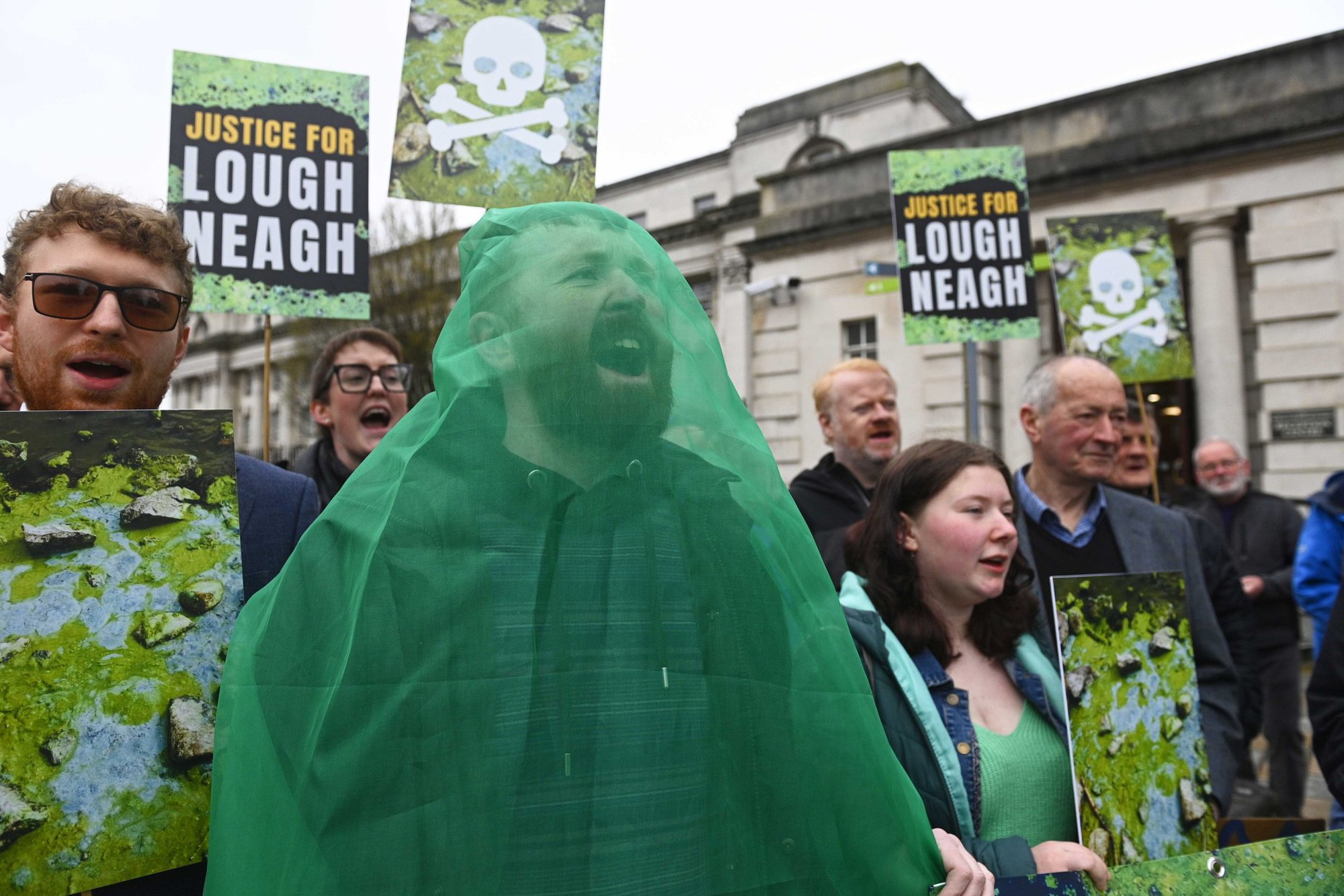
Communities up and down the Wye and along other rivers across the nation will now be anxiously awaiting the judge’s deliberations on our Judicial Review. Many of these inspiring river activists were with us this week demonstrating outside the court in Cardiff as we went in to begin the Judicial Review hearing.
We can but dare to hope that the courts provide our long-suffering rivers with a final line of defence, given the abject failure of those government agencies whose job it should have been to protect them.
Landmark legal action to save River Wye from pollution
Hundreds of people fearful for the ecological collapse of the River Wye, including river campaigner Feargal Sharkey, today gathered outside Cardiff’s Civil Justice Centre supporting a landmark legal case pursued by River Action against the Environment Agency and DEFRA.
The core of the Judicial Review is River Action’s belief that by failing to enforce critically important environmental regulations, the Environment Agency has acted unlawfully; and in doing so has failed to protect the Special Area of Conservation of the River Wye from the huge levels of diffuse agricultural pollution that has caused so much of the recent ecological collapse of the river.
Outside of Cardiff’s Civil Justice Centre, Chair and Founder of River Action Charles Watson, flanked by a 10ft tall giant puppet called the Goddess of the Wye, a steel drumming band, River Action’s legal team Leigh Day, lead barrister David Wolfe KC, Feargal Sharkey, Friends of the River Wye and many more concerned community groups, said:
“The agonising death of the River Wye has unfolded in recent years like a car crash in slow motion. This magnificent watercourse, so often voted our country’s most loved river, has in recent years been assaulted by a deluge of pollution from intensive agriculture, causing prolonged algal blooms.
“A major cause for this is the recent exponential growth of intensive poultry production within the catchment of the River Wye, which supplies millions of chickens a week to the nation’s leading supermarket retailer Tesco. At any one time there are as many as 24 million birds reared in the Wye valley – approximately a quarter of the country’s total poultry production.
“The thousands of tons of excrement from these birds is then shovelled out of the sheds and dumped across the fields of the Wye Valley and elsewhere. This industrial-scale manure dumping has caused the land of the river catchment to become overdosed by several times the level of phosphorous that can ever be absorbed naturally by what grows in the valley. And each year more gets added.
“If the law to prevent nutrient oversaturation had been properly enforced, then we argue that the horrendous pollution of the Wye catchment could have largely been prevented. However, we believe effective lobbying by the National Farmers Union led to DEFRA instructing the Environment Agency to ignore enforcing this critical protection – effectively giving the intensive poultry industry carte blanche to dump the manure they produce across the Wye Valley, thus causing untold environmental damage to the River Wye. Endangered species like the Atlantic Salmon are on the cusp of localised extinction. We are asking for something very simple of the Government: please enforce the law.”
Crowdfunder to help cover River Action’s legal costs This legal challenge presents a unique and urgent opportunity to force the Environment Agency to do its job and finally start to enforce the laws that exist to protect our rivers. In doing so it can help save the River Wye and ensure that its polluters are held to account. However, the predicted costs of this critically important legal case will exceed £60,000.
Chair and Founder of River Action Charles Watson said, “Please, if you can, help us cover our legal fees, research, and campaign costs to ensure the biggest impact is made.”
For interviews call Ian Woolverton on 07377 547 362 or email media@riveractionuk.com
Responding to the news that the average household water and sewerage bill in England and Wales will rise by 6% or about £27 to £473 a year from April 1, CEO of River Action James Wallace said:
“While support for lower income households is welcome, when the water industry says £14.4 billion will be invested by water companies what they really mean is most of the money will be paid by customers, again.
“Ultimately the Government is to blame for allowing water companies to profiteer while manipulating water pricing downwards over the past 14 years, creating a false illusion of cheap water, without even considering the costs of inflation.
“The suggestion that customers should pay more for water will be a very tough message to sell when the bills they have already paid water companies have been squandered on shareholder dividends and CEO bonuses rather than investing in maintaining leaky infrastructure.
“Why should the public pay twice for the modernisation and maintenance of sewage treatment and water resources? What assurances will the Government provide to ensure customer money is actually spent on promised water security and cutting pollution? Having overseen corporate daylight robbery for years, rebuilding trust will be key.
“And when will this Government commit to restructuring failing water companies and reform and refund the ragged skeletal remains of the Environment Agency and Ofwat? The freshwater emergency demands immediate systemic change to avert widespread ecocide and water shortages that will affect millions.”
ENDS:
For enquiries, comment or further information, please contact:
Ian Woolverton, Senior PR Coordinator: 07377 547 362; ian@riveractionuk.com
River Action has been granted consent to pursue a legal challenge against the Environment Agency over its failure to enforce critical agricultural pollution regulations called the Farming Rules for Water.
We will argue that by failing to prevent the spread of excessive levels of manure across agricultural land in the Wye river catchment, the EA has acted unlawfully by not enforcing existing rules for farmers. We are convinced that had these regulations been properly enforced, much of the horrific pollution along the River Wye could have been avoided.
Today, we have launched a crowdfunder to help with the costs of our legal challenge. If you can, please share far and wide. Thank you for your support 💚.
A huge thank you to eight-year-old Austin for sending over his brilliant invention, the ‘River Rescue Rocket’, which he created for his class’s science project as a solution to combat river pollution.
Take a read of his proposal below. Every detail has been thought out, even down to a solar-powered engine. Many of us could certainly take a leaf out of Austin’s book. Great job!
River Action’s response to the Office for Environmental Protection report, published today, which shows progress to ensure rivers reach good ecological status by 2027 is “largely off track”.
James Wallace, CEO of River Action UK, says, “It is no surprise that the Government’s own regulator – the OEP – gives a largely damning report on progress towards legally binding targets.
“After 14 years of cutbacks for environmental regulation, our rivers, wildlife and water security are in a dire state. Next we need the OEP to unleash its full armoury in pursuit of the many complaints of Government malpractice, incompetence and illegality with ferocity and urgency, and to pressure the Government to do its job: incentivise sustainable farming and waste management, ensure water companies are structured and financed to serve their customers, and ensure Ofwat and the Environment agency are reformed and resourced to monitor polluters and enforce the law.
“CEO’s of profiteering corporations like Thames Water should be quaking in their boots at the thought of penalties and prosecution, not laughing all the way to the bank. We are in a freshwater emergency and desperately need leadership and action, not broken promises and kowtowing to international shareholders.”
ENDS:
For enquiries, comment or further information, please contact:
Ian Woolverton, Senior PR Coordinator: 07377 547 362; ian@riveractionuk.com