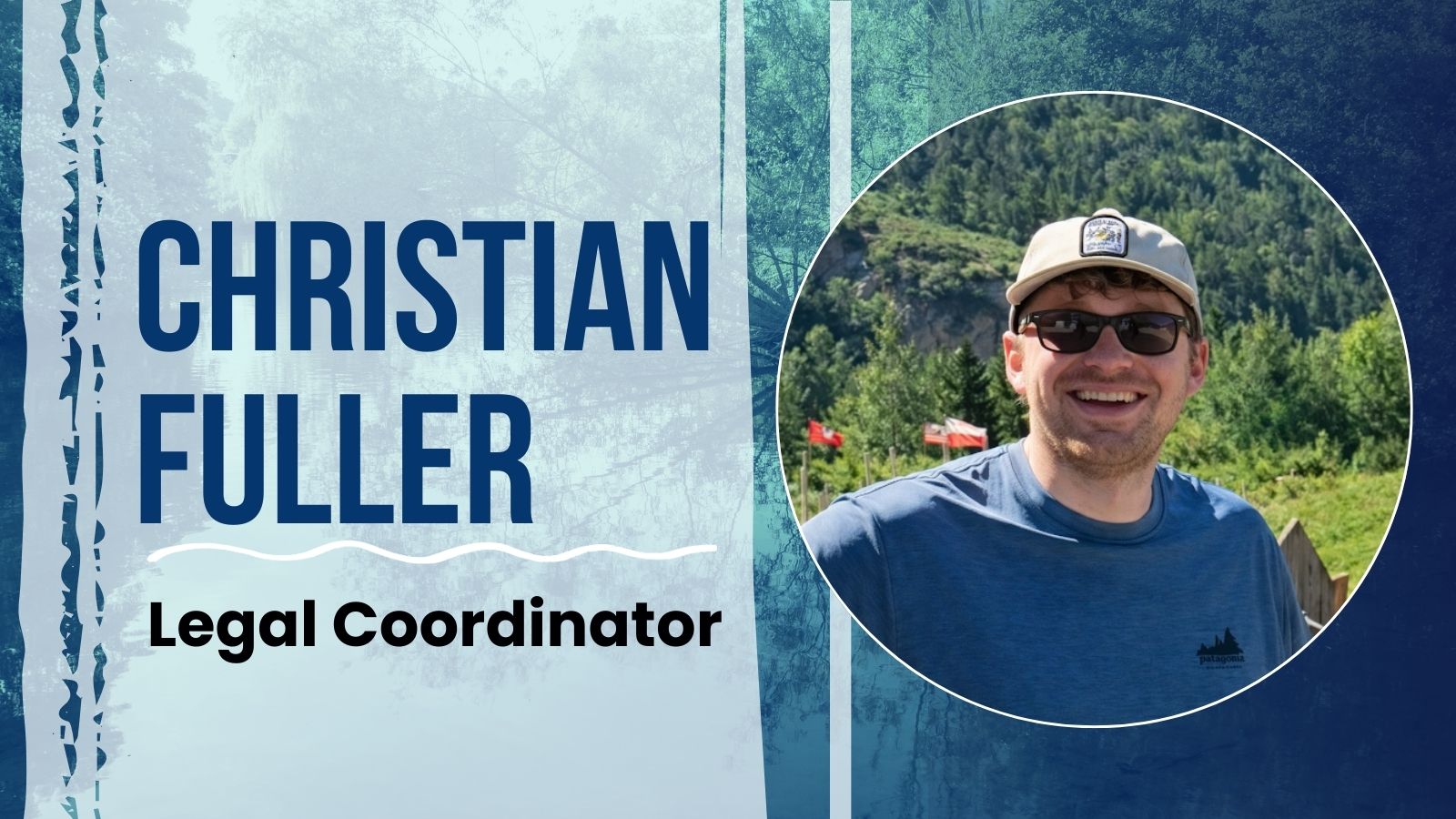
Meet Christian Fuller, River Action’s new Legal Coordinator
Q1. Tell us about yourself
Hi, I’m Christian, and I’ve recently joined River Action as Legal Coordinator.
I grew up in Conwy, where the Eryri National Park was a constant part of my life. Those early experiences shaped my relationship with nature: not something to dominate, but something we live alongside and have responsibilities towards.
Before joining River Action, I worked across environmental law, political monitoring, and campaigning, most recently at Greenpeace International in Amsterdam. Alongside this, I’ve been involved in political and environmental campaigning through SERA, Labour’s environment campaign. I’ve just moved back to the UK, and I’m really excited to be putting my skills to use protecting rivers and supporting the communities that depend on them.
Q2. What first sparked your interest in protecting rivers and freshwater ecosystems?
I am lucky to have spent a lot of time kayaking and swimming in rivers and lakes. As I got older, seeing those same rivers increasingly affected by pollution, sewage discharges, the climate crisis and ecological decline made the crisis feel both urgent and personal. Historically, geographically, and politically, rivers are meeting points in the British Isles. Rivers are the places where the climate and biodiversity crisis, corporate exploitation and weak enforcement meet, but they are also the space where we can come together to write something new.
Q3. You have just spent 6 months at Greenpeace International. Can you describe the work you did there, the campaigns you were involved with, and what you learned from that experience?
After completing a Masters in International Environmental Law at Utrecht University, I joined the Greenpeace International Legal Unit in Amsterdam for a six-month internship. What stayed with me most was seeing how powerful the law can be when it’s used alongside campaigning and political pressure. I supported strategic litigation across several campaigns: challenging unlawful deep-sea mining in areas beyond national jurisdiction; pursuing accountability for forced labour at sea in corporate supply chains; and using European law to resist a multi-million-dollar SLAPP suit brought by a US oil company against Greenpeace. I was also lucky enough to attend the International Court of Justice’s historic Advisory Opinion on Climate Change and to scope future climate litigation to build on 2025’s historic legal victories.
Q4. You serve as an executive committee member at the Socialist Environment and Resources Association (SERA). Could you tell us more about that role, what the organisation does, and how that experience shaped your approach to environmental advocacy?
SERA is Labour’s environment and climate organisation, working to strengthen ambition across the movement by connecting grassroots members, trade unions, NGOs and parliamentarians, and putting climate, nature and environmental justice at the centre of political power. As an executive committee member, I contribute to strategy, governance, fundraising and campaign development. I also founded and led Our Earth in 2050, a youth-led initiative amplifying young people’s voices within Labour’s environmental agenda – defining its purpose, securing resources, coordinating volunteers and building partnerships. This experience has shaped my approach to environmental advocacy by highlighting the importance of coalition-building, clear strategy, and political judgement – an approach I now bring to my work at River Action, where legal accountability, community mobilisation, and political engagement are combined to protect rivers and the communities that depend on them.
Q5. Looking ahead to your new role as River Action’s Legal Coordinator, what will you be focusing on, and what can people expect to see from you in 2026?
My role focuses on using the law as a lever for change. That includes supporting River Action’s strategic litigation, producing legal research and briefings, monitoring legal and policy developments, and working closely with colleagues and communities to ensure legal action feeds into wider campaigns.
A key part of the role is helping connect legal expertise with grassroots action – ensuring communities have the tools, information, and confidence to challenge pollution and hold decision-makers to account.
I’m particularly excited to contribute to legal strategies that are scalable and catalytic, such as catchment-based approaches that stops pollution at source, strengthens enforcement, and supports community-led action. There’s huge potential to use the law creatively and collaboratively, and I’m looking forward to helping develop that work.
Q6. Finally, in your opinion, what needs to change to rescue Britain’s rivers?
We need to move from a system that tolerates pollution and decline to one that actively prevents it. That means deliberate decision-making, stronger enforcement, real consequences for polluters, and communities having access to information, tools, and legal leverage. It also means recognising rivers as living systems that deserve protection in the public interest.
We have to shift legal and governance systems, move the markets, and empower communities. I’m excited to join River Action, whose approach, combining law, campaigning, and community action, gives me a lot of hope.