Sir Steve Redgrave Joins Communities in Legal Action Against Thames Water Pollution
Thames Water knew over 90 sewage sites were failing as 13 communities and Sir Steve Redgrave launch UK’s first coordinated sewage pollution statutory nuisance action
We can today reveal, using documents submitted by Thames Water to Ofwat, that 93 sewage treatment works and water pumping stations the company promised to upgrade remain unfinished, leaving rivers across the Thames catchment exposed to continued pollution and dangerously high levels of bacteria.
With Thames Water failing to act, 13 communities from Buckinghamshire and Elmbridge to Hackney, Hammersmith & Fulham, Oxford and Richmond to Wokingham are now fighting back, sending statutory nuisance complaints to their local authorities to demand accountability and urgent action.
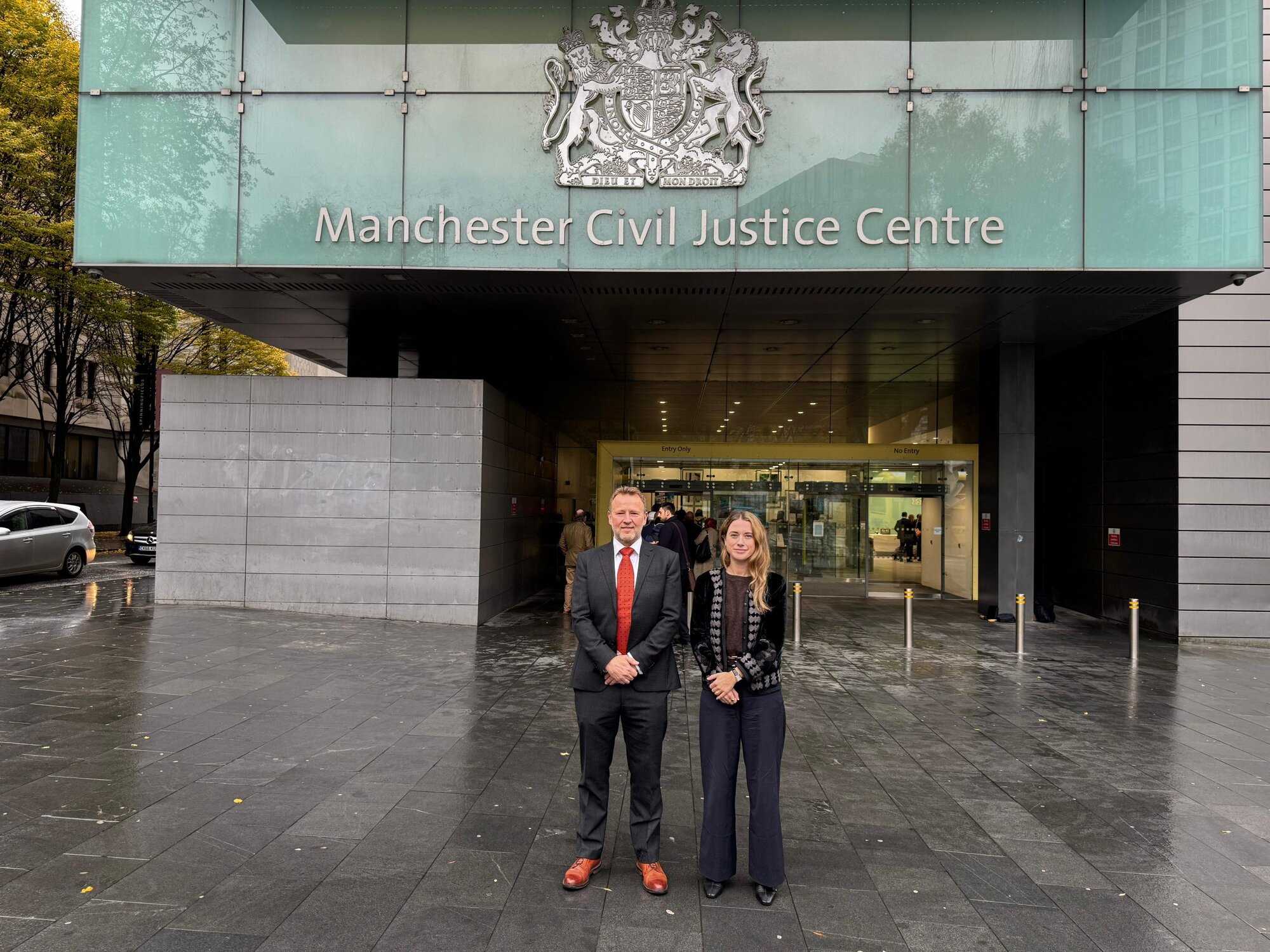
This marks the launch of the first coordinated statutory nuisance action of its kind, with communities uniting to ask local authorities to hold Thames Water legally accountable for the impact of sewage pollution. Rowing legend Sir Steve Redgrave and Olympic champion Imogen Grant MBE have also submitted nuisance complaints, joining residents from across the Thames. It follows a nuisance complaint brought by Matt Staniek of Save Windermere after pollution by United Utilities harmed England’s most famous lake.
Communities fighting back
With Thames Water failing to act, residents across the Thames catchment are turning to the law to challenge sewage pollution in the River Thames. communities in Buckinghamshire, Elmbridge, Hackney, Hammersmith and Fulham, Hounslow, Oxford, Richmond upon Thames, South Oxfordshire, Southwark, Vale of White Horse, Wandsworth, West Berkshire and Wokingham have today sent statutory nuisance complaint letters to their local authorities based on the sewage pollution experienced in their area, asking them to make Thames Water take decisive action to stop its sewage pollution that is causing harm along the River Thames.
River Action and these communities believe that discharges of untreated or inadequately treated sewage from infrastructure operated by Thames Water constitute a statutory nuisance under section 79 of the Environmental Protection Act 1990.
This type of complaint should trigger an investigation by the local authority to determine whether a statutory nuisance has occurred or is occurring and take reasonable steps to investigate the issues raised. If sewage is found to cause a statutory nuisance, an abatement notice — a legal order that would require Thames Water to stop causing the nuisance or face criminal prosecution – is required to be served on Thames Water by the local authority.
A statutory nuisance is an activity that unreasonably interferes with peoples’ use or enjoyment of land and is likely to cause prejudice or injury to health – for example, through noise, smells or other forms of harm. A ‘nuisance’ is described in case law as being a state of affairs which is not something “objectively a normal person would find it reasonable to have to put up with”. In this case, residents argue that sewage pollution from Thames Water’s failing sites and infrastructure has made rivers unsafe, disrupting recreation, sport, local businesses and everyday enjoyment.
Real-world examples underline the risks:
- A 16-year-old rower from the Henley Rowing Club became unwell after training on the river; tests confirmed he had contracted E. coli. His illness coincided with his GCSE exams, preventing him from revising and sitting some papers.
- In West Berkshire, a kayaker capsized and became unwell over the following days.
- At Taggs Island, five children fell ill after playing in the River Thames near Hurst Park.
These complaints seek to hold Thames Water legally accountable for the harm and interference caused by sewage to riverside communities, recreation, business and public health.

Calls for intervention
We are calling on local authorities to investigate these complaints and for the Government to apply to the High Court to put Thames Water into special administration to prioritise investment in sewage infrastructure and protect bill payers and the river that sustains our economy.
Our Head of Campaigns, Amy Fairman said:
“This action is about fixing sewage pollution in the Thames for good, not compensating people for past failings.
Each local authority must investigate these complaints and, where statutory nuisance is found to exist, issue an abatement notice and take enforcement action. Councils now have a legal duty to act.
Despite extensive evidence of performance failures and being on the brink of insolvency, the Government has not taken steps to place Thames Water into a special administration regime, a process that would allow for urgent infrastructure upgrades, put public interest ownership and governance first, and protect communities and the environment.
River Action is calling on the Secretary of State for the Environment to act now: the Government must take temporary control of Thames Water to end the era of private profiteering and stop polluting the river.”
Dirty discharges and dangerous bacteria levels
At several sites, it’s not just sewage overflows that are causing pollution but also the quality of treated effluent which also presents a direct threat to public health.
- At Henley-on-Thames Treatment Works, Thames Water’s own data – obtained by River Action from Thames Water via an Environmental Information Request – shows E. coli levels in treated effluent reaching 28,000 cfu/100 ml in September 2023 – more than 30 times the safe limit for designated bathing water. This toxic cocktail is a direct threat to swimmers, rowers, anglers, and wildlife.

Case study: Newbury Sewage Treatment Works (STW)
Newbury STW discharges into the River Kennet, within a globally rare chalk-stream catchment. The river is designated as a Special Area of Conservation and Site of Special Scientific Interest.
Thames Water classifies Newbury STW as one of Thames Waters top 26 most polluting sites (Ofwat, May 2025).
- Sewage spill hours increased 240% between 2019 and 2024, rising from 482 hours to 1,630 hours.
- Over five years, the site has released almost 4,000 hours of untreated or partially treated sewage.
- An upgrade was scheduled under Price Review 24 (PR24), while the linked London Road Pumping Station, due to be completed under PR19, remains unfinished.
Citizen science monitoring (22 September – 24 November 2025)
Local citizen scientist Blake Ludwig monitored E. coli levels in treated effluent at the Newbury Sewage Treatment Works and upstream sites along the River Kennet and Kennet & Avon Canal between 22 September and 24 November 2025, conducting 9 tests in total. All testing was conducted using a WHO-approved Fluidion Alert One E.Coli tester, in coordination with Planet Ocean.
- Three highest readings: 2,650, 2,271, and 1,945 cfu/100ml – far above the safe swimming limit
- Average E. coli level across all tests: 1,076 cfu/100ml
For an inland bathing site, the Environment Agency considers E. coli levels above 900 cfuCFU/100 mL to be poor and unsafe for swimming.

Citizen science monitoring (11 June 2024 – 16 September 2025)
Complementing the findings at Newbury, Citizen Scientists Buckinghamshire monitored E.coli levels in the treated effluent discharged from Little Marlow Sewage Treatment Works (Bourne End) between June 2024 and September 2025. The water quality testing groups conducted 14 tests on the final outflow.
- 6 out of 14 results exceeded 10,000 cfu/100ml
- 2 out of 14 results measured 1,000 cfu/100ml
- 9 out of 14 results were above 7,000 cfu/1200ml
As with the Newbury dataset, these readings sit well beyond the Environment Agency’s inland bathing-water threshold of 900 cfu/100ml, again indicating conditions that are unsafe for recreational water use.
Peaceful protest at Thames Water HQ
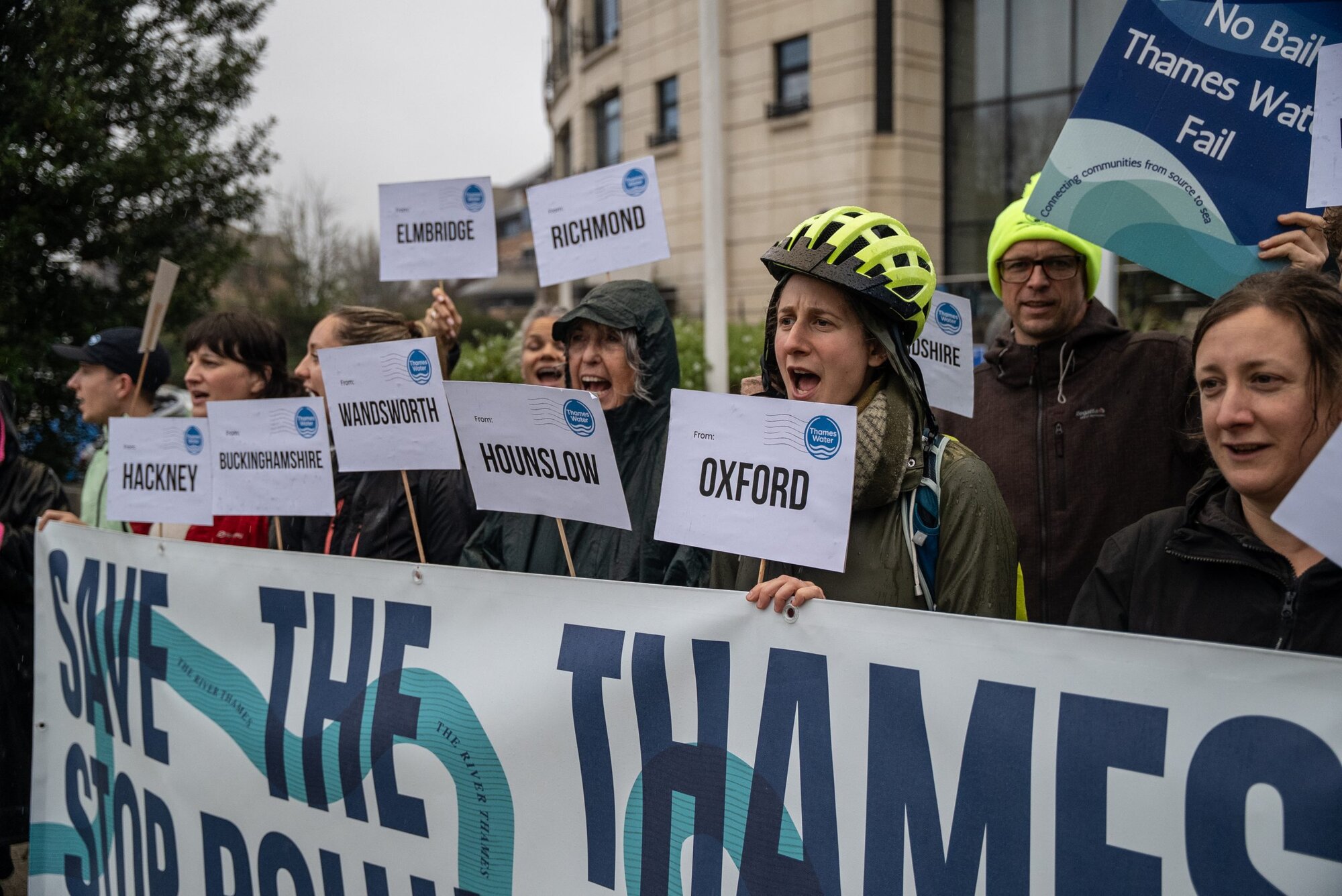
Campaigners from across the catchment staged a peaceful demonstration outside Thames Water’s headquarters, Clear Water Court in Reading. Many of those taking part were the very people who have submitted statutory nuisance complaints, and they carried placards naming the boroughs and districts involved. Groups from across the Thames basin joined the action.

Community groups and rowing legends join the action
Laura Reineke, founder of Friends of the Thames and a resident of Henley-on-Thames, said: “People here are fed up with living beside a river that’s being treated like an open sewer. We’ve submitted a nuisance complaint to our local authority because what Thames Water is doing is unacceptable.
“To find that treated effluent leaving their plant here has contained E. coli at levels 30 times higher than what’s safe for bathing is shocking. Local residents are angry and determined to hold this company accountable for the damage it’s causing to our river and our community.”
International rowing legend Sir Steve Redgrave said:
“As someone who has spent my life on the water, I am appalled by the pollution that Thames Water continues to allow. That’s why I’m joining River Action and communities along the River Thames in taking action to hold this company to account. Our rivers should be safe for everyone. It is unacceptable that people are being forced to fight for clean, healthy waterways.”
Olympic rowing champion Imogen Grant MBE said:
“Rivers are our lifeblood, for sport, wildlife, and community, and it’s shocking to see them poisoned by untreated sewage time and time again. I have filed a nuisance claim with Wokingham because I’ve had enough of pollution putting me and other river users at risk. I stand with River Action to hold Thames Water accountable and protect the rivers we all rely on.”

Notes to editor
This document, submitted by Thames Water to Ofwat, outlines the 93 improvement projects the company requested permission to carry over from PR19 to PR24. For ease of use, we have extracted the relevant data and displayed it in this document.
In response, Ofwat expressed concerns about non-delivery and whether customer protection is adequate. In this document it stated, “The company does not provide sufficient and convincing evidence that the proposed investment does not overlap with base activities or was not already sufficiently funded for delivery for the period 2020-2025 (PR19). It provides no evidence that non-delivery could have been mitigated.
“This enhancement request is for £172.99m within the water price control (out of a total £1,134m claim). There is a need for Thames Water to complete the outstanding PR19 WINEP schemes by 2030. The company has provided a short business case covering the total claim, but it provides no other supplementary evidence to explain the additional requested funding for ‘Water other’ WINEP drivers.
“The proposed funding covers additional investment for schemes under regulatory drivers including the Water Framework Directive (WFD), biodiversity and raw water deterioration. It also includes some capital maintenance costs to support scheme delivery. For capital maintenance, this is base expenditure rather than enhancement. For raw water deterioration, this was not an WINEP driver at PR19 for 2020-25 and should not attract additional enhancement funding under this category.
“Some of the reasons for non-delivery of the total WINEP enhancement claim are stated by the company as: cost increases over 2020 to 2025; the scale of the WINEP programme; under-funding in its PR19 final determination; new framework contractors and delays due to Covid. Many of these issues impact other companies equally and are within management control.”
In this correspondence from Ofwat to Thames Water, known as an enforcement order, the regulator explains that while the company can carry over the 93 projects for which funds were already allocated, it can only access an additional £250 million to upgrade these sites, projects that should have been completed during PR19. Ofwat also fined the water company £104.5 million for failure to upgrade these sites in PR19.
To date, 13 statutory nuisance letters have been submitted to local authorities across the River Thames catchment. They are: Buckinghamshire, Elmbridge, Hackney, Hammersmith and Fulham, Hounslow, Oxford, Richmond upon Thames, South Oxfordshire, Southwark, Vale of White Horse, Wandsworth, West Berkshire and Wokingham.
The Oxford Rivers Improvement Campaign used an Environmental Information Request (EIR) to obtain data on Newbury STW. The data show that sewage spill hours rose from 482 in 2019 to 1,630 in 2024, an increase of 240%. Over five years, the site discharged almost 4,000 hours of untreated or partially treated sewage. River Action used its analysis of this data to calculate these figures. You can view the calculations here.
Download stills and footage from the peaceful protest outside Thames Water HQ here.