

News
River Action launches legal challenge against the Government over Thames Water failures
River Action launches legal challenge over Government’s failure to explain when it will trigger special administration for Thames Water
We have filed a legal claim over Environment Secretary Steve Reed’s failure to explain when he will trigger special administration for Thames Water and other failing water companies – despite having the legal mechanism to take action, serious breaches by Thames Water, rising harm to customers and rivers, and calls from the Independent Water Commission for a clearer policy.
Our legal challenge is simple: we say that the Environment Secretary has acted unlawfully by failing to have or publish a policy on when he will use his power to ask the High Court to put a water company in the Special Administration Regime (SAR) – a mechanism under existing legislation specifically designed to enable the government to take action to deal with failing water companies.
This comes amid the deepening crisis at Thames Water, which has repeatedly breached environmental law, mismanaged its finances, failed to invest adequately in infrastructure, and shattered investor confidence and customer trust. Thames Water is on the brink of collapse with £20 billion in debt and widely regarded as no longer investable, with customers and the environment paying the price.
Steve Reed as Environment Secretary or Ofwat as water regulator (with his approval) have the power under section 24 of the Water Industry Act 1991 to ask the High Court to place a water company in special administration on either financial or performance grounds.
Special administration is a temporary insolvency and restructuring process for companies that provide essential public services like water, energy or transport. It is designed to ensure continuity of service while the company is stabilised and restructured. There is a bespoke special administration regime for the water industry, created in 1991 and designed to prioritise customers and services, putting financial interests second. Where water companies are failing, special administration can provide better, fairer and more sustainable outcomes – with the major benefit that it gives the water company the ability to recover and refinance with the opportunity for funds to be redirected away from investor profits towards the urgent infrastructure improvements needed to solve the ongoing sewage crisis, all without exposing its customers and at little cost to the public purse. Yet special administration has never been used for the water industry.
Thames Water has breached its duties and violated its licence conditions, seriously and repeatedly. It is the clearest possible case for special administration.
River Action’s legal challenge
The judicial review is concerned with the legal requirement for the Environment Secretary to have a policy for when he will trigger special administration for water companies. The claim challenges two key failings by the Government:
- Failure to publish a policy, breaching core public law duties.
- Failure to develop a policy at all, breaching obligations under the Habitats Regulations and other planning and environmental law.
Special administration is not limited to insolvency. It can also be used to protect customers and the environment when a water company is failing to meet performance standards. Our claim focuses on the Government’s approach to triggering a performance-based special administration process.
Under section 24 of the Water Industry Act 1991, special administration can be triggered by a water company’s failure to meet performance standards and a breach of its statutory or licence duties in ways that are “serious enough to make it inappropriate for the company to continue to hold its licence”. We believe that Thames Water clearly meets this threshold and has done so for years.
Independent Water Commission on Special Administration
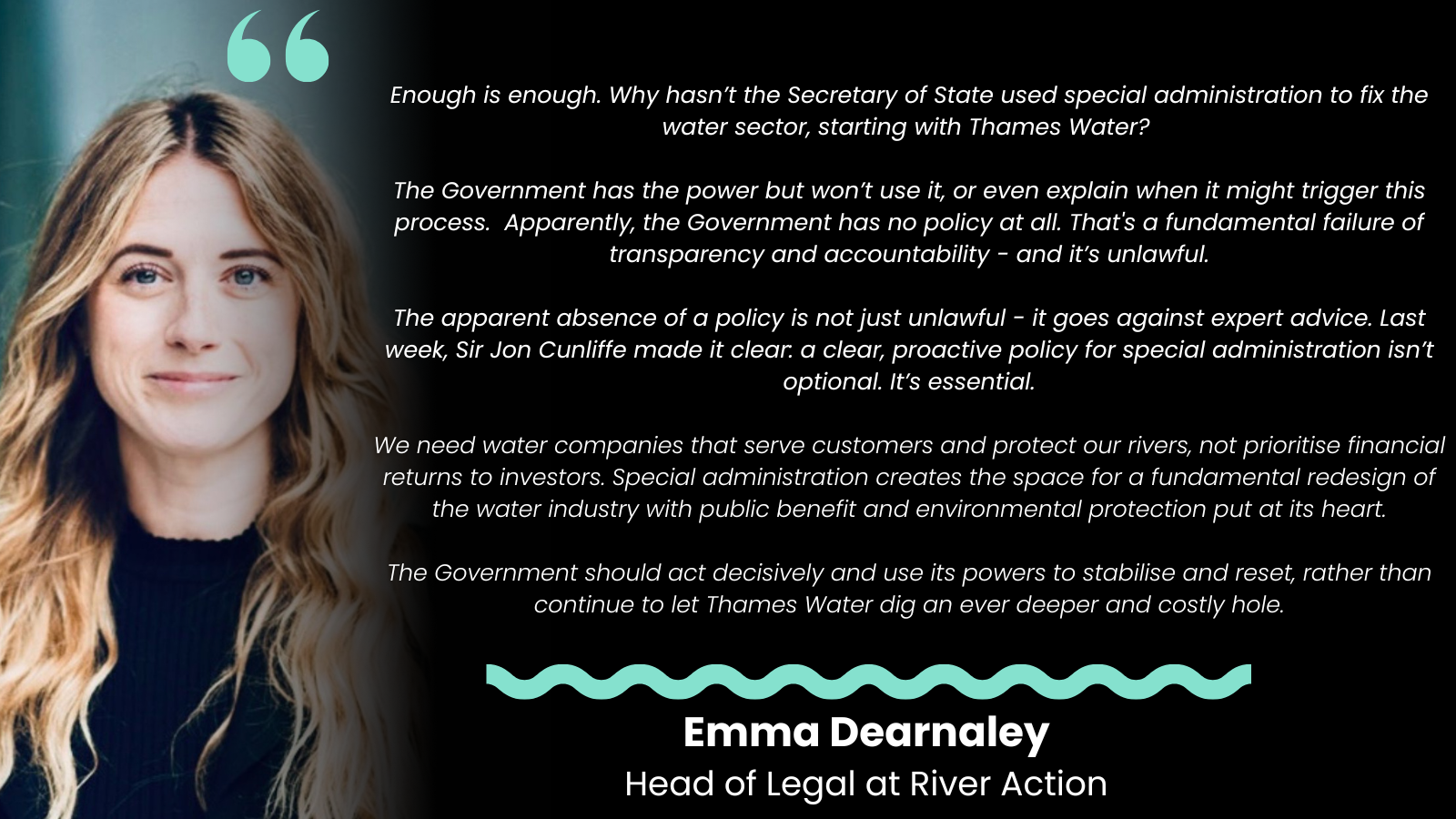
Last week, the Independent Water Commission, chaired by former Bank of England Deputy Governor Sir Jon Cunliffe said that “the policy around SAR assessment should be set out more clearly”. The Commission also said that “SAR should be a practical option for the regulator and government” and stressed the importance of water companies preparing a plan for SAR now.
A route to public benefit models
We believe that special administration represents the most effective and immediate means of addressing the failures within the water industry. We see special administration as the first step toward meaningful and necessary systemic reform including providing the opportunity for a shift to a public benefit model of water ownership, governance and financing, of the type seen successfully implemented across Europe.
We are calling for the urgent use of special administration procedures for Thames Water as a tool to stabilise and reset using public benefit principles, with other failing water companies to follow as necessary.

Frequently Asked Questions
What is the Water Industry Special Administration Regime (SAR)?
The Water Industry Special Administration Regime (SAR) was introduced in England and Wales under the Water Industry Act 1991, with detailed procedures governed by the Water Industry (Special Administration) Rules 2009 and a comprehensive modernisation of the regime in early 2024. The legislative intent behind this regime is to protect consumers, public health and the environment in the event that a regulated water or sewerage company becomes insolvent (an insolvency SAR) or fails to carry out its statutory functions or licensed activities to such an extent that it is inappropriate for it to continue to hold its appointment or licence (a performance SAR).
An application for special administration of a water company may only be made by the Secretary of State or Ofwat with the Secretary of State’s consent. This contrasts starkly with normal administration under the Insolvency Act 1986 which can be applied for by creditors, the company or a director.
Special administration allows the Government to:
- Appoint independent special administrators;
- Restructure failing companies and their debt (the focus of an insolvency SAR);
- Restore and maintain performance standards (the focus of a performance SAR);
- Ensure water and wastewater services continue without interruption.
Importantly, the special administration regime is designed to keep services running using the company’s own revenues – from ongoing customer bills – not taxpayer funding. It is intended as a mechanism for accountability and reform, not a bailout.
What are the details of the judicial review claim?
On 7 March 2025, we wrote to the Secretary of State for Environment, Food and Rural Affairs (“SSEFRA”) to ask whether the SSEFRA or the SSEFRA’s ministers had given consideration to whether it would be appropriate to exercise their discretionary power to apply to the High Court to have Thames Water placed into special administration in light of the contraventions of its “principal duties” in accordance with section 24 of the Water Industry Act 1991.
In response, the SSEFRA has refused to provide details of any such policy and has simply contended that there was no requirement to have a “written document or policy”.
Accordingly, we have three grounds of review:
- Ground 1: Failure to publish a policy. The SSEFRA has a policy on the circumstances in which he will exercise his discretion pursuant to section 24 WIA and has acted unlawfully in failing to publish that policy.
- Ground 2: Failure to have a policy. If, contrary to Ground 1, the SSEFRA does not have such a policy, that is in breach of Regulation 9(3) of the Conservation of Offshore Marine Habitats and Species Regulations 2017 (the Habitats Regulations).
- Ground 3: Failure to have a policy. If, contrary to Ground 1, the SSEFRA does not have such a policy, that is in breach of section 85(A1) of the Countryside and Rights of Way Act 2000, as amended by section 245 of the Levelling-Up and Regeneration Act 2023.
We are seeking a mandatory order that SSEFRA either provides details of any policy or, if there is no policy, requires a policy to be developed and published.
Why does Thames Water need to be brought into Special Administration?
- Persistent failures: Thames Water has a long record of breaching environmental, financial, and regulatory obligations.
- Record fine: In May 2025, Thames Water was fined nearly £123 million by water regulator Ofwat for breaches of rules relating to its wastewater operations (£104.5 million) and breaches of rules relating to dividend payments (£18.2 million). This is the largest penalty Ofwat has ever issued.
- Investor confidence collapsing: KKR, Thames Water’s preferred buyer, pulled out of negotiations leaving its various existing lenders as the only option. Thames Water’s creditors have reportedly demanded that the company and its management be granted immunity from prosecution for serious environmental crimes as a condition of their restructuring proposals, without which Thames Water has said it would not be “investable”.
- Inflated cost claims: The Treasury has claimed placing Thames Water into special administration could cost up to £4 billion – with reports it told DEFRA that it would have to meet these costs from DEFRA’s annual budget totalling £4.6 billion. Independent experts such as Professor Ewan McGaughey and Professor Dieter Helm believe the £4 billion figure is overstated and politically driven, with the likely costs being much lower and likely to be recouped by the Government on exit from administration.
What is the Independent Water Commission’s view on Special Administration?
On 21 July 2025, Sir Jon Cunliffe’s Independent Water Commission published its 88 final recommendations to the UK and Welsh governments for the reform of the water sector.
Two recommendations were made in relation to the special administration regime:
- Recommendation 46: The regulator in England and Wales should continue to adopt an evidence-based process to consider, on a case-by-case basis, whether it would be appropriate for a water company to transition to an alternative ownership model where they request to do so or following a Special Administration Regime.
- Recommendation 59: The regulator in England and Wales should develop and consult on a framework for ensuring companies are prepared for SAR.
In relation to Recommendation 59, the Commission said:
“793. The Commission believes the SAR should be a practical option for the regulator and government but that it should be very much a last resort. However well prepared, a SAR would be a major exercise which carries some risk of disruption to the company’s operation. The Commission notes that lowering the threshold for SAR would increase costs to customers through higher financing given the increased risk on investors. The Commission is also mindful of the risks in creating automatic triggers – experience in insolvency and similar regimes in other sectors, including financial services, is that conditions and circumstances of individual cases vary widely and cannot be anticipated. There is a need for broad, judgement based tests within a clear policy, that has been set out in advance, of how the regulator will assess failing companies against these tests, the factors it will take into account and the indicators it will consider. In the Commission’s view the two current tests for entry into SAR effectively balance objective and subjective factors and include an appropriate level of judgement. It believes, however, that the policy around making the SAR assessment should be set out more clearly.
794. The Commission believes that further practical steps can be taken to ensure the SAR is a credible, but low probability, threat. In particular, as part of the SAR policy set out above, the regulator should develop and consult on a framework for ensuring companies prepare a plan for SAR. This should consider what the practical barriers to SAR might be, and how these can be mitigated in advance.”
Although the Commission’s recommendations focus on the regulator, its comments around the need for a clearer policy for special administration logically apply to both Ofwat as regulator and SSEFRA, as the two authorities with the power to petition the High Court for a special administration order.